
Vasectomy in Thailand: Complete Guide to Cost, Recovery, and Key Questions
If you’re considering a vasectomy, you’ve probably heard two things: it’s one of the most effective forms of contraception, and it can be expensive in your home country. But what if you could get the same procedure — at a fraction of the cost — in a country with world-class healthcare? The decision isn’t just about price. You also need to know exactly what the procedure involves, how recovery feels, and whether it’s safe to travel for surgery. Without a clear picture, it’s easy to get stuck in analysis paralysis.
By the end of this guide, you’ll have a complete, evidence-based understanding of vasectomy in Thailand — including costs, recovery expectations, and the right questions to ask — so you can make an informed decision with confidence. We’ll walk you through six critical areas: cost breakdown, procedure types, recovery timeline, key questions for your doctor, benefits and side effects, and tips for traveling to Thailand.
Key Takeaways
Vasectomy in Thailand offers a safe, affordable option for permanent contraception, with costs typically 60-80% lower than in the US or UK.
- Cost savings: Procedure prices range from $150–$300, plus $500–$1,000 for travel and accommodation
- Quick recovery: Most men return to desk work within 2-3 days (CDC, 2024)
- No impact on hormones: Research from NIDDK confirms vasectomy does not affect testosterone or libido
- The Informed Choice Framework: Use our four-pillar approach (Cost, Procedure, Recovery, Outcomes) to plan your vasectomy with confidence
Cost of Vasectomy in Thailand
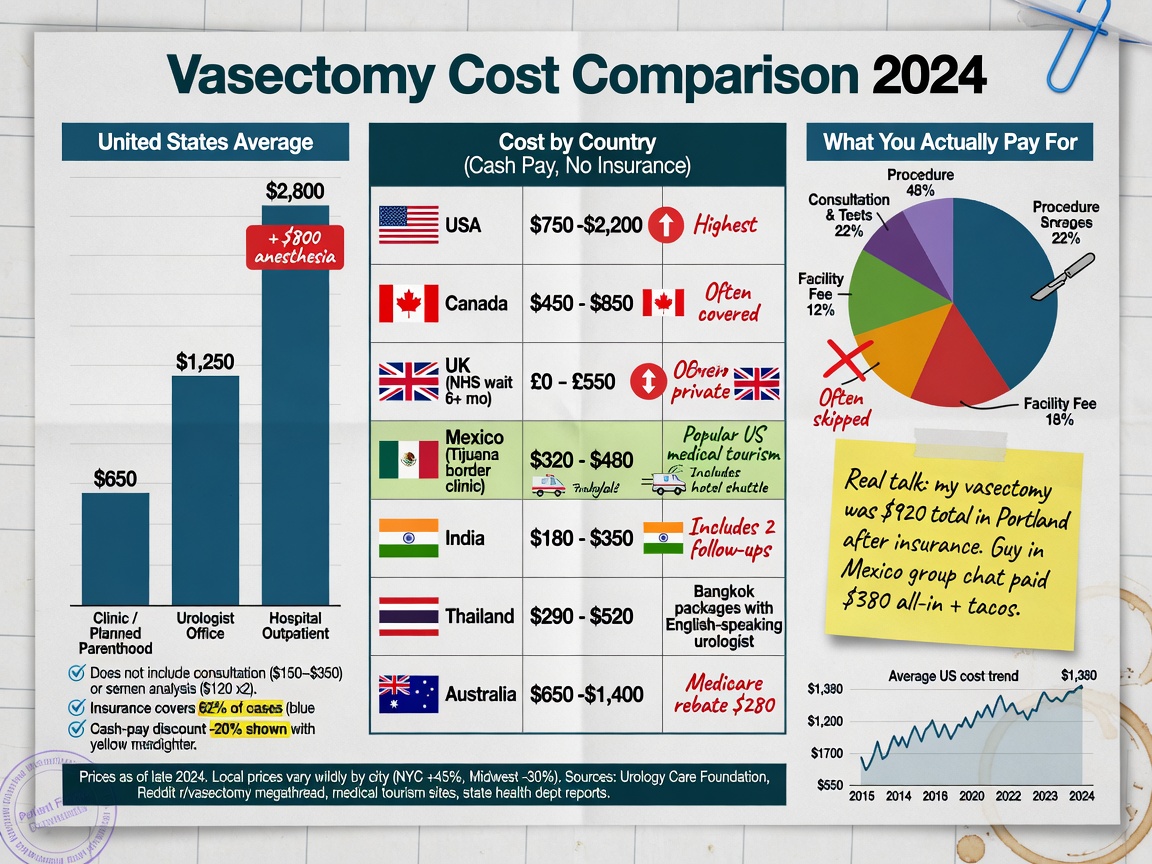
The cost of vasectomy in Thailand is significantly lower than in Western countries, typically ranging from $150 to $300 for the procedure alone (PubMed systematic review, 2017). This price difference is the primary reason men from the US, UK, and Canada choose medical tourism for permanent contraception. Understanding the full financial picture — including hidden costs like travel and aftercare — is the first pillar of The Informed Choice Framework.
When you look at the numbers, the savings are substantial. A vasectomy that would cost $1,000 to $3,500 in the United States can be performed in Thailand for a fraction of that amount. The gap is driven by lower overhead costs, competitive pricing among medical tourism clinics, and the relative simplicity of the procedure itself. But the procedure cost is only part of the equation.
What Does a Vasectomy Cost in Thailand?
Vasectomy cost Thailand varies by clinic and technique, but the range is remarkably consistent across accredited facilities. At Bumrungrad International Hospital, a JCI-accredited private hospital in Bangkok, the procedure typically costs between $200 and $300 for a no-scalpel vasectomy. Smaller private clinics may charge as little as $150, while premium hospital packages that include pre-operative blood work and post-operative follow-up can reach $400.
Several factors influence the final price. No-scalpel vasectomy, which is now the standard at most Thai clinics, may cost slightly more than traditional techniques due to the specialized equipment required. The type of anesthesia also plays a role — local anesthesia is standard, but some clinics offer sedation for anxious patients at an additional cost. Hospital-based procedures tend to be more expensive than those performed at standalone clinics, though the difference is usually less than $100.
| Clinic | Traditional Vasectomy | No-Scalpel Vasectomy | Additional Notes |
|---|---|---|---|
| Bumrungrad International Hospital | $200–$250 | $250–$300 | JCI-accredited; English-speaking staff |
| Bangkok Hospital | $180–$220 | $220–$280 | JCI-accredited; package includes pre-op bloodwork |
| Private clinic (Bangkok) | $150–$180 | $180–$220 | May require separate consultation fee |
| Public hospital | $100–$150 | $120–$180 | Longer wait times; limited English support |
A review of vasectomy costs in Thailand found that prices in low-resource settings range from $150 to $300 USD, making Thailand one of the most affordable destinations for the procedure. These prices are self-pay rates — no insurance is required, and most clinics accept cash or credit card. Always confirm current pricing directly with the clinic, as fees can change.
Vasectomy Cost Comparison: Thailand vs. USA, UK, Canada
Vasectomy price Thailand becomes even more compelling when you compare it to what men pay in their home countries. The savings are dramatic — typically 60–80% less than US prices and 40–60% less than UK private sector rates.
| Country | Procedure Cost | Travel & Stay | Total Estimated Cost |
|---|---|---|---|
| Thailand | $150–$300 | $500–$1,000 | $650–$1,300 |
| United States | $1,000–$3,500 | N/A | $1,000–$3,500 |
| United Kingdom (private) | £400–£1,000 | N/A | £400–£1,000 |
| Canada | CAD 800–CAD 2,000 | N/A | CAD 800–CAD 2,000 |
| Australia (private) | AUD 500–AUD 1,500 | N/A | AUD 500–AUD 1,500 |
The CDC vasectomy effectiveness and cost overview notes that cost is a significant barrier to vasectomy in the US, with many men opting for less effective or temporary methods due to price. In Thailand, the low cost removes that barrier entirely. The price difference exists because Thai clinics operate with lower overhead, benefit from medical tourism volume, and compete in a market where patient acquisition costs are minimal.
Even after adding flights, accommodation, and recovery supplies, the total cost of traveling to Thailand for a vasectomy is often less than the procedure alone in the US. For a man in New York or London, the math is straightforward: a week in Bangkok plus a medical procedure costs less than staying home.
Does Insurance Cover Vasectomy in Thailand?
Vasectomy insurance coverage for international patients is limited. Most travel insurance policies explicitly exclude elective surgeries, and vasectomy is classified as an elective procedure. Your domestic health insurance is unlikely to cover a procedure performed overseas, though it’s worth checking your policy — some international plans or premium PPOs may offer partial reimbursement.
What Thai clinics do offer are package deals that bundle pre-operative consultation, the procedure itself, post-operative medications, and sometimes a follow-up visit into a single price. These packages typically range from $250 to $400 and eliminate the risk of surprise charges. The best Thai vasectomy clinics, many of which are accredited by Joint Commission International, provide transparent pricing on their websites.
JCI-accredited hospitals in Thailand meet international quality standards, giving you confidence in the care you’ll receive. If you want coverage for complications — which is extremely rare — you may need a specialized medical tourism insurance policy. Companies like World Nomads and SafetyWing offer plans that cover emergency complications from elective procedures, but they won’t cover the procedure itself.
Hidden Costs: Travel, Accommodation, and Aftercare
Beyond the procedure cost, you’ll need to budget for travel, accommodation, and recovery supplies. This is where many cost guides fall short — they quote the procedure price but ignore the full financial picture. The fourth element of the Cost pillar is building a realistic total budget.
| Scenario | Flights (round trip) | Accommodation (5–7 nights) | Supplies & Medications | Total (incl. procedure) |
|---|---|---|---|---|
| Budget | $500 (economy, Asia) | $150 ($30/night × 5 nights) | $30 | $830–$980 |
| Mid-range | $800 (economy, US/UK) | $350 ($50/night × 7 nights) | $40 | $1,340–$1,490 |
| Premium | $1,000 (premium economy) | $490 ($70/night × 7 nights) | $50 | $1,690–$1,840 |
Flights from the US or UK to Bangkok typically cost $500 to $1,000 round trip, depending on the season. Accommodation near major hospitals like Bumrungrad or Bangkok Hospital ranges from $30 per night for a basic hotel to $70 per night for a comfortable serviced apartment. You’ll need 5 to 7 nights to allow for pre-procedure consultation and initial recovery. Over-the-counter pain relievers, ice packs, and supportive underwear add another $30 to $50.
CDC vasectomy recovery guidelines recommend avoiding prolonged sitting and heavy lifting for the first week — important considerations when booking your return flight. Factor in the cost of a follow-up semen analysis, which may need to be done back home ($50–$150). Some Thai clinics offer a package that includes remote follow-up coordination.
Now that you know what it costs, let’s look at what the procedure itself entails and how to choose between traditional and no-scalpel vasectomy.
Understanding Vasectomy: Procedure Types and Effectiveness
Vasectomy is a permanent male contraceptive procedure over 99% effective, with a failure rate of about 1 in 2,000 (CDC, 2024). Two main techniques exist: traditional vasectomy (using a scalpel) and no-scalpel vasectomy (using a puncture). Understanding the difference is the second pillar of your Informed Choice Framework.
The Procedure pillar gives you the knowledge to discuss options confidently with your doctor. Whether you choose traditional or no-scalpel, the fundamental goal is the same — cutting or blocking the vas deferens, the tubes that carry sperm from the testicles to the urethra. Once these tubes are sealed, sperm cannot reach the semen, making pregnancy impossible.
What Happens During a Vasectomy Procedure?
The Mayo Clinic vasectomy overview describes the procedure as a straightforward outpatient process lasting 15 to 30 minutes. You’ll be awake throughout, with only local anesthetic applied to the scrotal area. The sensation is pressure, not sharp pain — most men rate it a 1 or 2 on a 10-point scale.
Here’s what typically happens:
- Preparation: You’ll shave the scrotal area at home or the clinic will do it. Local anesthetic is injected — a brief sting that numbs the area completely.
- Accessing the vas deferens: The doctor locates the vas deferens through the scrotal skin. In a traditional vasectomy, a small incision is made. In a no-scalpel vasectomy, a tiny puncture is created with a specialized clamp.
- Cutting and sealing: The vas deferens is lifted out, cut, and a small section is removed. The ends are sealed with heat (cauterization) or tied with surgical clips.
- Closing: The puncture or incision is closed. No-scalpel vasectomy typically requires no stitches — the puncture heals on its own.
The entire procedure takes less time than a typical lunch break. You’ll walk out of the clinic under your own power, though your partner or a friend should drive you home.
No-Scalpel vs. Traditional Vasectomy: Key Differences
No-scalpel vasectomy is now the standard at most Thai clinics. The NICHD explanation of no-scalpel vasectomy confirms that the technique reduces complications and speeds recovery. Both methods are equally effective at preventing pregnancy.
| Factor | Traditional Vasectomy | No-Scalpel Vasectomy |
|---|---|---|
| Incision type | Small scalpel cut (1–2 cm) | Single puncture (2–3 mm) |
| Stitches required | Usually 1–2 stitches | None — puncture heals naturally |
| Procedure time | 20–30 minutes | 15–20 minutes |
| Recovery time | 3–5 days to desk work | 2–3 days to desk work |
| Complication rate | Higher (bleeding, infection) | Lower (minimal tissue damage) |
| Cost (Thailand) | $150–$250 | $200–$300 |
The no-scalpel technique uses a specialized clamp to puncture the scrotal skin rather than cutting it. This smaller opening reduces bleeding, lowers infection risk, and speeds healing. Most men who have had both procedures (for reversal and re-do) report the no-scalpel version was significantly more comfortable.
Both methods achieve the same result: permanent contraception. The choice often comes down to what your clinic offers and your urologist’s preference. In Thailand, nearly all accredited clinics perform no-scalpel vasectomy as their standard approach.
How Effective Is Vasectomy? Failure Rates Explained
The CDC vasectomy effectiveness and cost overview reports that vasectomy is over 99% effective — a failure rate of approximately 1 in 2,000. For context, that’s more effective than female sterilization (tubal ligation) and comparable to long-acting reversible contraceptives like IUDs.
Most failures occur early and are preventable. The number one cause is not waiting for semen clearance — having unprotected sex before the follow-up semen analysis confirms azoospermia (zero sperm in the ejaculate). This typically takes 8 to 16 weeks and 15 to 20 ejaculations. A second cause is very rare: spontaneous recanalization, where the cut ends of the vas deferens reconnect on their own. This occurs in about 0.05% of cases after two years.
The success rate depends on you following post-procedure instructions. Use backup contraception until your doctor confirms sterility. That single semen analysis is your guarantee.
What to Expect During Your Consultation
Your consultation is the time to ask every question on your mind. A South Valley Urology vasectomy FAQ notes that the doctor will review your medical history, explain the procedure in detail, and discuss potential risks. This is also when you’ll learn about the clinic’s specific protocols for follow-up care.
For international patients, the consultation often happens via telemedicine before you travel. Your doctor will want to know about any chronic conditions, medications (especially blood thinners), and previous surgeries in the groin area. Be honest about your health history — it affects your safety.
The consultation is also your opportunity to assess the clinic. Is the staff responsive and professional? Do they speak your language clearly? Do they provide written aftercare instructions in English? These details matter when you’re recovering in a foreign country.
Now that you understand the procedure, let’s move to the third pillar: recovery — what you can expect day by day.
Recovery After Vasectomy
Most men can return to desk work within 2-3 days after a vasectomy, and to full physical activity within one week (CDC, 2024). The Recovery pillar of The Informed Choice Framework prepares you for what each stage feels like, so you can plan your time off and avoid pushing yourself too hard.
Recovery from vasectomy is generally straightforward, but it’s not instant. Your body needs time to heal the tissue that was accessed during the procedure. The good news is that the discomfort is mild for most men, and the timeline is predictable.
Vasectomy Recovery Timeline: Day by Day
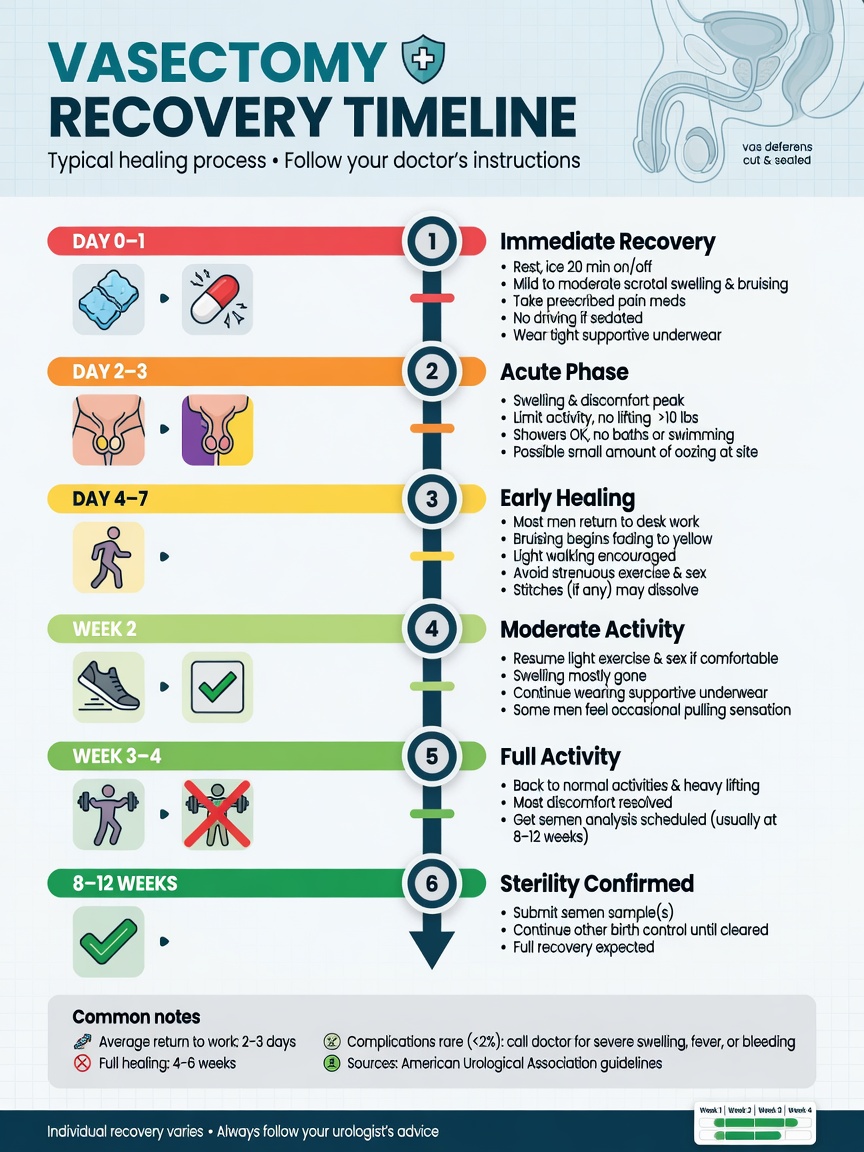
The CDC vasectomy recovery guidelines provide a clear framework for what to expect. Here’s a day-by-day breakdown:
-
Day 0 (Procedure day): Rest at home. Apply ice packs to the scrotum for 20 minutes on, 20 minutes off. Wear supportive underwear (compression shorts or a jockstrap). Take over-the-counter pain relievers as needed. Do not lift anything heavy or engage in physical activity.
-
Day 1–2: Swelling peaks. Pain is typically 2–3 on a 10-point scale — a dull ache rather than sharp pain. Continue ice packs and supportive underwear. You can walk slowly around the house but avoid stairs. Most men spend these days on the couch watching movies.
-
Day 3–5: Rapid improvement. Swelling begins to subside. Pain drops to 1–2. You can return to desk work if your job allows you to sit with an ice pack. No heavy lifting, no exercise, no sex.
-
Week 1: Swelling largely resolved. You can walk normally and do light household tasks. Avoid gym workouts, running, cycling, and anything that puts pressure on the scrotum. Men in physical labor jobs should remain off work.
-
Week 2: Most men feel fully recovered. You can resume exercise gradually and sexual activity (usually after 10–14 days). Listen to your body — if something hurts, stop.
-
8–16 weeks: Time for your follow-up semen analysis. Continue using contraception until your doctor confirms azoospermia. Once cleared, the vasectomy is effective.
Vasectomy Pain on a Scale of 1‑10: What to Expect
Pain is the most common fear men have about vasectomy. The reality is reassuring: the Mayo Clinic vasectomy overview describes the discomfort as mild to moderate, and most men rate their peak pain at 3–4 out of 10.
- During the procedure: 1–2 out of 10. The local anesthetic injection stings for about 10 seconds. After that, you feel pressure and tugging but no sharp pain.
- First 48 hours: 2–4 out of 10. A dull, aching sensation similar to a mild testicular injury. Ice packs and ibuprofen keep this manageable.
- Days 3–7: 1–2 out of 10. Occasional twinges when moving certain ways. Most men stop taking pain medication by day 3.
- After one week: 0–1 out of 10. You may forget you had the procedure.
Severe pain (above 7) is rare and warrants a call to your doctor. If you experience sudden, sharp pain or pain that worsens after 48 hours, seek medical attention. The vast majority of men describe the recovery as “much easier than I expected.”
Returning to Work: Desk Jobs vs. Physical Labor
How quickly you can return to work depends entirely on what you do. The AMA doctor advice on vasectomy emphasizes tailoring recovery to your occupation.
Desk jobs (office workers, programmers, call center staff): Most men can return to work 2–3 days after the procedure. The key is comfort: sit with an ice pack, take breaks to walk around every 30 minutes to prevent stiffness, and wear supportive underwear. Avoid long commutes — if you take public transit, consider working from home if possible.
Physical labor (construction, warehouse, nursing, delivery): Plan for 7–10 days off work. Heavy lifting, climbing, and prolonged standing all put pressure on the healing tissue. Returning too early increases the risk of swelling, pain, and complications like hematoma. Some men in physically demanding jobs take a full two weeks.
Tips for the first week back:
- Wear compression shorts or a jockstrap for support
- Take ibuprofen before work if you expect to be on your feet
- Avoid climbing stairs more than necessary
- Listen to your body — if you feel pulling or pain, rest
Red Flags After Vasectomy – When to Call a Doctor
While most recoveries are smooth, knowing the warning signs protects your health. The NIDDK on vasectomy long-term side effects notes that complications are rare but require prompt attention.
Call your doctor if you experience:
- Fever over 100.4°F (38°C) — could indicate infection
- Excessive bleeding that soaks through a bandage
- Severe pain that doesn’t respond to over-the-counter medication (7+ on the scale)
- Swelling that worsens after 48 hours rather than improving
- Redness, warmth, or discharge from the incision site
- Inability to urinate within 8 hours of the procedure
Post-vasectomy pain syndrome (PVPS): This is a rare condition affecting 1–2% of men, characterized by chronic testicular pain that persists for months after the procedure. The pain is typically a dull ache that comes and goes. Treatment options include anti-inflammatory medications, nerve blocks, and in severe cases, surgical reversal. Knowing about PVPS doesn’t mean you should fear it — it means you’re informed.
Recovery is temporary. Now let’s answer the questions every man should ask before the procedure.
Questions Men Should Ask Before a Vasectomy
The Questions section equips you to evaluate the Procedure and Recovery pillars of The Informed Choice Framework. Asking the right questions before you commit builds confidence and eliminates surprises.
Essential Questions About the Procedure
Vasectomy questions to ask should cover the technical details that affect your experience and outcome. Write these down before your consultation:
-
“Will you use the no-scalpel technique?” This question tells you whether the clinic practices the minimally invasive standard. If they don’t, ask why — some older urologists still prefer traditional methods, but no-scalpel has fewer complications.
-
“How long does the procedure take? Will I be awake?” A standard vasectomy takes 15–30 minutes with local anesthesia. You should be awake the entire time. If a clinic suggests general anesthesia for a routine vasectomy, ask why — it’s usually unnecessary and increases cost.
-
“What happens if I change my mind later?” Vasectomy reversal is possible but not guaranteed. Success rates depend on how long ago the vasectomy was performed and the technique used. The San Diego Vasectomy Center questions note that reversal is expensive (typically $5,000–$10,000) and not covered by insurance. Treat vasectomy as permanent.
-
“What are your clinic’s complication rates?” A reputable clinic tracks its outcomes. They should be able to tell you their infection rate, hematoma rate, and PVPS rate. If they can’t or won’t provide this information, that’s a red flag.
Questions About Recovery and Aftercare
For medical tourists especially, vasectomy consultation questions must include logistics that domestic patients don’t worry about:
-
“When can I fly home after the procedure?” Most doctors recommend waiting 2–3 days. The cabin pressure changes during flights can increase swelling, and sitting for long periods compresses the scrotum. If you must fly sooner, wear compression underwear and get up to walk every hour.
-
“What pain relief do you recommend?” Ibuprofen (Advil) is typically preferred over acetaminophen (Tylenol) because it reduces inflammation. Avoid aspirin — it thins the blood and increases bleeding risk. Your clinic should provide a specific regimen.
-
“When can I have sex again? When can I exercise?” The standard advice is: wait 2–3 weeks for sex, 1 week for light exercise, and 2 weeks for heavy lifting. But your doctor may adjust based on your healing progress. Don’t rush — complications from returning to activity too early are frustrating but completely avoidable.
-
“How do I arrange the follow-up semen analysis?” This is critical. Your Thai clinic may coordinate with a local lab back home, or you may need to find one yourself. The analysis must be done 8–16 weeks after the procedure, and you need to provide 15–20 ejaculations before the test. Plan this before you travel.
How to Prepare for Your Vasectomy Appointment
Vasectomy preparation is straightforward but requires some planning. Here’s a checklist for the week before your procedure:
- Arrange time off work: 2–3 days for desk jobs, 7–10 days for physical labor
- Purchase supportive underwear (compression shorts or a jockstrap) — wear them from day one
- Buy ice packs or frozen peas (they mold to the shape better than rigid packs)
- Stock up on ibuprofen and acetaminophen
- Shower the morning of the procedure — keep the area clean
- Eat normally (local anesthesia means no fasting required)
- Arrange a driver — you cannot drive yourself home after local anesthesia
The single most important rule: do not drive yourself. The anesthetic can impair your judgment, and even mild discomfort can affect your reaction time. A taxi or rideshare is fine, but having a partner or friend is better.
Now let’s address the elephant in the room — how vasectomy affects your sexual health and overall well-being.
Benefits and Side Effects of Vasectomy
Vasectomy does not affect testosterone levels, sexual performance, or increase cancer risk (NIDDK, 2024). The Outcomes pillar of The Informed Choice Framework separates evidence from anecdote, giving you a clear picture of what vasectomy does and doesn’t change about your body.
Top Benefits of Vasectomy: More Than Just Birth Control
The Mayo Clinic vasectomy overview lists permanent contraception as the primary benefit, but the advantages extend beyond preventing pregnancy:
-
Permanent peace of mind: Once your semen analysis confirms sterility, you never need to think about contraception again. No condoms, no pills, no IUDs, no anxiety about missed doses or expired devices. The worry is gone.
-
Long-term cost savings: A vasectomy is a one-time expense. Compare that to years of condom purchases ($100–$300 per year), birth control pills ($15–$50 per month), or an IUD ($500–$1,000 every 5–12 years). Over 20 years, vasectomy saves thousands of dollars.
-
No impact on sexual spontaneity: You don’t need to pause to put on a condom or check your partner’s cycle. Sex can be natural and unplanned.
-
Psychological relief: Some men report increased libido after vasectomy. This isn’t a hormonal change — it’s the removal of pregnancy-related anxiety. When you’re not worried about unintended pregnancy, desire often increases naturally.
Common Vasectomy Side Effects: Myth vs. Fact
Misinformation about vasectomy spreads easily online. Here’s what the evidence actually says:
| Myth | Fact | Source |
|---|---|---|
| “Vasectomy causes erectile dysfunction” | No physical mechanism exists. ED rates in vasectomized men match the general population. | NIDDK |
| “Vasectomy increases prostate cancer risk” | Large cohort studies show no causal link. Any observed association is likely due to detection bias. | NIDDK |
| “You gain weight after vasectomy” | Vasectomy has no metabolic effect. Weight changes are unrelated. | Mayo Clinic |
| “Women can tell you’ve had a vasectomy during sex” | Semen volume and appearance remain unchanged. Azoospermia is invisible. | NIDDK |
| “Vasectomy causes testicular cancer” | No increased risk has been found in any major study. | NICHD |
The NIDDK on vasectomy long-term side effects provides comprehensive evidence that vasectomy is safe. The procedure only affects the vas deferens — it doesn’t touch the testicles’ hormone-producing cells or the structures involved in erection and orgasm.
Does Vasectomy Affect Testosterone or Sexual Health?
This is the most common concern, and the answer is clear: vasectomy does not affect testosterone levels. The vas deferens carries sperm, not testosterone. Testosterone is produced in the testicles and enters the bloodstream directly through the spermatic veins — the vasectomy doesn’t disrupt this pathway.
The NIDDK on vasectomy long-term side effects confirms that multiple studies have found no change in testosterone levels, libido, or sexual satisfaction after vasectomy. Men who report increased sex drive after the procedure are experiencing psychological relief, not a biological change.
Your orgasm and ejaculation remain exactly the same. You still produce semen — 95% of it comes from the seminal vesicles and prostate, not the testicles. The only difference is that the semen no longer contains sperm. Your partner cannot tell, and your sexual experience doesn’t change.
Long-Term Safety: Cancer Risk and Chronic Pain
Two long-term concerns deserve honest discussion. First, cancer risk: decades of research have found no link between vasectomy and any form of cancer. The NIDDK on vasectomy long-term side effects states unequivocally that vasectomy does not increase the risk of testicular or prostate cancer. Earlier studies that suggested a prostate cancer link have been debunked by larger, better-controlled trials.
Second, post-vasectomy pain syndrome (PVPS): this rare condition affects 1–2% of men, causing chronic testicular discomfort that persists for months or years after the procedure. The pain is typically a dull ache that may worsen with prolonged sitting or sexual activity. Treatment options include anti-inflammatory medication, nerve blocks, and in persistent cases, vasectomy reversal. PVPS is uncommon, but you should know it exists so you can monitor your symptoms.
Now that you know the benefits and risks, the final pillar of your Informed Choice Framework is logistics: traveling to Thailand for the procedure.
Traveling to Thailand for Vasectomy
Thailand has over 50 JCI-accredited hospitals, including those offering vasectomy services (Joint Commission International, 2024). The final pillar of The Informed Choice Framework covers the practical aspects of medical tourism — safety, clinic selection, logistics, and a sample itinerary.
Is It Safe to Get a Vasectomy in Thailand?
Thailand is one of the world’s most popular medical tourism destinations, and for good reason. The country has over 50 JCI-accredited hospitals that meet international quality standards. Bumrungrad International Hospital, Bangkok Hospital, and Samitivej Hospital are among the most recognized names, with English-speaking staff, transparent pricing, and modern facilities.
The WHO global vasectomy fact sheet confirms that vasectomy is widely available and cost-effective throughout Southeast Asia. The procedure itself is low-risk — it’s a 15-to-30-minute outpatient procedure that doesn’t require general anesthesia. The safety record for vasectomy in Thai hospitals is excellent, consistent with international benchmarks.
Reddit forums contain numerous firsthand accounts from men who traveled to Thailand for vasectomy. A common sentiment: “Yes, I traveled to Thailand to get a vasectomy and it was totally worth it.” The key is choosing a clinic that prioritizes safety and communication.
How to Choose a Vasectomy Clinic in Thailand
Clinic selection is your most important decision. Here’s a framework for evaluating your options:
-
Check accreditation: Look for JCI accreditation, which means the hospital meets international standards for patient safety and quality of care. JCI-accredited hospitals in Thailand include Bumrungrad, Bangkok Hospital, and several others.
-
Verify the urologist’s credentials: The doctor should be a board-certified urologist with experience performing no-scalpel vasectomies. Many Thai urologists trained in the US, UK, or Australia. The Bumrungrad vasectomy blog provides information about their urology department and approach.
-
Read patient reviews: Check Google Reviews, Trustpilot, and Reddit forums for firsthand accounts. Pay attention to comments about communication, wait times, and follow-up care.
-
Compare package prices: Some clinics offer all-inclusive packages that cover consultation, procedure, medications, and follow-up. Others charge separately for each component. Request a detailed quote before booking.
-
Ask about language support: The clinic should provide English-speaking staff for consultation, procedure, and aftercare instructions. Miscommunication is the biggest risk in medical tourism.
Travel Logistics: Visas, Accommodation, and Recovery Stay
Most nationalities receive a visa-on-arrival for Thailand valid for 30 to 60 days — no special medical tourism visa is needed. You can enter as a tourist and undergo the procedure without any additional paperwork.
Accommodation planning: Book a hotel or serviced apartment near your clinic for 5 to 7 nights. You’ll need a comfortable place to rest for the first 2–3 days after the procedure. Look for:
- Elevator access (avoid stairs during recovery)
- Air conditioning (Bangkok is hot year-round)
- Mini-fridge for ice packs and cold drinks
- Proximity to a pharmacy for supplies
Pre- and post-procedure schedule: Plan to arrive 1–2 days before your procedure for a pre-op consultation. This gives you time to rest after the flight and confirm all details. After the procedure, stay for 2–3 days of recovery before flying home. The CDC vasectomy recovery guidelines recommend avoiding heavy lifting and long car rides post-op — the same applies to flights.
Follow-up semen analysis: You can either have this done in Thailand before you leave (if at least 8 weeks have passed since the procedure) or arrange it with a lab back home. Your Thai clinic should provide the lab request form for the analysis. Some clinics offer remote coordination support.
Sample Itinerary: 5 Days for a Vasectomy in Thailand
Here’s a realistic schedule that balances medical requirements with rest:
Day 1: Arrive in Bangkok. Check into your hotel near Bumrungrad or Bangkok Hospital. Rest after your flight. Confirm your pre-op consultation time. Do not drink alcohol — dehydration affects healing.
Day 2: Morning consultation with the urologist. Ask your questions from the checklist. Afternoon procedure (30 minutes). Return to hotel to rest. Begin ice packs and supportive underwear.
Day 3: Recovery day. Stay at the hotel. Apply ice, take ibuprofen, rest. Light walking around the room or short, slow walks in the hotel corridor. No sightseeing, no shopping.
Day 4: Swelling should be improving. You can walk slowly outside, but avoid crowds and stairs. Follow-up call or visit with the clinic. Begin planning your travel home.
Day 5: If your doctor clears you, fly home. Wear compression underwear on the flight. Get up to walk the aisle every hour. Continue avoiding heavy lifting for the remainder of the week.
For men in physical labor jobs, extend the recovery stay to 7 days — the extra rest makes a significant difference in healing.
Now you have the full picture — cost, procedure, recovery, benefits, and travel. But what if vasectomy isn’t the right choice?
When Vasectomy Isn’t the Right Choice – Limitations & Alternatives
No medical procedure is right for everyone. The Informed Choice Framework includes honest consideration of situations where alternatives may serve you better.
Common Pitfalls to Avoid
-
Not waiting for semen clearance: Some men believe they’re sterile immediately after the procedure. This is false. Sperm remain in the vas deferens for weeks after the procedure. Use contraception until your follow-up semen analysis confirms azoospermia.
-
Choosing a clinic without checking accreditation: Low prices can be tempting, but an unaccredited clinic may not meet safety standards. Always verify JCI accreditation before booking.
-
Underestimating post-op restrictions: Physical labor workers need 7–10 days off. Planning to return too soon risks complications and prolonged recovery. Be realistic about your job demands.
-
Not discussing reversal probability: Treat vasectomy as permanent. Reversal is possible but expensive ($5,000–$10,000), not guaranteed, and may not restore fertility. If you are uncertain about permanent contraception, consider reversible options first.
When to Choose Alternatives
-
You are unsure about permanent contraception: Consider an IUD (copper or hormonal) or contraceptive implant. These are long-acting (3–10 years) but fully reversible. The cost is higher upfront but lower than reversal. Discuss options with your partner and doctor.
-
Your partner is considering tubal ligation: Vasectomy is simpler, cheaper, and safer. Tubal ligation requires general anesthesia, has a longer recovery, and costs $1,500–$6,000. The Mayo Clinic vasectomy overview notes that vasectomy has fewer complications and a faster recovery.
-
You have a bleeding disorder or chronic scrotal pain: These conditions may increase your risk of complications. A urologist should evaluate your specific case before proceeding.
When to Seek Expert Help
- Previous testicular surgery, hernia repair, or chronic pelvic pain — these can make the procedure more complex
- Taking anticoagulants (blood thinners) — you may need to pause medication before the procedure, under your doctor’s supervision
- History of scrotal trauma or infection — these can affect the anatomy and increase surgical difficulty
Always consult a qualified healthcare provider to discuss your individual health situation before making any decisions about vasectomy.
Frequently Asked Questions
How much does a vasectomy cost in Thailand?
Most vasectomies in Thailand cost between $150 and $300 for the procedure alone, depending on the clinic and technique. When you add travel, accommodation, and supplies, the total averages $800 to $2,000. That’s 60–80% less than the $1,000–$3,500 typical in the US. Prices are lower due to lower overhead and medical tourism competition. Always confirm current pricing with your chosen clinic, as fees can change. Budget for 5–7 nights of accommodation and plan to arrive a day early for pre-op consultation.
Does a vasectomy affect testosterone or sex drive?
No — vasectomy does not affect testosterone levels or sexual desire. The vas deferens carries sperm, not testosterone, which is produced in the testes and enters the bloodstream directly. Multiple studies, including data from the National Institute of Diabetes and Digestive and Kidney Diseases, confirm testosterone, libido, and sexual function remain unchanged. Some men report a psychological boost from no longer fearing unplanned pregnancy. Your orgasm and ejaculation feel exactly the same — the only difference is the absence of sperm in your semen.
How long does it take to recover from a vasectomy?
Most men can return to desk work within 2-3 days (CDC, 2024). Day 0 is for rest and ice. Days 1–2 involve mild swelling and pain (2–4 on a scale of 10). By day 5, most feel normal. Avoid heavy lifting for one week and sex for 2–3 weeks. Full recovery — including return to intense exercise — takes about 10–14 days. Physical labor workers should allow 7–10 days off. Always listen to your body and don’t rush the process, as returning to activity too early can cause complications.
Is it safe to travel to Thailand for a vasectomy?
Yes — Thailand has over 50 JCI-accredited hospitals that meet international safety standards. Vasectomy is a low-risk outpatient procedure with excellent safety records. Choose a clinic with English-speaking staff, transparent pricing, and good patient reviews. Plan to arrive 1–2 days early, stay 2–3 days after for initial recovery, and avoid heavy activity during travel. Follow all post-op instructions and arrange follow-up semen analysis back home. Most men find the experience smooth and well-organized when they choose an accredited clinic.
What are the red flags after a vasectomy?
Seek medical help if you experience: fever over 100.4°F (38°C), excessive bleeding from the incision, severe pain that doesn’t respond to over-the-counter medication, or swelling that worsens after 48 hours. Signs of infection — redness, warmth, or discharge — also need prompt attention. Inability to urinate within 8 hours of the procedure warrants a call to your doctor. Chronic pain persisting for months occurs in only 1–2% of men (post-vasectomy pain syndrome) and should be discussed with your urologist. Most complications are rare and easily treated when caught early.
Conclusion
For men seeking a permanent contraceptive solution, vasectomy in Thailand combines world-class medical care with costs 60-80% lower than in Western countries (PubMed, 2017). The most effective approach uses The Informed Choice Framework: evaluate your options across the four pillars — Cost, Procedure, Recovery, and Outcomes. This framework ensures you plan every aspect of your vasectomy journey with confidence, from comparing clinic prices to understanding post-op recovery and long-term effects.
Whether you choose a no-scalpel vasectomy at a JCI-accredited Thai hospital or decide that a different contraceptive is right for you, the Informed Choice Framework gives you a repeatable method for evaluating any medical tourism decision. Start with cost, then procedure, then recovery — and always ask the right questions.
Begin your journey by shortlisting 2–3 JCI-accredited Thai clinics and requesting their package prices. Include a 7-day recovery stay in your budget. Schedule a teleconsultation with your top choice to ask the questions from our checklist. Finally, confirm your home provider can do the follow-up semen analysis. Always consult a healthcare provider before making a decision.
This content is for educational purposes only and does not constitute medical advice. Consult a qualified healthcare provider for personal medical guidance.