

Pre-Surgery Health Optimization: Complete Guide
Medical Disclaimer: This content is for informational purposes only and does not replace professional medical advice. Consult your healthcare provider before making any changes to your health regimen.
If you’re scheduled for surgery, your health optimization in the weeks before can be just as important as the procedure itself. Many patients focus only on the day of surgery, ignoring modifiable factors like weight, smoking, and blood sugar that can significantly impact complication rates and recovery speed. By the end of this guide, you’ll know the specific steps to take for each of the four most critical pre-surgery health factors, so you can approach your procedure with confidence. We’ll cover BMI optimization, smoking cessation, diabetes management, and anesthesia/fasting guidelines, all framed by the Pre‑Surgery Health Triangle – a simple way to remember the three pillars you control.
Key Takeaways
Pre-surgery health optimization reduces complication risk by addressing BMI, smoking, diabetes, and fasting – four factors you can actively improve before your procedure using the Pre‑Surgery Health Triangle framework.
- Safe BMI threshold: A BMI under 40 is typically required for elective surgery; losing 5-10% body weight can lower anesthesia risks.
- Smoking cessation: Quitting at least 6 weeks before surgery can cut pulmonary complications by up to 50%.
- Blood sugar control: An A1c below 7-8% is the standard target; GLP-1 agonists like Ozempic should be held for one week before surgery.
- Fasting rules: Follow the 2-4-6 rule – clear liquids 2 hours, breast milk 4 hours, solid food 6 hours before anesthesia.
Why Pre-Surgery Health Optimization Matters
Pre-surgery health optimization means actively managing medical and lifestyle factors that affect your body’s ability to handle surgery and recover. This guide focuses on the four pillars supported by the strongest evidence: BMI, smoking, diabetes, and fasting. Mastering these can significantly lower your risk of complications and speed up healing.
The Pre-Surgery Health Triangle Framework
The Pre‑Surgery Health Triangle is a framework that connects BMI optimization, smoking cessation, and diabetes management as the three most impactful modifiable risk factors before surgery. Think of it as three interconnected legs: weight, smoking, and blood sugar. Each influences the others – for example, high BMI often co-exists with diabetes, and smoking increases insulin resistance. Addressing all three creates a synergistic effect that improves your body’s ability to withstand the stress of surgery.
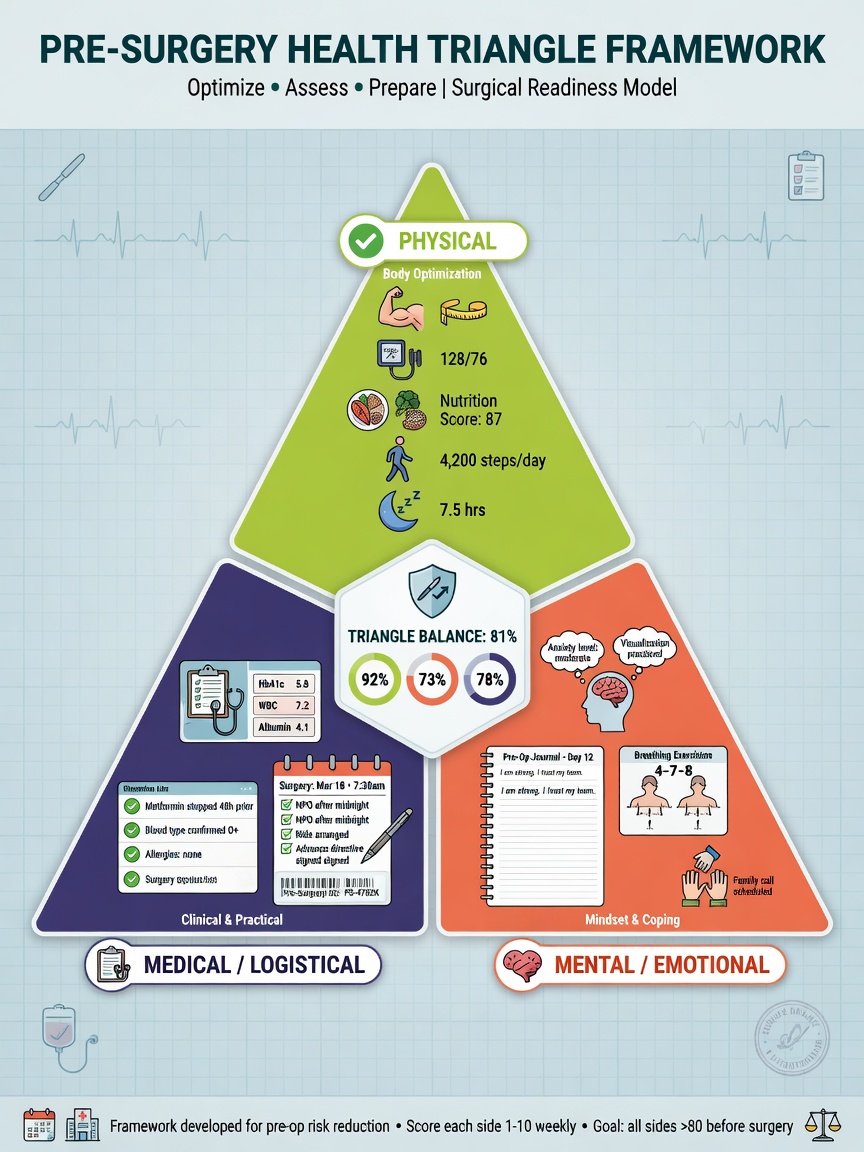
Surgical teams now routinely assess these factors because the evidence is clear. Preoperative evaluation consensus guidelines from a multidisciplinary review found that patients who optimize these factors spend fewer days in hospital, have lower infection rates, and recover faster. By approaching your preparation with this framework, you’ll understand not just what to do, but why each step matters. In the sections ahead, we break down each pillar with specific thresholds and actionable advice.
How Each Factor Impacts Surgical Risk
Each pillar of the Pre‑Surgery Health Triangle affects surgical outcomes through distinct mechanisms. High BMI increases the risk of wound infection, anesthesia complications, and longer surgery duration due to positioning challenges and altered drug distribution. Smoking impairs wound healing, raises the rate of postoperative pneumonia, and increases the need for mechanical ventilation. Uncontrolled diabetes leads to poor glucose control during surgery, which directly contributes to higher infection rates and delayed healing.
Consider this: a patient with a BMI of 42 who smokes has roughly a three-fold higher risk of surgical site infection compared to a non-smoker with a normal BMI. These risks are additive, which is why addressing all three pillars simultaneously yields the greatest benefit. Now let’s examine the first pillar in detail: body weight and BMI.
BMI and Weight Optimization Before Surgery
BMI (body mass index), a measure of body fat based on height and weight, is one of the first numbers your surgical team evaluates. Understanding where you stand and what targets matter can guide your preparation in the weeks before your procedure.
What BMI Is Unsafe for Surgery?
The general guideline used by most surgical teams is that a BMI under 40 is acceptable for elective surgery, though many surgeons prefer a BMI under 35 for certain procedures like joint replacements. Obesity is classified as Class I (BMI 30-34.9), Class II (35-39.9), and Class III (40 or higher). The risk escalates significantly above 40 due to challenges with airway management, wound healing, and cardiovascular strain.
| BMI Category | BMI Range | Surgical Risk Level |
|---|---|---|
| Normal | 18.5-24.9 | Lowest risk |
| Overweight | 25-29.9 | Low to moderate |
| Class I Obesity | 30-34.9 | Moderate |
| Class II Obesity | 35-39.9 | Moderate to high |
| Class III Obesity | 40+ | High – may require postponement |
SSCBC prehab guidelines on obesity recommend that elective surgery be deferred if BMI exceeds 40 until weight reduction is achieved. For a total knee replacement, a surgeon may require BMI under 35 due to mechanical stress on the new joint and positioning challenges during the operation. These thresholds are common guidelines – consult your surgeon for your specific situation.
The 4 M’s of Obesity Explained
Beyond the number on the scale, clinicians evaluate four specific aspects of obesity known as the 4 M’s, which together determine surgical risk more precisely than BMI alone.
Morbid obesity – defined as BMI 40 or higher – carries increased risk of anesthesia and surgical complications. Metabolic syndrome refers to a cluster of conditions including elevated glucose, high blood pressure, and abnormal cholesterol that together increase cardiac risk during surgery. Mechanical issues arise because larger body habitus can make surgery more difficult, prolonging anesthesia time and creating positioning challenges on the operating table. Finally, medication interactions occur because obesity alters drug distribution – higher doses may be needed, and some drugs are stored in fat tissue, affecting their duration of action.
A patient on metformin and a statin may need dosing adjustments, and those with metabolic syndrome require careful cardiac evaluation before surgery. Preoperative assessment for obesity provides a comprehensive overview of the 4 M’s framework for surgical patients. Understanding these four dimensions helps your surgical team tailor their approach to your specific needs.
Effective Weight Loss Strategies Before a Scheduled Procedure
If your BMI is above the safe threshold, a realistic target is 5-10% weight loss, which can improve metabolic markers and significantly reduce surgical risk. The ideal timeline is to start 6-12 weeks before your procedure, and it’s important to avoid rapid weight loss methods like extreme keto diets or very-low-calorie diets unless medically supervised.
Practical steps include dietary modification with a moderate calorie deficit and emphasis on lean protein, along with low-impact physical activity such as walking or swimming. Switching from three large meals to five smaller meals with lean protein can help jumpstart weight loss without extreme measures. Ask your surgeon or dietitian before starting any weight loss plan, as your nutritional status directly affects wound healing and immune function. While weight optimization addresses one leg of the Health Triangle, smoking cessation is equally critical.
Smoking Cessation for Surgical Preparation
Smoking is a major modifiable risk factor for surgical complications. The nicotine and carbon monoxide in cigarette smoke impair oxygen delivery to tissues, delay wound healing, and increase the risk of pneumonia and other pulmonary complications after surgery.
Why At Least 6 Weeks of Abstinence?
The six-week benchmark is supported by strong evidence. Carbon monoxide and nicotine impair oxygen delivery and wound healing; after stopping, these effects reverse gradually over weeks. Studies show that maximal risk reduction occurs at 6-8 weeks of abstinence. However, even shorter periods help – quitting 24-48 hours before surgery reduces carbon monoxide levels, and two weeks of abstinence improves immune function.
A smoker who quits three weeks before surgery will still have better outcomes than one who continues, but the ideal window is six weeks. Preoperative evaluation guidelines review the evidence that smoking cessation for 6-8 weeks significantly reduces surgical complications. The key message is that every day of abstinence counts, but aiming for six weeks gives your body the best chance to heal.
The 3-3-3 Rule for Smoking Cessation
The 3-3-3 rule is a simple memory aid that helps patients track their progress. The breakdown works like this: three days without smoking means nicotine withdrawal peaks, but carbon monoxide levels in your blood drop significantly. Three weeks of abstinence leads to improved circulation and better oxygen delivery to tissues. Three months maximizes overall surgical risk reduction for smokers who can wait that long.
Most elective surgery can be safely scheduled after six or more weeks of abstinence, and the 3-3-3 rule serves as a motivational framework rather than a strict medical guideline. The ASOI bariatric preop workup describes the 3-3-3 rule as a patient education tool for smoking cessation before bariatric surgery. Even if you have less than three days before surgery, stopping immediately is still beneficial.
How Quitting Reduces Complication Risk
Patients who quit smoking before surgery experience a 30-50% lower rate of pulmonary complications compared to active smokers. The benefits extend beyond the lungs: reduced incidence of surgical site infection, lower rates of pneumonia, less need for reintubation, and shorter hospital stays. Improved wound healing alone can make a significant difference in your recovery timeline.
Non-smokers have a substantially lower risk of wound complications because adequate oxygen delivery is essential for tissue repair. The third leg of the Health Triangle is diabetes – a condition that, when poorly controlled, can derail even the best surgical plan.
Diabetes and Blood Sugar Management Before Surgery
Diabetes medications, a broad class including metformin, insulin, GLP-1 agonists, and SGLT2 inhibitors, require careful management before surgery. GLP-1 agonists, such as Ozempic and Wegovy, are injectable drugs that delay gastric emptying and affect anesthesia risk in ways many patients don’t expect.
Target A1c Levels Before Surgery
HbA1c is a measure of your average blood glucose over the past three months. The standard target for elective surgery is an A1c below 7-8%, individualized per patient and surgery type. Poor glucose control impairs immune function, delays wound healing, and increases infection risk. If your A1c exceeds 8-9%, your surgical team may recommend postponing the procedure until better control is achieved.
| A1c Level | Surgical Recommendation |
|---|---|
| Below 7% | Optimal – proceed as planned |
| 7-8% | Acceptable for most procedures |
| 8-9% | May require optimization |
| Above 9% | Likely postpone for glycemic control |
A patient with an A1c of 9.2% scheduled for hip replacement may be asked to work with their endocrinologist for three months before proceeding. NCBI diabetes and surgery guidelines establish the A1c threshold for elective surgery in a comprehensive review. Confirm your specific target with your surgical team, as individual circumstances may adjust the threshold.
Adjusting Diabetes Medications – Including GLP-1 Agonists
Medications that control blood sugar require careful management leading up to surgery, and the adjustments differ by drug class. Most oral diabetes drugs like metformin can be taken normally on the day of surgery. SGLT2 inhibitors such as Jardiance are often held for 3-4 days beforehand due to the risk of ketoacidosis. GLP-1 agonists like Ozempic and Wegovy must be held for a full week before surgery because they slow gastric emptying, which increases the risk of aspiration under anesthesia.
| Drug Class | Example | Pre‑Surgery Adjustment |
|---|---|---|
| Metformin | Glucophage | Take as usual |
| GLP-1 agonist | Ozempic, Wegovy | Hold 7 days before |
| SGLT2 inhibitor | Jardiance, Farxiga | Hold 3-4 days before |
| Basal insulin | Lantus, Levemir | Reduce dose 20-30% |
| Short-acting insulin | Novolog, Humalog | Hold day of surgery |
Insulin adjustments vary by patient: basal insulin is usually continued at a reduced dose, while short-acting insulin is often held on the day of surgery. The ASA guidance on diabetes drugs before surgery provides official recommendations for holding GLP-1 agonists due to delayed gastric emptying. This information evolves rapidly – consult your anesthesiologist for the most current guidance specific to your medications.
Monitoring Blood Sugar During the Perioperative Period
On the day of surgery, blood glucose should be monitored regularly with a target of 100-180 mg/dL. Your anesthesia team will continue monitoring and managing glucose levels throughout the procedure. After surgery, monitoring continues as medications are gradually resumed. For a Type 2 diabetic taking metformin, a typical morning-of-surgery glucose of 140 mg/dL is acceptable.
Good blood sugar control before, during, and after surgery significantly reduces the risk of complications. Finally, let’s cover the immediate preparation on the day of surgery – the fasting and anesthesia guidelines that all patients must follow.
Anesthesia and Fasting Guidelines
The 2-4-6 rule is a preoperative fasting guideline from the American Society of Anesthesiologists designed to prevent pulmonary aspiration during anesthesia. General anesthesia is a medically induced reversible state of unconsciousness, and having a full stomach during this state can be dangerous.
What Is the 2-4-6 Rule for Anesthesia?
The 2-4-6 rule provides clear timing: stop clear liquids (water, apple juice, black coffee without milk) 2 hours before surgery; stop breast milk 4 hours before; and stop solid food, non-clear liquids like milk or orange juice with pulp, and candy 6 hours before. The purpose is to reduce stomach contents and prevent aspiration – when stomach contents enter the lungs – during anesthesia.
| Substance | Stop Time Before Surgery |
|---|---|
| Clear liquids (water, apple juice, black coffee) | 2 hours |
| Breast milk | 4 hours |
| Non-human milk, light snack | 6 hours |
| Solid food, heavy meal | 8 hours (longer if fatty) |
Adherence to the 2-4-6 rule reduces the risk of pulmonary aspiration from approximately 1 in 2,000 to 1 in 10,000 according to ASA fasting recommendations. Patients with diabetes or GERD may need individualized fasting instructions, so always confirm with your surgical team.
Common Disqualifications for General Anesthesia
Some medical conditions may lead your anesthesiologist to recommend an alternative to general anesthesia. These include severe heart or lung disease such as unstable angina or severe COPD, an unrecovered stroke within the past three months, uncontrolled sleep apnea especially if CPAP is not used, and a recent myocardial infarction within 6-12 weeks without intervention.
These disqualifications are not automatic – your anesthesiologist evaluates each case individually. A patient with severe COPD and an FEV1 under 30% of predicted may be offered regional anesthesia instead of general. Safer alternatives exist, including spinal anesthesia, regional blocks, and sedation, so there’s always a plan B. Your anesthesia team will choose the safest option for your specific situation.
Fasting Safety Tips and Exceptions
A few practical points can help you navigate fasting correctly. Brushing your teeth with a small amount of water is fine – the tiny amount swallowed doesn’t violate the rules. Most medications can be taken with a sip of water even during the fasting period. If you accidentally drink a glass of water 90 minutes before surgery, inform your anesthesiologist – they’ll adjust the plan accordingly.
For emergency surgery, fasting rules may be waived entirely, and the anesthesiologist will take extra precautions to protect your airway. Even with the best preparation, things can go wrong. In the next section, we cover common pitfalls and when to seek help from your medical team.
Common Pitfalls and When to Seek Expert Help
Even motivated patients can make mistakes during pre-surgery preparation. Knowing what to avoid is just as important as knowing what to do.
Mistakes Patients Often Make
Three specific mistakes appear frequently. The first is crash dieting two weeks before surgery, which can lead to malnutrition, electrolyte imbalances, and delayed wound healing. The second is stopping smoking only two days before surgery – this provides minimal benefit while adding unnecessary stress. The third is holding all diabetes medications without medical guidance, which can cause dangerous blood glucose spikes.
These mistakes are common, but they’re also avoidable. A calm, measured approach with guidance from your healthcare team produces far better outcomes than drastic last-minute changes.
When to Consult Your Surgeon or Anesthesiologist
Certain situations warrant an immediate call to your surgical team. If your BMI is above 40 and you haven’t discussed it with your surgeon, pick up the phone. If you’re unsure how to adjust your diabetes medications, ask before making changes. If you accidentally ate or drank something within the forbidden fasting window, inform your anesthesia provider. And if you’ve experienced a recent health change such as chest pain or stroke symptoms, do not wait – contact your medical team right away.
Always call your surgeon’s office if you have any concerns – don’t rely on online information alone when your health is on the line.
Medical Disclaimer: This content is for informational purposes only and does not replace professional medical advice. Always consult your healthcare provider before making changes to your pre-surgery preparation plan.
Frequently Asked Questions
What BMI is unsafe for surgery?
Most elective surgery is considered safe for patients with a BMI below 40 – that’s Class III obesity. A higher BMI increases risks for anesthesia, wound infections, and longer surgery time. For example, many orthopaedic surgeons prefer a BMI under 35 for joint replacements. These thresholds vary based on your health and procedure type. Always discuss your specific BMI with your surgical team – they can give you an individualized recommendation.
What is the 3-3-3 rule for smoking before surgery?
The 3-3-3 rule is a simple memory aid for smoking cessation before surgery. It breaks down: 3 days without smoking reduces nicotine withdrawal and drops carbon monoxide levels; 3 weeks improves circulation and oxygen delivery; 3 months maximizes surgical risk reduction. This rule is a motivational tool, not a strict medical guideline. Even quitting 24 hours before surgery is better than not quitting at all. Work with your healthcare provider to set a realistic timeline.
What A1c is too high for surgery?
An A1c above 8% is generally considered too high for elective surgery – most surgical teams target below 7-8%. Elevated A1c indicates poor blood sugar control, which increases the risk of infection and slows wound healing. If your A1c is above this threshold, your surgeon may delay the procedure to give you time to improve control. The exact number depends on your overall health and the type of surgery. Your endocrinologist works with your surgeon to set a safe goal.
What is the 2-4-6 rule for anesthesia?
The 2-4-6 rule is a preoperative fasting guideline to prevent aspiration during anesthesia. It means: stop clear liquids (water, apple juice) 2 hours before surgery; stop breast milk 4 hours before; stop solid food and non-clear milk products 6 hours before. This rule is set by the American Society of Anesthesiologists. Following it reduces the risk of stomach contents entering the lungs. Check with your hospital – some may have longer fasting times for certain patients.
What disqualifies you from general anesthesia?
General anesthesia may be unsafe for patients with severe heart or lung disease, uncontrolled sleep apnea, recent stroke (within 3 months), or recent heart attack. Additionally, patients who haven’t followed fasting guidelines may be considered for spinal or regional anesthesia instead. These disqualifications are not automatic – your anesthesiologist evaluates each case individually. Safer alternatives like sedation or regional blocks exist. Your anesthesia team will choose the best option for your safety.
Conclusion
Pre‑surgery health optimization is not a single task – it’s a comprehensive approach covering BMI, smoking, diabetes, and fasting. By addressing each factor, you can reduce complication risk, improve recovery, and approach surgery with confidence. The Pre‑Surgery Health Triangle – weight, smoking, and blood sugar – provides a simple framework to remember the three most impactful pillars. Evidence from surgical guidelines supports that optimizing these factors leads to better outcomes, including shorter hospital stays and faster healing.
The Pre‑Surgery Health Triangle gives you a clear mental model: work on your weight, quit smoking, and control your blood sugar. Together, these three pillars create a foundation of health that supports your body through the stress of surgery and speeds your return to normal life. When you add proper fasting and medication management, you’ve covered every major factor within your control.
Start by scheduling a conversation with your surgeon or primary care provider. Ask about your BMI target, smoking cessation program, and diabetes medication adjustments. Most importantly, give yourself time – begin your optimization at least six weeks before your procedure. Your body will thank you.
Medical Disclaimer: This content is for informational purposes only and does not replace professional medical advice. Consult your healthcare provider before making any changes to your health regimen.