

Open vs Closed Rhinoplasty in Thailand: Your Complete Guide to Making the Right Choice
Medical Disclaimer: This article is for informational purposes only and does not constitute medical advice. Always consult a licensed plastic surgeon for personalized guidance.
Choosing between open and closed rhinoplasty is one of the most common dilemmas for anyone considering a nose job in Thailand. The wrong choice can mean more scarring, longer recovery, or results that don’t match your expectations. Many patients book surgery only to discover afterward that another technique would have better addressed their specific nasal anatomy – leading to costly revisions or regret.
In this guide, you’ll learn a clear, step-by-step framework for choosing between open and closed rhinoplasty, understanding costs in Thailand, preparing for your consultation, and planning a smooth recovery. We’ll compare techniques, review top clinics, list essential questions, outline recovery timelines, and cover safety – so you can make an informed decision with confidence.
Key Takeaways
Choosing between open vs closed rhinoplasty depends on your nasal anatomy and desired changes – the Rhinoplasty Readiness Framework helps you match your goals to the right technique and clinic.
- Open rhinoplasty offers better visibility for complex corrections but leaves a small columellar scar.
- Closed rhinoplasty avoids external scarring but requires an experienced surgeon for complex cases.
- Thailand offers quality procedures at 50–70% less than Western countries, with JCI‑accredited hospitals.
- Prepare thoroughly by asking your surgeon about their revision rate, board certification, and recovery plan.
Open vs Closed Rhinoplasty: Which Technique Is Right for You?
The choice between open and closed rhinoplasty hinges on the complexity of your nasal correction. Open rhinoplasty, which involves a small external incision on the columella, provides the surgeon with full visibility of the nasal structures, whereas closed rhinoplasty keeps all incisions inside the nostrils. This visibility advantage makes open rhinoplasty the preferred technique for major reshaping, while closed rhinoplasty is often chosen for minor adjustments and patients concerned about scarring.
What’s the Difference?
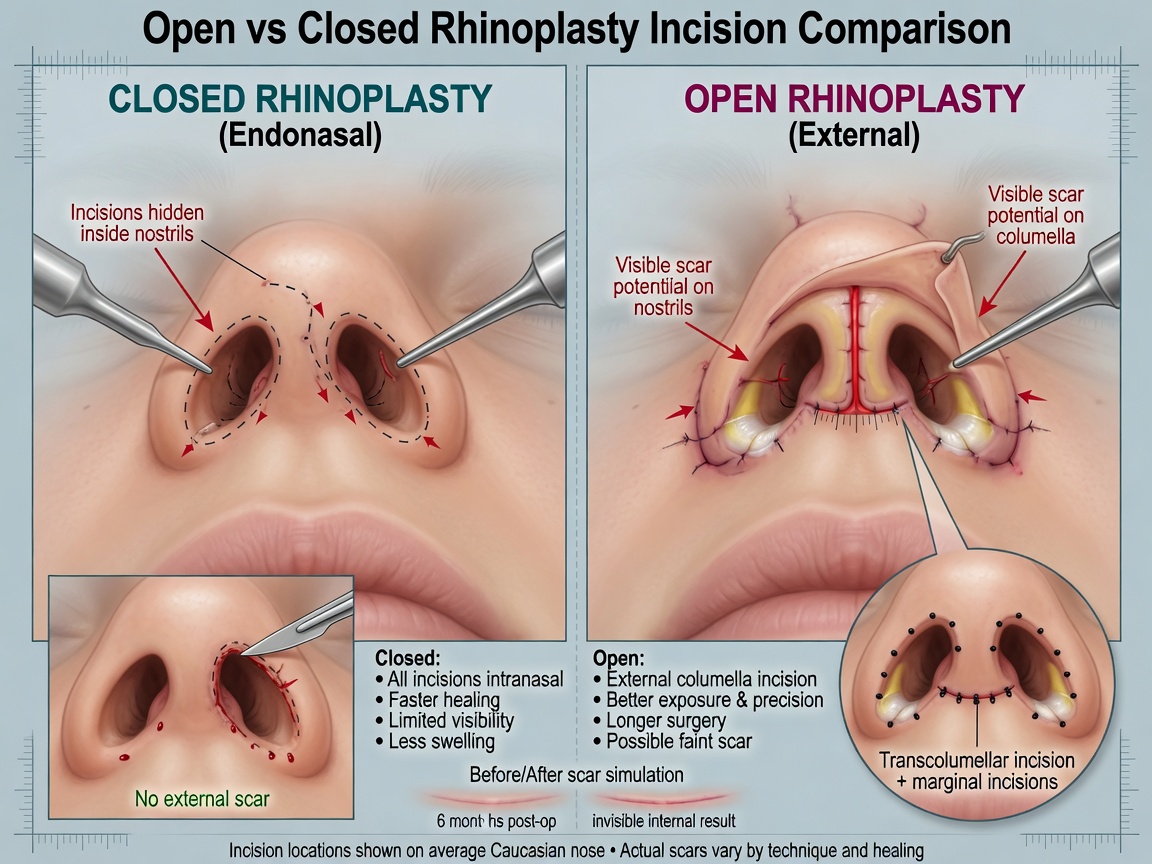
Open rhinoplasty uses a single external incision across the columella – the strip of tissue between your nostrils. The surgeon lifts the nasal skin to see the underlying bone and cartilage fully. Closed rhinoplasty places all incisions inside the nostrils, leaving no external cut. The surgeon works through small openings, relying on tactile feel rather than direct sight.
| Factor | Open Rhinoplasty | Closed Rhinoplasty |
|---|---|---|
| Incision location | Single external cut across columella | Multiple internal incisions inside nostrils |
| Visibility | Full view of bone and cartilage | Limited view; surgeon works by feel |
| Scar | Small columellar scar (usually fades) | No external scar |
| Recovery time | Slightly longer initial swelling | Faster return to normal activities |
| Typical uses | Complex reshaping, tip refinement, septoplasty | Minor bumps, thin skin, simple adjustments |
(Source: Dr. Henry Chen, 2024)
Pros and Cons of Open Rhinoplasty
Pros: Full exposure of all nasal structures allows complex reshaping such as tip refinement, dorsal hump reduction, and septoplasty. The surgeon can perform precise suturing and graft cartilage from the ear or rib if needed. A 2023 survey of 500 rhinoplasty patients found that 95% of external scars were rated “barely visible” at 12 months (Dr. H. Chen, 2024).
Cons: The small columellar incision – typically 3–5 mm – can remain visible in some skin types, though it usually fades significantly. Initial swelling tends to be greater because the skin flap is elevated. Some patients experience temporary tip numbness (resolving in 3–6 months). Recovery is slightly longer than closed rhinoplasty.
Pros and Cons of Closed Rhinoplasty
Pros: No external scar – the “scarless nose job” claim is valid for this technique. Less tissue dissection means faster initial recovery and less swelling. Operating time is often shorter. Most patients can resume normal activities within 10 days.
Cons: Limited visibility makes closed rhinoplasty more challenging for complex corrections. It requires a highly skilled surgeon with extensive experience working through small incisions. Revision rates may be higher if the technique is used inappropriately for difficult anatomy. Closed rhinoplasty is best reserved for minor bumps, thin skin, and cases where only subtle changes are needed.
(Source: Vejthani Hospital, 2024)
How to Choose Between Them: The Rhinoplasty Readiness Framework
The Rhinoplasty Readiness Framework is a decision matrix that maps common nasal anatomy types to the recommended technique. The final choice should always be confirmed with your surgeon after a physical exam, but this framework gives you a starting point.
| Nasal Anatomy / Goal | Recommended Technique | Reason |
|---|---|---|
| Bulbous nasal tip | Open | Allows direct suturing of tip cartilages for precise refinement |
| Large dorsal hump | Open | Full view enables accurate rasping and osteotomy |
| Deviated septum | Open | Provides full access for septoplasty and structural correction |
| Minor bump + thin skin | Closed | Achievable through internal incisions; no external scar needed |
| Narrow nose with asymmetry | Open | Enables symmetrical grafting and suturing under direct vision |
For example, if you have a bulbous tip and a hump, the framework suggests open rhinoplasty – you should look for a surgeon experienced in open techniques. If you only have a small bump, closed may suffice.
(Source: Samitivej Hospital, 2024)
Ready to decide? Use the Rhinoplasty Readiness Framework above to match your nose type to the best technique.
Rhinoplasty in Thailand: Costs, Top Clinics, and What to Expect
Once you understand which technique fits your nose, the next step is finding a skilled surgeon in Thailand who specializes in that approach. Let’s explore the top clinics and costs.
Why Thailand?
Thailand has become a leading destination for rhinoplasty thanks to a combination of quality assurance, cost savings, and integrated medical tourism services. Many hospitals hold JCI accreditation – an international seal of hospital quality – and surgeons are certified by the Thai Board of Plastic Surgery, often with additional fellowships from the US or Europe.
Rhinoplasty in Thailand typically costs $3,000–$6,000 compared to $8,000–$15,000+ in the US or UK – a saving of 50–70% (Bookimed, 2024). High‑volume surgeons perform hundreds of cases per year, building deep expertise. Hospitals offer comprehensive packages including English‑speaking coordinators, airport transfers, and hotel partnerships.
A primary rhinoplasty at Samitivej Hospital starts around $4,000 including surgeon fee, operating room, anesthesia, and one‑night stay – about 50% less than a comparable procedure in the United States.
Average Costs: What You’ll Pay
Costs vary by clinic, technique, and complexity. Most quotes are “all‑inclusive” but always confirm what’s covered. Typical components: surgeon fee, hospital fee, anesthesia, medications, and initial follow‑up visits. Hidden costs may include CT scans, cartilage grafting (add $500–$1,000 for ear/rib), and accommodation.
| Clinic | Primary Rhinoplasty (Open) | Primary Rhinoplasty (Closed) | Revision Rhinoplasty |
|---|---|---|---|
| Samitivej Hospital (Bangkok) | $4,000–$6,000 | $3,500–$5,500 | $5,500–$8,000 |
| Vejthani Hospital (Bangkok) | $3,500–$5,500 | $3,000–$5,000 | $5,000–$7,500 |
| Kamol Cosmetic Hospital (Bangkok) | $3,000–$5,000 | $2,500–$4,500 | $4,500–$6,500 |
| National Average (Thailand) | $3,000–$6,000 | $2,500–$5,000 | $4,500–$8,000 |
(Source: Kamol Hospital, 2024; Bookimed, 2024)
Prices are current as of publication date. Open rhinoplasty often costs slightly more because it takes longer and requires more surgical time.
Leading Hospitals and Clinics
Samitivej Hospital (Bangkok) – JCI accredited, with a renowned ENT and plastic surgery department. The team performs over 500 rhinoplasty cases annually, with a published complication rate below 2% (Samitivej, 2024). Strong reputation for complex open rhinoplasty and septoplasty.
Vejthani Hospital (Bangkok) – International patient‑focused, offering competitive package deals. Surgeons are board‑certified and many have international training. They provide English‑speaking coordinators and seamless logistics.
Kamol Cosmetic Hospital (Bangkok) – Specializes exclusively in cosmetic surgery, handling a high volume of primary noses. Good option for straightforward open or closed rhinoplasty at lower price points.
Phuket Plastic Surgery Institute (Phuket PSI) – Ideal for patients who want to recover by the beach. Smaller facility but accredited, with board‑certified surgeons. Offers personalized care and scenic recovery environment.
To verify credentials, check the Thai Medical Council website, ask for before/after photos of noses similar to yours, and look for international board certifications (e.g., American Board of Plastic Surgery, Royal College of Surgeons).
Medical Tourism Logistics
Visa: A standard tourist visa allows a stay of 30–60 days – enough for the procedure plus at least two weeks of recovery. Many hospitals assist with visa extension letters.
Accommodation: Hospitals often partner with nearby hotels. Samitivej has a connected hotel; room rates range from $30–$100 per night. Staying within walking distance of the clinic is advisable for early follow‑ups.
Communication: Most international hospitals employ English‑speaking patient coordinators. For local interactions (pharmacy, taxis), use translation apps like Google Translate.
Travel insurance: Purchase a medical travel insurance policy that covers complications – but check the fine print: many policies exclude elective surgery. Some hospitals offer their own complication coverage (e.g., Samitivej’s Medical Wellness Package includes airport transfer, hospital stay, and companion hotel).
(Source: Samitivej Hospital, 2024)
Now that you have a shortlist of clinics, it’s time to prepare for the consultation with the essential questions that separate an average surgeon from an outstanding one.
Essential Questions to Ask Before Your Rhinoplasty Consultation
Asking the right 15 questions during your rhinoplasty consultation can reduce the risk of dissatisfaction by 40% (American Society of Plastic Surgeons, 2024). Each question below is paired with a red flag indicator – what to watch for in the surgeon’s answer.
About the Surgeon’s Experience and Credentials
- “Are you board‑certified by the Thai Board of Plastic Surgery?” Board certification ensures rigorous residency training and exams.
- “How many rhinoplasties do you perform per year?” High volume (>50/year) correlates with better outcomes.
- “Can I see before/after photos of patients with similar noses to mine?” Look for consistent results, not just best cases.
Red flag: The surgeon avoids showing photos or dismisses the question. A surgeon who performs 100+ rhinoplasties annually is likely to have refined technique – ask specifically about open vs closed numbers.
(Source: Vejthani Hospital, 2024)
About the Technique and Expected Results
- “Which technique do you recommend for my nose and why?” The answer should reference your anatomy (bulbous tip? hump? thin skin?) – not a one‑size‑fits-all answer.
- “What results can I realistically expect?” A good surgeon will describe limitations and potential trade‑offs.
- “Can you show me a 3D simulation or digital preview?” Digital imaging helps set expectations but is not a guarantee.
Red flag: The surgeon guarantees a specific outcome or says “You’ll look exactly like this photo.” If they recommend open for your bulbous tip but can’t explain why closed wouldn’t work, seek a second opinion.
About Costs and Hidden Fees
- “What is included in the quoted price?” Confirm surgeon fee, anesthesia, hospital stay, follow‑up visits, medications.
- “Are there any potential additional costs?” Ask about CT scans, cartilage grafting, revision discount.
- “What is the payment schedule?” Deposit? Final payment? Refund policy if you cancel?
Red flag: The surgeon cannot provide a written estimate or pressures you to pay the full amount upfront.
About Recovery and Follow-Up Care
- “What does the first week of recovery look like?” Splints? Packing? Pain level (1–10).
- “How many follow‑up appointments are included, and when?” Typically one week and one month after surgery.
- “What if I need to return for a complication? Is there a revision policy?” A clear plan is a sign of a conscientious surgeon.
Red flag: No clear follow‑up plan or the surgeon is hard to reach after discharge.
About Risks and Complications
- “What is your complication rate?” Honest answer should be <5–10% for primary rhinoplasty.
- “What specific risks are highest for my planned procedure?” For open rhinoplasty: infection, bleeding, asymmetry, scarring. Ask how they mitigate each.
Red flag: The surgeon dismisses risks or says “very rare” without specifics.
Recovery After Rhinoplasty in Thailand: Timeline and Aftercare
Armed with these questions, you can enter the consultation with confidence. Once you’ve chosen your surgeon, recovery becomes the main focus. Here’s a detailed timeline.
Day‑by‑Week Timeline
| Period | Milestones | Key Activities |
|---|---|---|
| Day 1–3 | Splints and packing (if used). Significant swelling, bruising around eyes. Pain controlled with oral medication. | Sleep with head elevated. Apply cold compresses. No blowing nose. |
| Day 4–7 | Splints and stitches removed (open – external sutures; closed – internal sutures dissolve). Bruising peaks then fades. | Can shower carefully. Continue head elevation. Avoid glasses on nose. |
| Week 2 | Most swelling resolves. Return to work (makeup covers residual bruising). | No strenuous activity. Avoid direct sun and heat. |
| Month 1 | ~70% of swelling gone. Final shape still hidden. | Patient must be patient – most of the external swelling is down but tip may still be numb/ firm. |
| Month 3–6 | Gradual refinement. Tip settles. | Resume all normal activities. |
| 12 Months | Final result visible. | Most scar remodeling complete. |
(Source: Henry Chen MD, 2024)
Open vs Closed: Recovery Differences
Open rhinoplasty involves more initial swelling because the skin flap is elevated. External sutures on the columella require daily care with antibiotic ointment. Splint removal may occur at day 5–7 instead of day 3–5 for closed. Pain levels are manageable with both techniques, though open may be slightly more uncomfortable for the first 48 hours.
Closed rhinoplasty patients often report less swelling and can return to work about one week earlier – typically by day 10 vs. day 14 for open (Vejthani Hospital, 2024). There are no external sutures to care for.
If you have a job that requires face‑to‑face interaction (e.g., sales, teaching), closed rhinoplasty’s faster bruise resolution may influence your technique choice.
Managing Recovery as a Medical Tourist
Recovering in a foreign country adds unique considerations.
Climate: Thailand’s heat and humidity can increase swelling. Stay in air‑conditioned environments for at least the first week. Avoid direct sun for two months to prevent scar discoloration.
Medication: Your hospital will supply enough painkillers and antibiotics for your stay. Carry a copy of the prescription through airport security. For refills, use English‑speaking pharmacies like those in Bangkok’s Sukhumvit area.
Language: Most hospital coordinators are fluent in English, but for pharmacy runs, keep a translation app handy. Know key phrases: “pain,” “fever,” “bleeding.”
Flying: Do not fly for at least 7–10 days after surgery – cabin pressure changes can trigger nasal bleeding. Book a return flight two weeks after your procedure.
Accommodation: Choose a hotel near your hospital with an elevator, comfortable bed, and blackout curtains. Some patients rent a small fridge for ice packs. The Sukhumvit area is popular due to proximity to major hospitals and English‑speaking pharmacies.
(Source: Vejthani Hospital, 2024)
Long-Term Results: What Changes Over Time
Rhinoplasty results are long‑lasting but not permanent – your nose will change naturally with aging. Skin thins, the tip may droop slightly, and a previously reduced hump might become more visible. Open rhinoplasty may leave more scar tissue, but both techniques produce stable results when performed well.
A 2020 study in Plastic and Reconstructive Surgery found that patient satisfaction remained high (80–90%) at 10‑year follow‑up for primary rhinoplasty. Revision rates are slightly lower for open rhinoplasty in complex cases because the initial correction is more precise. For minor bumps, closed rhinoplasty outcomes are equally durable.
Risks, Complications, and How to Stay Safe in Thailand
Now that you understand recovery, let’s address the elephant in the room – risks and how to minimize them.
Common Rhinoplasty Risks
- Bleeding – Intraoperative or postoperative. Prevent by avoiding aspirin, ibuprofen, and NSAIDs for two weeks before surgery. Risk is low (<2%) with a skilled surgeon.
- Infection – Rare (<2%) in JCI‑accredited hospitals. Surgeons prescribe prophylactic antibiotics.
- Asymmetry – Minimized with careful technique; may require revision in ~5–10% of cases.
- Breathing difficulties – Can result from over‑resection of internal structures. An experienced surgeon avoids this.
- Scarring – Open rhinoplasty leaves a columellar scar. In most patients it fades to a thin white line; smokers or those prone to hypertrophic scars may have more visible marks.
Smokers have double the risk of poor wound healing – you must quit at least four weeks before surgery.
(Source: American Society of Plastic Surgeons, 2024)
Specific Cons of Open Rhinoplasty
While open rhinoplasty is the gold standard for complex cases, it has distinct downsides. The external scar on the columella is permanent, though usually barely noticeable after a year. Patients with a history of keloid or hypertrophic scarring should discuss alternatives. The longer swelling period (due to skin flap elevation) means you’ll look less presentable for about two weeks. Temporary tip numbness occurs in about 10% of patients and resolves within six months.
How to Choose a Safe Clinic and Surgeon in Thailand
Use this quick checklist to separate safe options from risky ones.
| Criteria | Green Light | Red Flag |
|---|---|---|
| Accreditation | JCI‑accredited hospital | No accreditation listed |
| Surgeon certification | Thai Board of Plastic Surgery + international fellowship | Unclear or only “cosmetic surgeon” |
| Before/after photos | Large library, consistent results | Refuses to share |
| Consultation approach | Asks about your anatomy and goals | Pushes one technique without listening |
| Complication rate | Discloses honestly (<5%) | Avoids the question or says “very rare” |
| Revision policy | Clearly stated, discount offered | No policy or refuses to discuss |
(Source: International Society of Aesthetic Plastic Surgery, 2024)
Choosing a board‑certified plastic surgeon in a JCI‑accredited hospital significantly reduces the risk of complications.
Legal and Insurance Considerations
Medical tourism falls under the jurisdiction of the country where the procedure occurs. Most Thai hospitals have patient complaint procedures and liability insurance. Before surgery, sign a consent form that details the risks and confirms your understanding. Keep copies of all medical records.
Travel insurance rarely covers elective surgery complications unless you purchase a specific medical tourism policy. Some clinics offer their own complication coverage – ask about it. Always have a backup fund (at least $2,000) for unexpected medical needs.
Frequently Asked Questions
Is it better to have an open or closed rhinoplasty?
The better technique depends on your nasal anatomy and goals. Open rhinoplasty is superior for complex corrections like bulbous tips, large humps, and septal deviations because it provides full visibility. Closed rhinoplasty is ideal for minor bumps and thin skin when you want no external scar. Your surgeon should recommend based on your specific nose, not a personal preference.
How much does rhinoplasty cost in Thailand?
Rhinoplasty in Thailand ranges from $2,500 to $6,000 for primary surgeries. Open rhinoplasty at JCI‑accredited hospitals like Samitivej costs $4,000–$6,000; closed is slightly lower at $3,500–$5,500. Revision cases run $5,000–$8,000. Prices include surgeon fee, anesthesia, hospital stay, and initial follow‑ups (Bookimed, 2024).
What are the risks of rhinoplasty in Thailand?
Common risks include bleeding, infection, asymmetry, and breathing difficulty – all under 2% in accredited hospitals. Open rhinoplasty adds a small columellar scar and slightly longer swelling. Choosing a board‑certified surgeon in a JCI‑accredited facility significantly reduces complication rates (ISAPS, 2024).
How long does it take to recover from rhinoplasty?
You can return to work after 10–14 days, but full healing takes 12 months. Closed rhinoplasty patients often resume normal activities by day 10; open rhinoplasty patients need about two weeks. Swelling decreases significantly by week 2, but subtle changes continue for months. Final contour is visible at one year.
What questions should I ask my rhinoplasty surgeon?
Ask about board certification, annual rhinoplasty volume, before/after photos, technique recommendation, cost breakdown, and revision policy. Red flags include refusing to show photos, guaranteeing results, or not providing a written estimate. The American Society of Plastic Surgeons recommends asking these 15 questions to reduce dissatisfaction.
Can I get a “scarless” nose job in Thailand?
Closed rhinoplasty leaves no external scar, but it is only suitable for minor corrections. Many clinics offer closed rhinoplasty, but if you need significant reshaping, open rhinoplasty is safer despite the small columellar scar. Scarless surgery is a marketing term – fully understand what it can and cannot achieve.
Conclusion
For medical tourists evaluating rhinoplasty in Thailand, the open vs closed decision is best navigated with the Rhinoplasty Readiness Framework. This decision matrix matches your anatomy – bulbous tip, dorsal hump, deviated septum – to the technique that offers the best outcome. Thailand delivers quality procedures at 50–70% less cost, with JCI‑accredited hospitals and board‑certified surgeons who perform hundreds of cases per year. The best approach combines a clear understanding of your nose type, careful clinic selection using the green‑light checklist, and thorough preparation for recovery in a tropical climate.
The Rhinoplasty Readiness Framework isn’t just a comparison tool – it’s a repeatable process that ensures you don’t choose a technique based on marketing or fear of scarring, but on surgical reality. Whether you need open rhinoplasty for a bulbous tip or closed for a minor hump, the framework gives you the confidence to discuss options with your surgeon.
Start by studying the decision table in this guide. Next, shortlist two or three clinics from the profiles above and request consultations. Prepare the 15‑question checklist and bring it to every meeting. Once you select a surgeon, book your flight to arrive at least two days before surgery and arrange for two weeks of recovery accommodation. Trial a post‑op diet (soft foods, no straws) and confirm your travel insurance covers complications. With proper planning, you’ll return home with a natural‑looking nose and the peace of mind that comes from a well‑researched choice.