
Partial vs Total Knee Replacement: A Complete Guide to Choosing the Right Approach
If you’re considering knee replacement surgery, the biggest decision isn’t whether to have it — it’s whether to go with a partial or a total replacement. Choose the wrong type and you could face a second surgery sooner than expected; choose wisely and you might enjoy decades of pain-free mobility. By the end of this guide, you’ll understand the key differences, who qualifies for each, what recovery looks like, and how to make the best choice for your unique knee condition. We’ll start by explaining the anatomy, then walk through candidacy, recovery, outcomes, risks, costs, and Thailand-specific options.
Key Takeaways
Partial knee replacement preserves healthy compartments and offers faster recovery, but has a higher revision rate. Total knee replacement is more durable for widespread arthritis but involves a longer recovery. The Compartment Conservation Principle guides the decision — preserve when possible, replace when necessary.
- Partial is best for arthritis limited to one compartment with intact ligaments
- Total is required for multi-compartment damage or deformity
- Revision risk is higher for partial (~27% at 10 years vs ~22% for total)
- Satisfaction is higher for partial in appropriately selected patients
Partial vs Total Knee Replacement: Key Differences
Partial knee replacement resurfaces only the damaged compartment (medial, lateral, or patellofemoral), leaving healthy bone and cartilage intact. Total knee replacement resurfaces all three compartments and replaces the entire knee joint surface. Partial knee replacement preserves 60-70% of your natural knee joint, maintaining more normal gait mechanics than total knee replacement (HSS, 2024). The choice depends on which compartments are diseased.
Knee Compartments and Disease Patterns
Your knee has three compartments: the medial (inner side), lateral (outer side), and patellofemoral (under the kneecap). Osteoarthritis typically begins in the medial compartment because it bears the highest load during walking — roughly 60-70% of your body weight transfers through the inner knee with each step. The lateral compartment takes less weight, and the patellofemoral compartment handles motion during bending and squatting.
The Compartment Conservation Principle states: preserve healthy knee compartments whenever possible to maintain natural biomechanics, but only if the remaining cartilage is disease-free and ligaments are intact. For a patient with isolated medial compartment arthritis, a partial knee replacement can resurface only that area while leaving the lateral compartment and patella untouched. This matters because preserving healthy tissue means preserving natural knee function — your own ligaments, cartilage, and bone continue working as they did before arthritis set in.
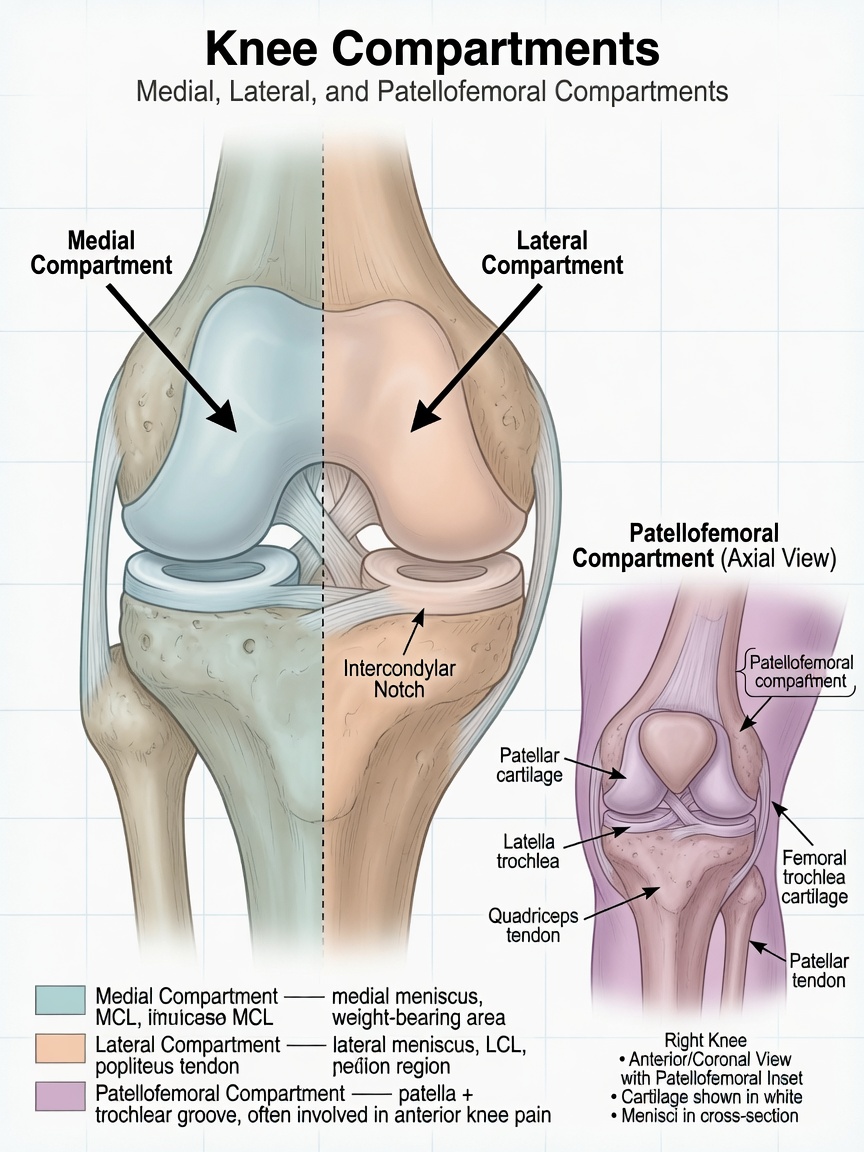
Caption: Understanding your knee’s three compartments helps clarify why partial replacement is an option for isolated arthritis.
Disease patterns follow predictable paths. In most patients, osteoarthritis starts in the medial compartment due to mechanical loading. Over years, it may spread to the lateral compartment or under the kneecap. The rate of progression varies — some patients maintain single-compartment disease for decades, while others develop multi-compartment arthritis within a few years. This is why early intervention matters: catching arthritis when it’s confined to one compartment preserves more surgical options.
What Each Surgery Involves
Partial knee replacement uses a 3- to 4-inch incision over the affected compartment. The surgeon removes only the damaged cartilage and a thin layer of bone (about 5-10% of the bone surface), then attaches a metal and polyethylene implant to resurface that compartment. The anterior cruciate ligament (ACL) and posterior cruciate ligament (PCL) are preserved, maintaining the knee’s natural stability and proprioception — your ability to sense joint position without looking.
Total knee replacement requires a 6- to 8-inch incision and exposes all three compartments. The surgeon removes damaged cartilage and bone from the end of the femur, the top of the tibia, and the underside of the patella — roughly 30-40% of the bone surface. In most conventional totals, the ACL and PCL are removed, and the implant’s geometry provides stability instead. Some newer “cruciate-retaining” designs preserve the PCL, but the ACL is almost always sacrificed.
The bone preservation difference is striking: partial removes only the damaged surface while keeping your natural bone architecture largely intact. Total replaces the entire load-bearing surface. This distinction becomes critical if you ever need revision surgery — converting a partial to a total is generally simpler than revising a failed total because less bone has been removed initially.
| Feature | Partial Knee Replacement | Total Knee Replacement |
|---|---|---|
| Incision length | 3-4 inches | 6-8 inches |
| Bone preserved | ~90% | ~60-70% |
| Cruciate ligaments | Preserved | Removed or substituted |
| Hospital stay | 1-2 days | 2-3 days |
| Typical recovery | 6-8 weeks | 12-16 weeks |
| Suitability | 1 compartment damage | 2-3 compartment damage |
| Revision rate at 10 years | ~27% (PubMed, 2024) | ~22% (PubMed, 2024) |
The numbers show that partial has a higher revision risk, but this is offset by better function and satisfaction for suitable candidates. The CDC statistics on knee replacement surgery report over 400,000 total knee replacements annually in the U.S., with partials accounting for approximately 8-10% (2023). This gap partly reflects the stricter candidacy requirements for partial — not everyone qualifies, but those who do often experience excellent outcomes.
Once you understand the anatomical differences, the next logical question is: who actually qualifies for each procedure? Let’s look at the candidacy criteria.
Who Qualifies for Partial or Total Knee Replacement?
Not everyone qualifies for partial knee replacement. The ideal candidate has osteoarthritis confined to one compartment (most often medial), with an intact anterior cruciate ligament (ACL) and no significant deformity or inflammation. Patients with multi-compartment arthritis, ACL deficiency, or inflammatory arthritis are typically better suited for total knee replacement. The Compartment Conservation Principle applies directly here: preserve compartments that are disease-free and resurface only the affected area.
Preserving Healthy Compartments
The Compartment Conservation Principle means you keep what’s healthy and only address what’s damaged. Applied to candidacy, this translates into specific inclusion and exclusion criteria.
Inclusion criteria for partial knee replacement:
- Arthritis confined to a single compartment (most commonly medial)
- Intact ACL and PCL — confirmed by physical exam or MRI
- Correctable angular deformity of less than 5-10 degrees (varus or valgus)
- No inflammatory arthritis such as rheumatoid arthritis or lupus
- Body mass index (BMI) under 40 — higher BMI increases implant stress
- No significant bone loss or prior infection in the affected knee
Exclusion criteria for partial knee replacement:
- Multi-compartment arthritis visible on X-ray or MRI
- ACL deficiency or severe ligamentous instability
- Inflammatory arthritis affecting the entire joint
- Fixed angular deformity exceeding 10 degrees
- Significant bone loss requiring augmentation
- Prior high tibial osteotomy or other complex knee surgery
A 55-year-old patient with isolated medial compartment OA and no ligament issues is an ideal partial candidate. The same patient with lateral compartment involvement or a torn ACL would require a total. The WHO patient selection criteria emphasize that knee replacement decisions should be based on disease severity, prior conservative treatment, and individual patient factors (2023).
Best Age for Partial Replacement
Age is one of the most debated factors in partial knee candidacy — and for good reason. There is no single best age, as outcomes depend on activity level, bone quality, and disease progression rather than chronological age alone.
For patients under 60, partial knee replacement offers a compelling advantage: it delays the need for total knee replacement by 10-15 years. A 50-year-old patient who receives a partial can remain active during their peak working years and defer the more invasive total until later in life. However, younger patients have higher activity demands that may accelerate implant wear. A 2024 systematic review in PubMed found that patients under 60 had a 30% revision rate at 10 years for partial versus 20% for total, but also reported higher satisfaction scores when partial was appropriately indicated.
For patients over 70, the calculus shifts. Partial still offers faster recovery and less postoperative pain, which matters more for older patients who may struggle with prolonged rehabilitation. But some evidence suggests that partials in older patients may have higher failure rates due to osteoporosis-related implant settling or progression of arthritis in untreated compartments. Many surgeons recommend total for patients over 70 who have reasonable bone quality and multi-compartment disease.
The key insight: age alone is not a contraindication for either procedure. A healthy 65-year-old with single-compartment disease and intact ligaments is an excellent partial candidate. A 75-year-old with the same isolated disease and good bone quality may also benefit from partial. The critical factors are compartment involvement and ligament status, not the number on your birth certificate.
Clinical Criteria Checklist
You may be a candidate for partial knee replacement if:
- [ ] Arthritis is confined to one compartment (medial, lateral, or patellofemoral)
- [ ] Your ACL is intact and functional
- [ ] Angular deformity is less than 5-10 degrees
- [ ] You do not have inflammatory arthritis
- [ ] Your BMI is under 40
- [ ] There is no significant bone loss
- [ ] You have not had major knee surgery in the past
You likely need total knee replacement if:
- [ ] Arthritis affects two or three compartments
- [ ] Your ACL is deficient or severely damaged
- [ ] You have inflammatory arthritis (RA, lupus, psoriatic arthritis)
- [ ] Deformity exceeds 10 degrees and is not correctable
- [ ] You have had prior high tibial osteotomy or complex knee reconstruction
- [ ] Significant bone loss requires augmentation or grafting
The final decision requires orthopaedic evaluation and imaging — typically weight-bearing X-rays in multiple views plus MRI to assess ligament and cartilage status. Use this checklist as a starting point for informed discussion with your surgeon, not as a self-diagnosis tool.
Knowing your candidacy is half the battle. Once you and your surgeon determine which procedure is appropriate, the next major concern is recovery — and the timelines differ significantly.
Recovery Time: What to Expect After Surgery
Partial knee replacement patients typically return to driving by week 3, while total knee replacement patients often need 6-8 weeks (CDC, 2024). This gap reflects the differences in surgical invasiveness, bone cutting, and soft tissue trauma. Recovery expectations should be realistic for both procedures — neither is a quick fix, and both require dedicated rehabilitation.
Partial Recovery Timeline
Week 1: You’ll stay in the hospital 1-2 days. By day 2, you’ll stand and take a few steps with a walker or crutches. Physical therapy begins within 24 hours of surgery, focusing on gentle range-of-motion exercises and ankle pumps to prevent blood clots.
Weeks 2-4: You’ll continue physical therapy at home 2-3 times per week. Most patients discontinue the walker by week 2-3 and transition to a cane or no assistive device by week 4. Driving is typically safe by week 3-4, provided you’re no longer taking narcotic pain medication and have adequate reaction time. Return to desk work is common by week 3-4.
Weeks 5-8: Normal walking without an assistive device is the norm by week 6. Low-impact activities such as swimming, stationary cycling, and golf (with a cart) are permitted. Range of motion should approach full extension and 120+ degrees of flexion.
Month 3-6: Full activities of daily living are restored. You can return to low-impact sports — swimming laps, cycling outdoors, doubles tennis. The Henry Ford Health recovery timeline for knee replacement notes that partial patients often feel “back to normal” by month 3, while still needing to protect the implant from high-impact forces.
Key milestones:
- Day 2: Stand and walk with assistive device
- Week 2-3: Discontinue walker
- Week 3-4: Drive and return to desk work
- Week 6: Normal walking, low-impact activities
- Month 3: Full activities of daily living
Total Recovery Timeline
Week 1-2: Hospital stay of 2-3 days. You’ll walk with a walker and begin physical therapy focusing on two critical goals: regaining full knee extension (straightening) and quadriceps activation. Extension is often harder to achieve than flexion after total replacement because the surgical approach affects the extensor mechanism.
Weeks 3-6: Continue home physical therapy 2-3 times per week. Most patients transition from walker to cane by week 4-6. Driving is typically not safe until week 6-8 — the left knee (for automatic transmission drivers) still lacks the rapid reaction strength needed for emergency braking. Return to sedentary work is possible by week 6-8 for desk jobs.
Weeks 8-12: Walking without assistance becomes comfortable. Range of motion continues improving, though some patients require formal physical therapy for up to 12 weeks to achieve full extension and 110+ degrees of flexion.
Month 4-12: Normal ambulation without any assistive device. Low-impact sports are possible by month 4-6. Range of motion may continue improving up to 6-12 months post-surgery. The HSS recovery and outcomes data for total knee replacement indicates that full recovery — meaning minimal stiffness, normal gait, and return to all desired low-impact activities — takes 6-12 months for most patients.
Key milestones:
- Day 1-2: Stand with assistance
- Week 4-6: Transition from walker to cane
- Week 6-8: Drive and return to sedentary work
- Month 3-4: Walk without assistance
- Month 6-12: Full recovery, low-impact sports
Pain: Does Partial Hurt Less?
Yes, most studies confirm that partial knee replacement is significantly less painful in the early postoperative period. Patients undergoing partial report 20-30% lower pain scores on day 2 post-op compared to total (Riverside Health, 2024). This difference stems from three factors: a smaller incision means less soft tissue trauma, minimal bone resection reduces inflammatory response, and preserved cruciate ligaments maintain more natural joint mechanics.
However, this doesn’t mean partial is pain-free. Both procedures involve cutting bone, implanting hardware, and rehabilitating the joint. Pain management protocols for both include oral medications (opioids for the first 3-5 days, then NSAIDs and acetaminophen), ice application, elevation, and compression. The difference is one of degree — partial patients typically require fewer narcotics and transition to over-the-counter pain relief faster.
By month 3, pain levels between the two procedures converge. Most patients — partial and total alike — report that their surgical pain is far less than the arthritis pain they lived with before surgery. The real distinction is in the first 2-4 weeks, where partial offers a noticeably smoother experience.
Activities to Avoid After Surgery
Both partial and total knee replacements come with permanent activity restrictions, though partial is generally more permissive.
Permanent restrictions for both procedures:
- Running and jogging: The repetitive impact accelerates implant wear and increases loosening risk
- Basketball and volleyball: Jumping and pivoting stress the implant-bone interface
- Contact sports: Football, soccer, martial arts pose dislocation and fracture risks
- Heavy lifting (over 50 pounds repeatedly): Increases implant stress
- High-impact aerobics: The pounding damages polyethylene components
Additional restrictions for total knee replacement:
- Deep squatting: Many total knee designs limit flexion to 110-120 degrees
- Kneeling on hard surfaces: Can be painful due to the skin incision over the kneecap — using a kneeling pad helps
- Marathon running: Even low-impact running is typically discouraged after total replacement
Activities that are safe and encouraged:
- Swimming and water aerobics
- Stationary and outdoor cycling
- Golf (walking or cart)
- Hiking on moderate terrain
- Doubles tennis
- Ballroom and line dancing
- Walking (unlimited)
The FDA on activity restrictions after knee replacement advises patients to avoid high-impact activities permanently but emphasizes that low-impact exercise is essential for maintaining implant longevity and overall health. Partial patients typically have fewer restrictions because their natural ligaments provide more inherent stability, but the same high-impact activities are still discouraged.
Outcomes and Patient Satisfaction: What the Research Shows
Over 90% of partial knee replacement patients report good to excellent outcomes at 10 years when properly selected (HSS, 2024). Total knee replacement has similarly high satisfaction rates — around 85-90% — but the two procedures excel in different areas. Understanding these differences helps set realistic expectations.
Functional Outcomes and Satisfaction
Partial knee replacement consistently outperforms total on several functional measures. Patients with partial achieve better range of motion (average 125-135 degrees versus 110-125 degrees for total), more natural gait patterns, and superior proprioception — the knee’s ability to sense its position in space. A 2024 systematic review in PubMed found that partial patients scored significantly higher on the Oxford Knee Score (a validated patient-reported outcome measure) at 1, 5, and 10 years post-surgery.
| Outcome Measure | Partial Knee Replacement | Total Knee Replacement |
|---|---|---|
| Patient satisfaction (10 years) | 90-95% | 85-90% |
| Range of motion | 125-135 degrees | 110-125 degrees |
| Normal gait restoration | 85% | 70-75% |
| Return to low-impact sports | 80% | 60-70% |
| Oxford Knee Score (10 years) | 42-45 | 38-42 |
Why does partial achieve better functional outcomes? Because preserving the cruciate ligaments maintains the knee’s natural rollback mechanism during flexion — the femur glides backward on the tibia as you bend your knee. Total knee replacement substitutes this with implant geometry that approximates, but does not perfectly replicate, natural kinematics. For patients who value natural-feeling knee function — climbing stairs, getting out of a low chair, kneeling in the garden — partial offers a measurable advantage.
Satisfaction rates tell a similar story. When patients are appropriately selected (single-compartment disease, intact ligaments), partial satisfaction approaches 95% at 10 years. Total satisfaction hovers around 85-90%, with the most common complaint being residual stiffness or a sensation that the knee “doesn’t feel normal.” However, for patients with multi-compartment arthritis, total replacement is the only option — and 85-90% satisfaction is still excellent for a procedure that eliminates debilitating pain.
Revision Rates and Implant Longevity
This is where the trade-off becomes clear. Partial knee replacement has a higher revision rate — approximately 27% at 10 years versus 22% for total (PubMed, 2024). On the surface, that looks like a clear disadvantage. But the context matters enormously.
The higher revision rate reflects two factors. First, partials are often performed in younger, more active patients who place higher demands on the implant. Second, the remaining untreated compartments can develop arthritis over time — this is disease progression, not implant failure. When a partial fails, it’s typically because arthritis has spread to another compartment, not because the implant itself wore out.
Importantly, revising a partial to a total is generally a less complex procedure than revising a failed total. Because the partial preserved bone stock and left the cruciate ligaments intact (until removal during revision), the surgeon has more bone to work with and less scarring to navigate. A 2024 study found that conversion of partial to total had outcomes comparable to primary total replacement, while revision of a failed total had significantly worse outcomes and higher complication rates.
Implant longevity at 10 years:
- Partial knee replacement: 73% implant survival (27% revision rate)
- Total knee replacement: 78% implant survival (22% revision rate)
- Partial to total conversion: Outcomes similar to primary total
- Total to total revision: Significantly worse outcomes than primary
The bottom line: partial has a higher revision risk, but this risk is partly driven by patient selection and the consequences of revision are less severe. For appropriately selected patients, the functional advantages of partial often outweigh the revision risk.
Is Partial More Cost-Effective?
The initial cost of partial knee replacement is lower than total — shorter hospital stay, faster return to work, and fewer physical therapy sessions. Estimates suggest partial saves $3,000-8,000 in direct medical costs per procedure in the U.S. healthcare system.
However, the higher revision rate can offset these savings over time. When a partial fails and requires conversion to a total, the combined cost of two surgeries exceeds that of a single total. Health economic modeling suggests that partial is cost-effective when the 10-year revision risk is below 30% and when patients are appropriately selected. At current revision rates (~27% at 10 years), partial meets this threshold but just barely.
The cost-effectiveness equation also depends on patient age. For a 55-year-old patient who receives a partial, delays total by 12 years, and then undergoes a straightforward conversion, the economic case is strong. For a 65-year-old with a 50% chance of needing revision within 15 years, total may be more cost-effective from both a financial and outcome perspective.
Risks and Complications: Making an Informed Decision
Surgical site infections occur in 1-2% of knee replacements; blood clots in 1-3% (CDC, 2024). These numbers are the same for both partial and total — the risk profile is similar for major complications. Understanding the full spectrum of risks helps you make an informed choice.
Common Complications for Both Procedures
Infection: Deep surgical site infection occurs in approximately 1-2% of knee replacements. It’s one of the most serious complications because treating it may require implant removal, antibiotic spacer placement, and a second surgery. Superficial wound infections are more common (2-5%) and typically resolve with oral antibiotics. The CDC data on infection rates after knee replacement shows that infection risk has declined over the past decade due to improved sterilization protocols and antibiotic prophylaxis.
Blood clots (deep vein thrombosis): DVT occurs in 1-3% of patients despite preventive measures including blood thinners, compression devices, and early mobilization. A clot that travels to the lungs (pulmonary embolism) is rare — about 0.5% — but potentially fatal. Current protocols using low-molecular-weight heparin or direct oral anticoagulants have significantly reduced DVT rates.
Implant loosening: Aseptic loosening — the implant separating from bone without infection — occurs in approximately 5% of patients by 10 years. Risk factors include high activity levels, obesity, poor bone quality, and suboptimal implant alignment. Modern cementing techniques and implant designs have reduced loosening rates.
Stiffness (arthrofibrosis): About 5-10% of patients develop excessive scar tissue that limits range of motion. Risk factors include preoperative stiffness, diabetes, and inadequate physical therapy. Treatment ranges from aggressive PT to manipulation under anesthesia to surgical release.
Nerve damage: The peroneal nerve (near the knee’s outer aspect) can be injured during surgery, causing temporary or permanent foot drop. This occurs in 0.5-1% of knee replacements.
Other complications:
- Wound healing issues (1-2%)
- Fracture around the implant (rare, <1%)
- Patellar complications (clunk, maltracking, fracture) — more common in total
- Metal allergy (rare, but can cause persistent pain)
- Continued pain without identifiable cause (5-10%, more common in total)
The FDA comprehensive list of knee replacement complications details each of these risks and notes that complication rates vary by patient health, surgical approach, and hospital volume.
Why Partial Has Higher Revision Risk
The revision rate for partial knee replacement (27% at 10 years) exceeds that of total (22%), and it’s important to understand why — not all revisions mean the implant failed.
Reason 1: Disease progression in remaining compartments. This is the most common cause of partial revision. The arthritis that affected the medial compartment can spread to the lateral compartment or patellofemoral joint over time. This isn’t implant failure — it’s the natural history of osteoarthritis continuing in untreated areas. Patients who undergo partial should understand that they may eventually need a total if arthritis progresses.
Reason 2: Patient selection factors. Partial knee replacement is often chosen for younger, more active patients who place higher demands on their implants. A 55-year-old who plays tennis twice weekly will stress the implant more than a 75-year-old with a sedentary lifestyle. Higher activity levels mean faster wear and higher revision risk.
Reason 3: Implant wear. Partial implants use a polyethylene bearing surface that can wear over time. Wear particles can cause bone loss (osteolysis) and loosening. Modern highly cross-linked polyethylene has reduced wear rates but not eliminated them.
Reason 4: Surgical technique. Partial knee replacement is technically more demanding than total. The smaller incision and limited visualization make precise implant positioning harder. Malalignment can accelerate wear and increase revision risk. Surgeon experience matters — high-volume surgeons who perform 50+ partials annually have significantly lower revision rates.
The critical nuance: the higher revision rate does not mean partial is a worse procedure. It reflects a different risk-benefit calculation. For the right patient, the superior function and faster recovery of partial are worth the revision risk. The key is honest preoperative counseling about what that risk means in practical terms.
Newer Alternatives: Less Invasive Options
Robotic-assisted knee replacement represents the most significant advancement in knee surgery over the past decade. Systems like Mako (Stryker) and NAVIO (Smith+Nephew) use preoperative CT scans or intraoperative mapping to create a 3D model of your knee, then guide the surgeon’s bone cuts with submillimeter precision.
For partial knee replacement: Robotic assistance is particularly valuable because the smaller exposure makes visualization challenging. Studies show that robotic-assisted partial reduces the rate of implant malalignment from 10-15% to 2-3%, which may translate into lower revision rates. However, long-term data beyond 5 years is still emerging.
For total knee replacement: Robotic systems improve component alignment and soft tissue balance but have not yet demonstrated lower revision rates compared to conventional total replacement by experienced surgeons. Some patients report better “feel” and faster early recovery with robotic totals.
Other minimally invasive approaches:
- Quadriceps-sparing approaches: Avoid cutting the quadriceps tendon, potentially speeding recovery
- Subvastus and midvastus approaches: Smaller incisions with less muscle disruption
- Custom cutting guides: Patient-specific 3D-printed guides based on preoperative CT or MRI
It’s important to note that these alternatives are not replacements for standard techniques — they are refinements. A well-performed conventional knee replacement by an experienced surgeon often matches the outcomes of robotic-assisted surgery. The technology adds precision but cannot compensate for poor surgical judgment or inappropriate patient selection.
Knee Replacement Costs: Thailand vs. Home
Knee replacement in Thailand costs 50-70% less than in the US, with savings ranging from $15,000 to $30,000. For patients paying out of pocket, these numbers are transformative. Understanding exactly what you get for your money — and what you don’t — is essential for informed decision-making.
Average Costs in Thailand
| Procedure | Thailand (USD) | United States (USD) | UK (GBP) | Australia (AUD) |
|---|---|---|---|---|
| Partial knee replacement | $8,000 – $12,000 | $25,000 – $40,000 | £12,000 – £18,000 | $20,000 – $30,000 |
| Total knee replacement | $10,000 – $15,000 | $30,000 – $50,000 | £14,000 – £22,000 | $25,000 – $40,000 |
Prices in Thailand vary by hospital, implant brand, length of stay, and surgeon seniority. Top-tier hospitals like Bumrungrad International charge toward the upper end of the range, while smaller accredited hospitals in Chiang Mai or Phuket may offer prices on the lower end. Implant choice also matters — premium brands (Zimmer, Stryker, DePuy) cost more than standard implants, but most hospitals include a well-established implant in the package price.
The savings are substantial but come with the logistics of international travel. A patient paying $35,000 for total knee replacement in the US can save $22,000 by going to Thailand — enough to cover first-class flights, a month of recovery lodging, and have money left over.
What the Price Includes
A typical knee replacement package in a Thai hospital includes:
Included:
- Hospital room (private or semi-private, 1-3 days)
- Surgeon fee
- Anesthesiologist fee
- Implant (standard or premium depending on package)
- Nursing care and ward charges
- Operating room time
- Physical therapy sessions during stay
- Medications (routine post-op medications)
- Airport transfer (one-way or round trip)
- Coordinator support (English-speaking patient liaison)
Not included:
- International flights
- Visa fees (medical visa is typically free or low-cost)
- Pre-operative consultation if needed before arrival (usually included if done via telemedicine)
- Accommodation for companion/family member
- Post-discharge physical therapy (available at extra cost)
- Extended stay beyond standard package (e.g., if complications arise)
- Personal expenses (food beyond hospital meals, incidentals)
- Follow-up care after returning home
Most hospitals offer package upgrades — longer stays, premium implants, private suites — that add $1,000-3,000 to the base price. The total out-of-pocket cost including travel and lodging typically ranges from $12,000-20,000 for partial and $15,000-25,000 for total, still dramatically less than US prices.
Medical Tourism: A Good Choice?
Thailand is home to over 50 JCI-accredited hospitals, making it one of the top destinations for medical tourism (WHO, 2024). The decision to travel for knee replacement should be based on three factors: hospital accreditation, surgeon credentials, and your comfort with the travel logistics.
Why Thailand stands out:
- JCI accreditation: 50+ hospitals meet international quality standards
- Surgeon experience: Many Thai orthopedic surgeons trained in the US, UK, or Australia
- Cost savings: 50-70% less than US prices, even including travel
- Infrastructure: World-class hospitals with English-speaking staff
- Recovery environment: Warm climate, good food, affordable accommodation
Who should consider medical tourism:
- Uninsured or underinsured patients in the US
- Patients facing multi-year public system wait times (UK, Canada)
- Those who can stay 3-4 weeks for recovery before long-haul travel
- Patients with straightforward surgical needs (no complex comorbidities)
Who should be cautious:
- Patients with complex medical conditions requiring close follow-up
- Those who cannot stay abroad for adequate recovery time
- Patients needing coordinated care across multiple specialists
- Anyone uncomfortable with the communication and logistics of overseas care
The WHO medical tourism guidelines recommend verifying hospital accreditation, reviewing surgeon credentials, and ensuring continuity of care after returning home. For knee replacement specifically, you need a clear plan for: preoperative consultation (usually done virtually), surgery and hospital stay (3-5 days), local recovery (2-3 weeks in a nearby hotel or recovery facility), and post-return follow-up (coordinated with a local physiotherapist).
Thailand-Specific Guide for Knee Replacement
Thailand offers a mature medical tourism infrastructure built over three decades. The country receives over 2 million medical tourists annually, with orthopaedic surgery — particularly knee and hip replacement — among the top procedures. Knowing which hospitals meet international standards and how to navigate the logistics turns a daunting process into a manageable one.
Top JCI-Accredited Hospitals
JCI (Joint Commission International) accreditation is the gold standard for international hospital quality. Thai hospitals with JCI accreditation undergo rigorous inspection every three years covering infection control, surgical safety, medication management, and patient rights.
Bumrungrad International Hospital (Bangkok): One of the world’s largest private hospitals, with 580 beds and over 1,200 physicians. Their orthopaedic center handles 500+ knee replacements annually. Bumrungrad has dedicated international coordinators for each patient and offers comprehensive package pricing available on their website.
BNH Hospital (Bangkok): A boutique hospital with 150 beds, known for personalized attention. Their hip and knee centre specializes in joint replacement, and many surgeons have fellowship training from US and European institutions.
Samitivej Hospital (Bangkok): Part of the Bangkok Dusit Medical Services network, with 400+ beds and a dedicated joint replacement program. They offer “recovery vacation” packages that combine surgery with hotel-based rehabilitation.
Bangkok Hospital (Bangkok and multiple locations): The largest private hospital network in Thailand, with 30+ locations nationwide. Their orthopaedic centres in Bangkok, Phuket, and Chiang Mai all meet JCI standards.
Phyathai Hospital (Bangkok): More affordable than the top-tier hospitals while maintaining JCI accreditation. Popular among cost-conscious medical tourists.
Chiang Mai Ram Hospital (Chiang Mai): A JCI-accredited hospital in northern Thailand, popular among patients who prefer a quieter recovery environment away from Bangkok’s congestion.
When choosing a hospital, consider: JCI accreditation status (verify on the JCI website), the orthopaedic surgeon’s training and experience (ask about number of partial/total knees performed annually), and package pricing transparency (what’s included and what’s extra).
Step-by-Step Medical Tourist Guide
Step 1: Research and hospital selection (2-4 weeks before travel)
- Identify 2-3 JCI-accredited hospitals with strong orthopaedic programs
- Review surgeon profiles — look for fellowship training in joint replacement
- Request package pricing in writing via hospital website or coordinator
Step 2: Submit medical records (3-4 weeks before travel)
- Provide recent X-rays, MRI if available, and medical history
- Include a letter from your primary care physician summarizing your health status
- Hospitals typically respond within 2-3 business days
Step 3: Virtual consultation (2-3 weeks before travel)
- Meet with the orthopaedic surgeon via video call
- Discuss candidacy for partial vs total based on your imaging
- Confirm surgical approach, implant choice, and expected outcomes
- Receive a final cost estimate
Step 4: Plan travel and visa (2-3 weeks before travel)
- Apply for a Non-Immigrant O (Medical) visa at the Thai embassy
- Required documents: hospital letter confirming treatment, passport photos, visa application form
- Processing time: 5-10 business days
- Book flights allowing 3-4 weeks total in Thailand
Step 5: Pre-operative preparation (arrival to hospital)
- Arrive 2-3 days before surgery for in-person consultation and blood work
- Hospital coordinator will handle airport pickup and admission
- Sign consent forms and finalize payment
Step 6: Surgery and hospital stay (3-5 days)
- Partial knee: typically 1-2 days in hospital
- Total knee: typically 2-3 days in hospital
- Physical therapy begins day 1 post-surgery
Step 7: Local recovery (2-3 weeks after discharge)
- Transfer to a hotel or recovery facility near the hospital
- Continue physical therapy (hospital offers outpatient PT)
- Follow-up appointments with surgeon at weeks 1 and 2
- Most patients can fly after 2-3 weeks once sitting is comfortable
Step 8: Return home and follow-up (3-4 weeks after surgery)
- Coordinate with a local physiotherapist before leaving Thailand
- Request full medical records and post-op X-rays for your home doctor
- Schedule virtual follow-up with your Thai surgeon at 6 weeks and 3 months
Recovery Vacation in Thailand
Many hospitals offer “recovery vacation” packages that combine your surgery with hotel-based rehabilitation. After discharge from the hospital (3-5 days), you transfer to a nearby hotel or serviced apartment where a care team — nurses, physiotherapists, and coordinators — manages your recovery.
Why consider a recovery vacation:
- Warm climate: Reduces stiffness and allows comfortable outdoor walking
- Affordable accommodation: Nice serviced apartments near top hospitals cost $50-80 per night
- Good food: Nutritious Thai cuisine supports healing
- PT support: Hotels with on-call physiotherapy avoid the hassle of traveling to a clinic
- Peace of mind: Hospital coordinators remain available for questions
Typical recovery vacation packages: 14-21 days in a hotel near the hospital with daily physiotherapy, nursing check-ins, airport transfers, and 24/7 coordinator support. Costs range from $2,000-5,000 depending on hotel category and level of care.
Patients who stay 3-4 weeks after surgery before returning home report smoother transitions than those who fly earlier. The extra time allows you to reach key milestones — walking without assistance, bending past 90 degrees, discontinuing pain medication — before facing the challenges of travel.
Limitations — When These Procedures Don’t Fit
Every surgical decision involves trade-offs. Understanding when partial or total knee replacement is not the right call — and what alternatives exist — demonstrates the balanced perspective needed for an informed choice.
Common Pitfalls When Choosing Knee Replacement Type
Pitfall 1: Assuming partial is “less serious” and therefore lower risk. Partial is less invasive than total, but it still involves bone cutting, implant placement, and the same major complication risks — infection, DVT, nerve damage. Treating partial as a “minor surgery” leads to inadequate preparation and unrealistic expectations.
Pitfall 2: Overestimating the durability of partial. A 27% revision rate at 10 years means roughly 1 in 4 partial patients will need another surgery within a decade. Many patients assume their partial will last 20+ years like a hip replacement. The reality is that knee implants of any type face higher mechanical demands than hips, and partials have an additional disease-progression risk.
Pitfall 3: Choosing partial based on age alone without checking ligament integrity. A 45-year-old with multi-compartment arthritis and a torn ACL is not a partial candidate regardless of age. Similarly, a 70-year-old with isolated disease and intact ligaments may be an excellent candidate. Ligament status matters more than age.
Pitfall 4: Expecting immediate pain relief. Knee replacement of any type requires months of rehabilitation. Some patients experience persistent mild to moderate pain even after full recovery. About 5-10% of patients report ongoing knee pain without identifiable cause — this is more common after total than partial, but both procedures carry this risk.
Pitfall 5: Choosing a surgeon based on price rather than outcomes. In medical tourism especially, the cheapest option is rarely the best. Surgeon volume matters — studies show that surgeons performing 50+ knee replacements annually have lower complication rates than lower-volume surgeons, regardless of country.
When to Choose Alternatives
Multi-compartment arthritis with inflammatory disease: Total knee replacement is the clear choice. Partial will fail quickly if arthritis affects multiple compartments or if inflammatory disease (RA, psoriatic arthritis) damages the entire joint.
High-demand athletic patients: Consider partial if eligible (single compartment, intact ACL). For those who need high-level function, robotic-assisted partial may offer better precision. Custom or “patient-specific” implants — designed from your MRI — are another option for athletes. These are more expensive and longer data is still emerging.
Young patients with early arthritis: Before considering any replacement, exhaust non-surgical options: physical therapy, activity modification, bracing, injections (corticosteroid, hyaluronic acid, or PRP). Knee replacement in patients under 40 carries a high revision risk — some studies show 50% revision rates at 15 years. Osteotomy (realigning the bone to shift weight off the damaged compartment) may be a better first-line surgical option for very young patients.
Patients with ligament instability: If you have ACL deficiency and knee instability that causes giving-way episodes, partial is not appropriate. Total knee replacement with a cruciate-substituting implant can address both the instability and the arthritis in one procedure.
Morbidly obese patients (BMI > 40): Total knee replacement has higher complication rates at this BMI — more infection, more loosening, worse function. Some surgeons recommend weight loss surgery before knee replacement to reduce risks. Partial is rarely appropriate due to excessive implant stress.
When to Seek Expert Help
Complex surgical history: If you’ve had prior knee surgery — high tibial osteotomy, ACL reconstruction, meniscal transplant, or fracture fixation — seek a surgeon who specializes in revision and complex knee replacement. These cases require careful preoperative planning and implant selection.
Severe deformity: Fixed varus (bow-legged) or valgus (knock-kneed) deformity exceeding 15 degrees requires a surgeon experienced in soft tissue balancing and potentially more constrained implants. Standard primary knee replacement techniques may not suffice.
Medical comorbidities: Patients with diabetes, cardiovascular disease, chronic kidney disease, or immunosuppression need careful preoperative optimization. A thorough medical evaluation by both your primary care physician and anesthesiologist before traveling for surgery is non-negotiable.
The medical tourism decision: Consult with both a surgeon in your home country and the Thai surgeon before committing. Your home surgeon can help interpret the Thai surgeon’s recommendations and provide guidance on what to expect post-return. Some patients choose to have a “shared care” arrangement — procedure in Thailand, follow-up at home.
Frequently Asked Questions
How long does a partial knee replacement last?
A partial knee replacement typically lasts 10-15 years, with 73% functioning well at 10 years (PubMed, 2024). Revision is sometimes needed due to progression of arthritis in other compartments or implant wear. Individual longevity depends on activity level, weight, and surgical technique. Younger patients under 60 may experience higher revision rates due to greater activity demands.
How much does knee replacement cost in Thailand compared to the US?
Partial knee replacement in Thailand costs $8,000-$12,000, compared to $25,000-$40,000 in the US. Total knee replacement is $10,000-$15,000 in Thailand vs $30,000-$50,000 in the US. These packages include hospital, surgeon, implant, and standard care. Travel and accommodation are extra. Adding flights, visa, hotel recovery stay, and companion costs brings the total to $12,000-$25,000 — still half or less of US prices.
What is the best age to have a partial knee replacement?
Most studies recommend partial for patients between 40 and 65. Younger patients have higher activity demands that may accelerate wear, while older patients may benefit from the durability of total. However, individual candidacy based on compartment disease and ligament health is more important than age alone. A healthy 70-year-old with single-compartment disease and intact ligaments can be an excellent candidate.
What can you never do again after knee replacement surgery?
High-impact activities like running, basketball, and contact sports are permanently discouraged for both partial and total replacements. Low-impact activities — swimming, cycling, golf, walking, hiking — are safe and encouraged. Partial patients may have slightly fewer restrictions, but always follow your surgeon’s advice. Most patients can return to all activities of daily living and recreational exercise without limitation.
Is partial knee replacement better than total?
“Better” depends on your specific condition. Partial offers faster recovery, less pain, and better function for appropriate candidates (one-compartment arthritis, intact ligaments). Total is more durable for widespread disease and severe deformity. If you qualify for partial, you’ll likely enjoy more natural knee function and a quicker return to activities. If you need total, you’ll get a durable, pain-relieving joint that serves well for decades. The right choice is the one matched to your knee’s pathology.
How long does it take to walk normally after partial knee replacement?
Most partial knee patients walk without assistance by week 3-4 and resume normal gait by week 6. Total knee patients typically take 8-12 weeks to walk comfortably without an assistive device. Physical therapy and adherence to milestones are key for both. “Normal” walking — no limp, no assistive device, comfortable pace — comes faster with partial but is achievable with either procedure through consistent rehabilitation.
Conclusion
For patients with knee osteoarthritis, the choice between partial and total knee replacement depends on the number of compartments affected, ligament integrity, and personal health factors. Partial preserves natural knee structure and offers faster recovery, while total provides durable function for severe arthritis. The Compartment Conservation Principle guides the decision: preserve what’s healthy, replace what’s not. With proper patient selection, over 90% of patients achieve excellent outcomes.
The Compartment Conservation Principle reminds us that knee replacement is not one-size-fits-all. By matching the procedure to your knee’s unique disease pattern, you can maximize function and long-term satisfaction. Always discuss the principle with your orthopedic surgeon during consultation.
Choose partial if: you have isolated compartment disease, intact ACL, and mild deformity. Choose total if: arthritis affects multiple compartments or ligaments are damaged. Your next step: request an MRI to stage your disease and consult a knee specialist to confirm candidacy. For those considering Thailand, verify hospital accreditation and surgeon experience before booking.
This article is for informational purposes only and does not constitute medical advice. Consult your orthopedic surgeon for personal medical recommendations.