`
Otoplasty in Thailand: Cost, Safety & Age Guide — The Informed Patient’s Complete Resource
If you’re considering otoplasty (ear pinning surgery) to correct protruding ears, you’ve likely faced two obstacles: high costs in your home country and uncertainty about whether going abroad is safe. The cost difference is dramatic — ear pinning in the United States ranges from $5,000 to $8,000, while equivalent surgery in Thailand runs $1,600 to $2,500. That 60-70% savings — what we call The 70% Rule — makes the procedure accessible to thousands who would otherwise forgo it.
But cost savings mean nothing without safety, and safety is the first question every informed patient asks. This guide gives you a complete, evidence-based comparison of otoplasty in Thailand — covering cost, safety standards, procedure details, age guidelines, and recovery timelines — so you can decide with confidence. You’ll learn how to verify hospital accreditations, evaluate surgeon credentials, and plan your recovery abroad without surprises.
This content is for informational purposes only and does not constitute medical advice. Consult a board-certified plastic surgeon for a personalized evaluation of your condition and options.
Key Takeaways
Otoplasty in Thailand offers 60-70% cost savings compared to the US and UK while maintaining JCI-accredited safety standards.
- Save 60-70%: Thailand otoplasty costs $1,600-$2,500 vs. $5,000-$8,000 in the US
- Safe at JCI hospitals: Verify accreditation and board-certified surgeon credentials before booking
- Age matters: Minimum age is 5-7 years; adults of any age can be candidates
- Recovery takes 1-2 weeks: Return to work or school in 7-10 days; headband worn for 2-4 weeks
How Much Does Otoplasty Cost in Thailand?
Otoplasty in Thailand costs $1,600 to $2,500, saving patients 60-70% compared to equivalent care in the United States ($5,000-$8,000). According to Statista cost data (2025), this price gap makes Thailand one of the most cost-effective medical tourism destinations for cosmetic ear surgery without sacrificing accredited quality standards. Patients save 60-70% on otoplasty in Thailand compared to Western countries, with procedure costs ranging from $1,600 to $2,500 (Statista, 2025).
The savings follow a consistent pattern — Thailand’s lower overhead costs, competitive medical tourism market, and favorable exchange rates create what we call The 70% Rule: you’ll pay roughly one-third of what you’d pay in the US or UK for equivalent JCI-accredited care. But understanding the full price requires looking beyond the surgery fee.
Otoplasty Cost: Thailand vs. USA, UK, Australia
Here’s how Thailand compares to other countries for ear pinning surgery:
| Country | Average Otoplasty Cost Range | Savings vs. Thailand |
|---|---|---|
| Thailand | $1,600 – $2,500 | Baseline |
| United States | $5,000 – $8,000 | 60-70% savings |
| United Kingdom | £3,000 – £5,000 ($3,800 – $6,400) | 55-65% savings |
| Australia | $6,000 – $9,000 AUD ($3,800 – $5,700 USD) | 55-70% savings |
| South Korea | $2,500 – $4,000 | 0-37% savings |
These are averages — actual costs vary by surgeon reputation, hospital location, and case complexity. A prominent ear specialist at a luxury Bangkok hospital will charge more than a community hospital in Chiang Mai. The 70% Rule holds consistently, but the exact savings depend on your choices.
What’s Included in the Otoplasty Price in Thailand
Most Thai hospitals offer all-inclusive packages covering surgeon fees, one-night hospital stay or day surgery, anesthesia, medications, follow-up appointments, and a compression headband. Some premium hospitals bundle airport pickup and VIP recovery rooms — always confirm what’s included before booking.
A critical question to ask: “What happens if I need a revision?” — some packages include touch-ups, most don’t. Revision rates run 5-10%, so clarifying this upfront protects your investment.
Hidden Costs to Budget For
Even with an all-inclusive package, budget for these additional expenses: international flights ($500-$1,500 round trip depending on origin), accommodation for 1-2 weeks in Bangkok, Phuket, or Chiang Mai ($30-$150 per night), local transportation and meals, and travel insurance (some policies exclude elective surgery). If traveling with a companion, double the accommodation and meals budget.
The Otoplasty Procedure: Step by Step
Otoplasty reshapes protruding ears through a small incision hidden behind the ear. The surgeon uses Mustarde sutures to create a natural antihelical fold and may reshape the conchal bowl to bring the ear closer to the head. Otoplasty uses Mustarde sutures and conchal bowl reshaping performed through a hidden incision behind the ear, typically completed in 1-2 hours under local anesthesia with sedation (Mayo Clinic, 2025). The same procedure that costs 60-70% less in Thailand follows identical surgical techniques as those performed in Western clinics — international standards apply regardless of location.
How Ear Pinning Surgery Works
The surgeon makes a small incision in the natural crease behind the ear — the scar is nearly invisible once healed. Through this opening, they access the ear cartilage and apply one or both primary techniques:
Mustarde sutures place permanent stitches to create the antihelical fold (the natural Y-shaped ridge of the ear). Furnas technique sutures the conchal bowl to the mastoid bone behind the ear, reducing ear protrusion. Many surgeons combine both approaches.
Cartilage may be gently scored or shaved for flexibility — no bone is removed, and no major tissue is excised. Both ears are typically done in one session lasting 60-120 minutes under local anesthesia with sedation (patient awake but relaxed) or general anesthesia.
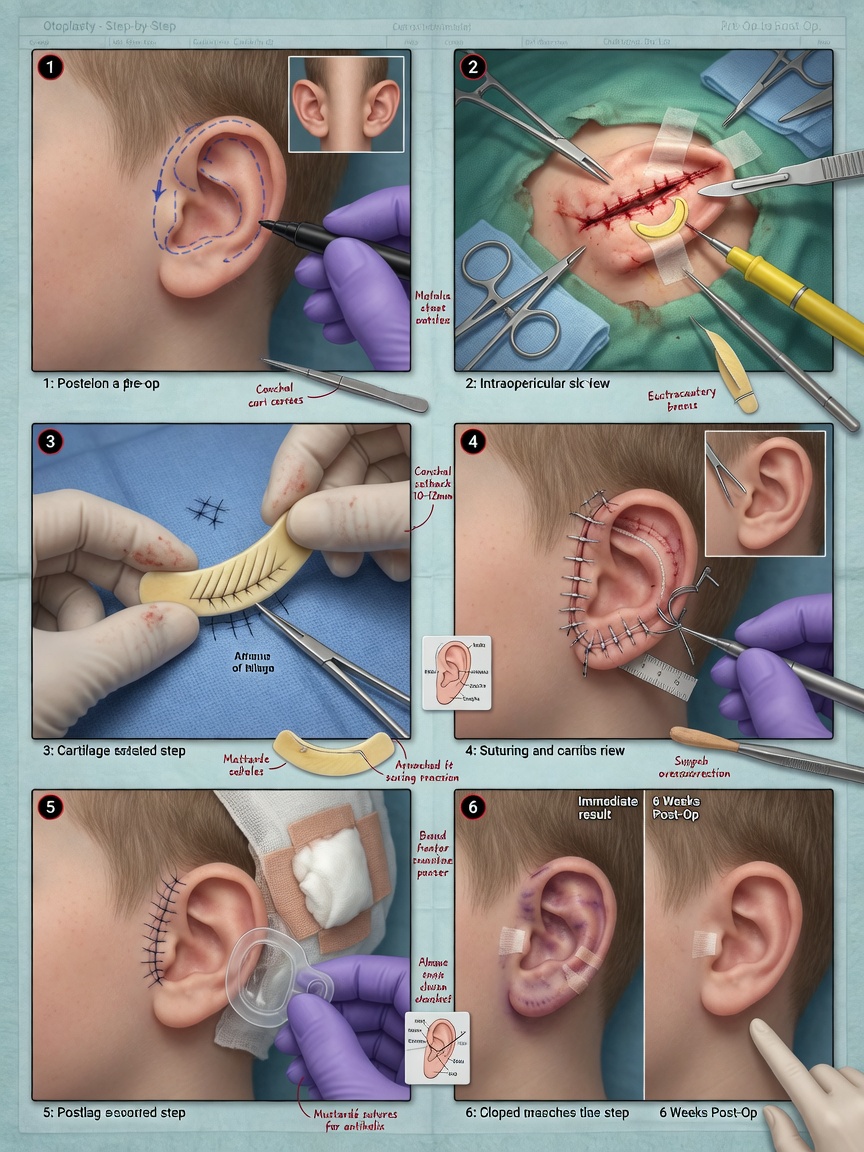
Caption: Mustarde sutures and conchal bowl reshaping — the two primary techniques in otoplasty — performed through a hidden incision behind the ear
Anesthesia Options and Surgery Duration
Local anesthesia with sedation is common for otoplasty — the patient remains awake but relaxed, no breathing tube required. General anesthesia is also available and often preferred for anxious patients or children. In Thailand, many otoplasty packages include general anesthesia due to patient preference, but you can request local with sedation if you prefer.
Total time at the hospital runs 4-6 hours including pre-op preparation, the surgery itself, and recovery room monitoring. Most patients go home the same day or stay one night for observation.
What to Expect at a Thai Hospital
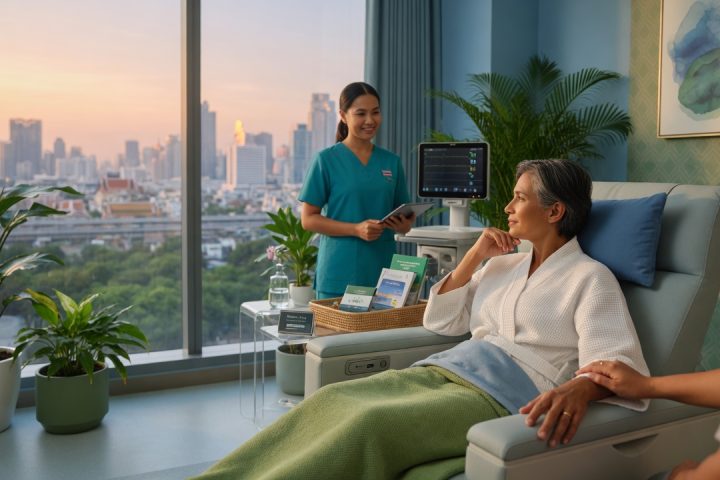
The medical tourism experience differs significantly from local surgery. Before arriving, you’ll have a video consultation with your surgeon, submit medical records online, and receive a personalized treatment plan. Upon arrival in Thailand, many hospitals offer airport pickup, VIP check-in, and assign an English-speaking patient coordinator.
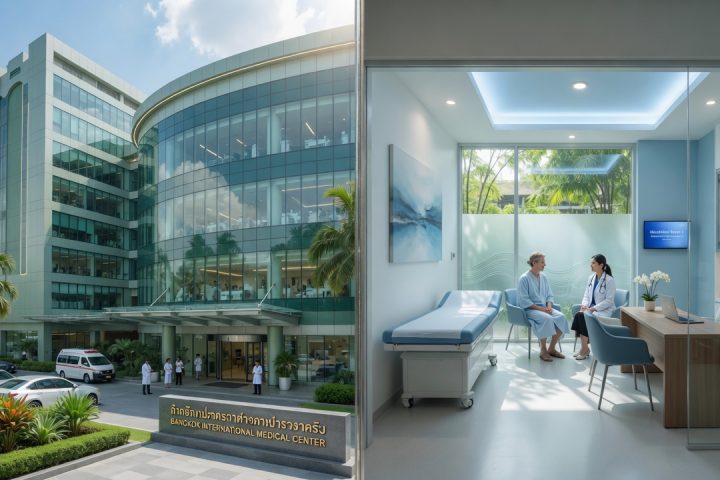
The hospital environment at JCI-accredited facilities matches Western standards — clean, modern, with private international patient rooms. Meal options accommodate dietary needs. After surgery, you’ll receive thorough discharge instructions, any prescribed medications, and a scheduled follow-up appointment before leaving the hospital.
Is Otoplasty Safe in Thailand?
Thailand’s top hospitals meet or exceed international safety standards — but safety depends entirely on choosing JCI-accredited hospitals and board-certified surgeons. Thailand has 60+ JCI-accredited hospitals, meeting the same international patient safety standards as leading US medical centers (Joint Commission International, 2025). According to WHO medical tourism guidelines (2025), verifying hospital accreditation and surgeon credentials is the single most important step for international patients.
The 70% Rule has a safety corollary: the savings apply to cost, not quality. JCI-accredited hospitals in Thailand follow the same infection control protocols, medication management standards, and patient safety cultures as accredited facilities in the United States. There is no 70% discount on safety — the same international standards apply.
JCI and International Hospital Accreditation
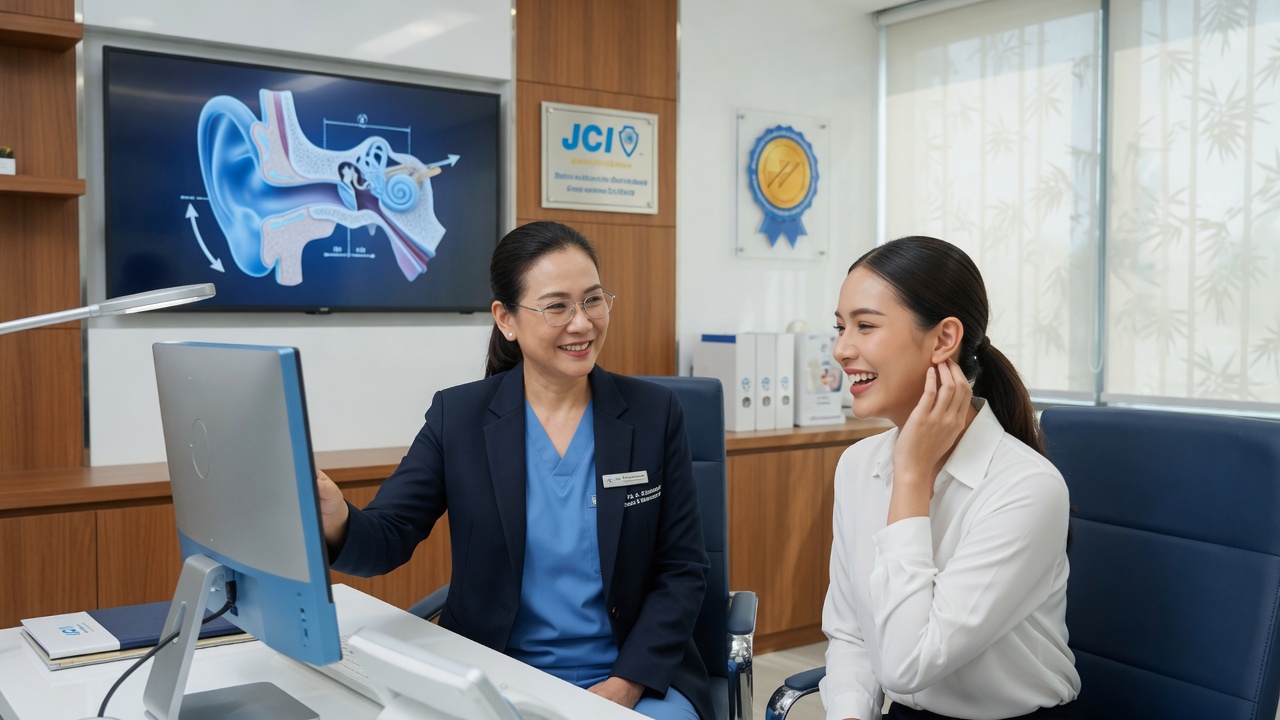
JCI (Joint Commission International) is the global gold standard for hospital accreditation — the same organization that accredits US hospitals. Thailand hosts over 60 JCI-accredited facilities, more than most Asian countries and among the highest density globally for medical tourism destinations.
JCI accreditation requires verified compliance with: international infection control protocols, proper medication management, qualified staff credentialing, patient safety culture, and emergency preparedness. You can verify any hospital’s accreditation status through the JCI accredited hospitals database (2025) — search by country (Thailand) or hospital name directly.
Beyond JCI, look for ISO certification, Thai Hospital Accreditation (HA), and specific plastic surgery department credentials. A hospital that proudly displays its accreditation and invites verification is signaling transparency.
Surgeon Qualifications and Credentials
The surgeon matters as much as the hospital. Look for Thai Board of Plastic Surgery certification — this is different from a general surgeon or ENT specialist who also performs otoplasty. Prefer surgeons who are members of the Society of Plastic and Reconstructive Surgeons of Thailand, and check for international fellowship training (many Thai plastic surgeons train in the US, UK, or Australia).
Red flags include: a surgeon who isn’t a board-certified plastic surgeon, reluctance to share before-and-after photos of otoplasty specifically, or unverifiable credentials. The Medical Council of Thailand website allows you to verify any surgeon’s license — ask for their full name and license number during consultation.
“During your video consultation, ask: ‘How many otoplasty procedures do you perform per year?’ and ‘What is your revision rate?'” A confident surgeon will answer transparently. Experienced otoplasty surgeons typically perform 50-100 cases annually.
Complication Rates and Risk Prevention
All surgery carries risk, but otoplasty complication rates are well-documented. According to a systematic review of otoplasty complications (PubMed, 2025), rates include: hematoma (1-3%), infection (1-2%), suture-related issues (2-5%), recurrence of protrusion (5-10%), and asymmetry (5-15%). Most complications are minor and manageable, though recurrence is the most common reason patients seek revision.
To reduce risk: choose an experienced, board-certified plastic surgeon at a JCI-accredited hospital, follow all pre-op and post-op instructions precisely, avoid smoking (nicotine significantly impairs healing), and disclose all medications and supplements during consultation. In Thailand, JCI-accredited hospitals maintain protocols that keep complication rates consistent with international benchmarks — the key is choosing the right facility.
Am I the Right Age for Otoplasty?
The minimum recommended age for otoplasty in children is 5-7 years, when ear cartilage is sufficiently developed and the child can cooperate with post-operative care (NICHD, 2025). For adults, there is no upper age limit — healthy candidates of any age can undergo ear pinning. The age considerations differ significantly between children and adults, and candidacy depends on overall health plus ear anatomy.
Otoplasty for Children and Teens
Children as young as 5-7 years old can undergo otoplasty. At this age, ear cartilage has developed sufficiently, and the child is old enough to cooperate with post-operative care — wearing a headband, keeping incisions clean, and avoiding activities that might disrupt healing. According to NICHD age guidelines for ear correction (2025), surgery before school age can reduce bullying risk and psychological distress from teasing.
Best timing for children is school holidays — summer or winter break provides the needed 1-2 weeks at home before returning to school. Note that the compression headband will be visible, so the child should be prepared for questions from friends. Thai hospitals require a parent or legal guardian for consent, and some require a parent to stay for the child’s entire recovery period.
Research shows significant psychological benefits: reduced anxiety, improved self-esteem, and decreased social avoidance after ear correction in children. But the decision must be the child’s as well as the parents’ — reluctance is a valid reason to wait.
Otoplasty for Adults
There is no upper age limit for otoplasty. Healthy adults of any age can be candidates, provided they have no contraindications like uncontrolled diabetes, bleeding disorders, or unrealistic expectations. Adult cartilage is more calcified and less flexible than children’s, which may require technique adjustments — an experienced surgeon adapts accordingly.
Adult motivations differ: lifelong self-consciousness about prominent ears, career confidence (especially in client-facing roles), or finally addressing something they’ve wanted to fix for decades. Recovery considerations include potentially longer healing for thicker cartilage, more time off work needed, and family responsibilities to plan around.
Age and Candidacy Considerations
Otoplasty is not suitable for everyone. Contraindications include: pregnancy or nursing, active infections near the ear, uncontrolled diabetes, bleeding disorders, and unrealistic expectations about what surgery can achieve. “Consult a board-certified plastic surgeon for a personalized assessment — online research is not a substitute for an in-person evaluation of your ear anatomy and medical history.”
Recovery Timeline After Ear Pinning
Otoplasty recovery typically requires 1-2 weeks before returning to work or school, with a compression headband worn for 2-4 weeks to protect the results (PubMed, 2025). Even recovery logistics follow The 70% Rule: you’ll save 60-70% on the overall procedure cost, but you need to budget the same recovery time regardless of where surgery occurs. Recovery is manageable with proper planning — especially important for international patients traveling home afterward.
Week-by-Week: What to Expect
- Week 1: Swelling and bruising peak at 48-72 hours after surgery. Mild to moderate pain is controlled with oral medication — most patients describe it as soreness, not sharp pain. The compression headband is worn 24/7. Sutures are removed at day 7-10. Avoid sleeping on your sides, bending over, or heavy lifting. Ice packs reduce swelling.
- Week 2: Swelling significantly reduces, bruising fades. You can return to office work or school — though the headband is still worn at night. No gym, swimming, or contact sports. Most patients feel well enough for light daily activities.
- Weeks 3-4: The headband is worn only at night. Most normal activities resume, including light exercise (with surgeon approval). The final result starts to become visible as swelling fully resolves.
- 1 month and beyond: Results continue to improve over 3-6 months. Scars behind the ears fade significantly over 6-12 months, becoming nearly invisible in the natural crease.
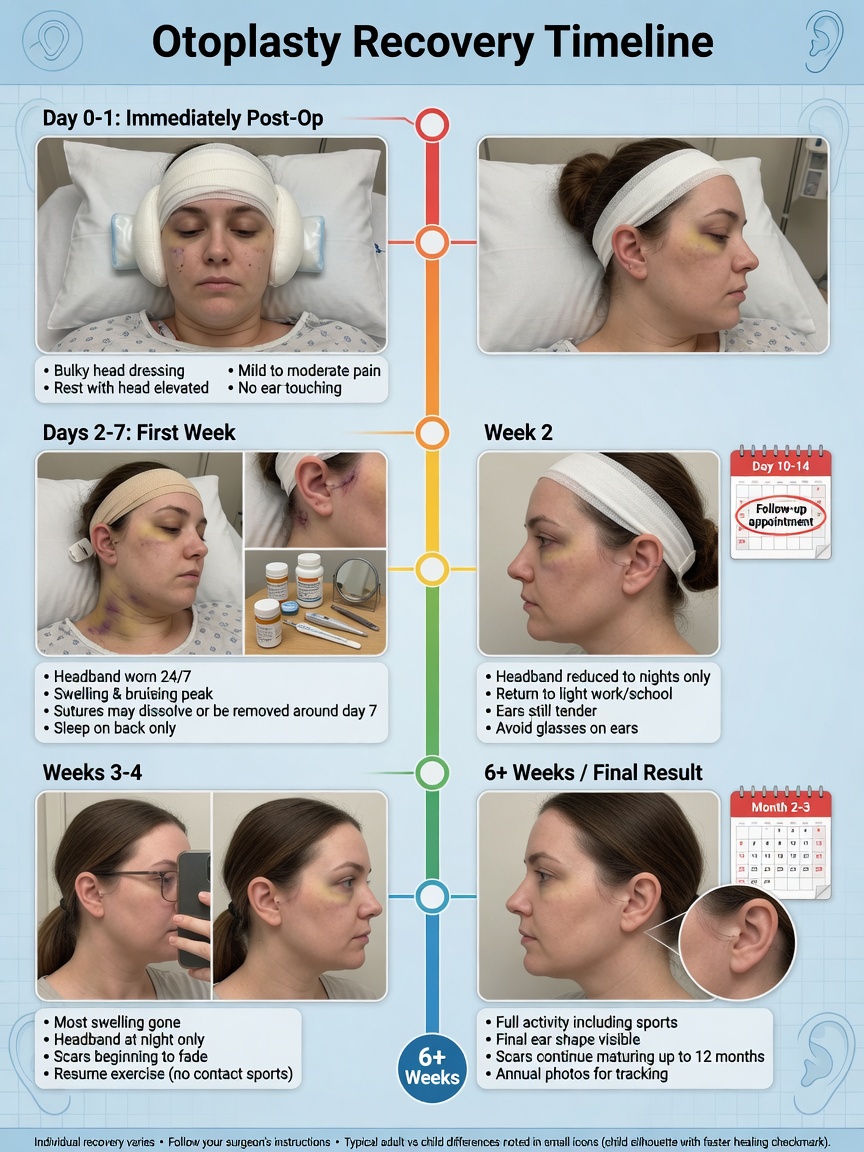
Caption: Otoplasty recovery progresses from headband use around the clock to nighttime-only wear by week three
Returning Home After Otoplasty in Thailand
Most surgeons recommend staying in Thailand for 7-10 days after surgery — this allows for suture removal and at least one follow-up appointment. Flying before 3-5 days post-op is not recommended due to bleeding risk and pressure changes. Plan your return flight for day 8-10 after your procedure.
Airport considerations: carry your pain medication prescriptions, use a neck pillow to avoid sleeping on your ears during the flight, and be prepared for the compression headband to show through security (it’s medical, not suspicious). Have your surgeon’s contact information for questions after returning home — Thai hospitals commonly offer video follow-up consultations for international patients.
Consider travel insurance that covers post-surgical complications, but verify that it specifically includes elective surgery. Many standard policies exclude planned medical procedures abroad.
Long-Term Results and Scarring
Otoplasty results are permanent. The ear cartilage and sutures hold the new position indefinitely — no ongoing maintenance is needed. Recurrence of protrusion happens in 5-10% of cases, usually within the first year after surgery. Most recurrence is minor; revision is optional and considered a touch-up rather than a new procedure.
Scarring: the incision sits behind the ear in the natural crease. When healed (12 months), it’s nearly invisible — visible only if someone specifically looks behind your ear. Scar maturity takes 6-12 months, during which the line fades from pink to white.
Top Hospitals in Thailand for Otoplasty
Thailand offers over 60 JCI-accredited hospitals with dedicated international patient centers and English-speaking plastic surgeons (Joint Commission International, 2025). Your choice of hospital and surgeon is the most important safety decision you’ll make. This guide doesn’t rank specific hospitals — credible medical sources don’t produce “top 10” lists for elective surgery — but it gives you the evaluation criteria to choose wisely.
How to Choose a Hospital in Thailand
Start with JCI accreditation — this is non-negotiable for international safety standards. Verify directly on the JCI website: search the hospital name and confirm active accreditation status.
Next, evaluate the international patient department. Does the hospital offer: pre-travel video consultations, English-speaking patient coordinators, airport pickup services, and dedicated international patient floors? Thailand’s top medical tourism hospitals have decades of experience hosting international patients — this infrastructure matters.
Consider the plastic surgery specialization. Does the hospital have a dedicated plastic surgery department (not just a general surgery department that covers otoplasty)? Ask how many otoplasty cases they perform annually. According to CDC medical tourism safety guidelines (2025), choosing a facility that regularly performs your specific procedure reduces complication risk.
Location matters for your recovery: Bangkok offers the most options and best medical infrastructure but is busy. Phuket provides a beachside recovery environment. Chiang Mai is quieter with lower accommodation costs. Consider proximity to your accommodation and the airport for your return flight.
Finally, read patient reviews on independent platforms — not just the hospital’s website testimonials. Look for otoplasty-specific feedback, not generic plastic surgery reviews.
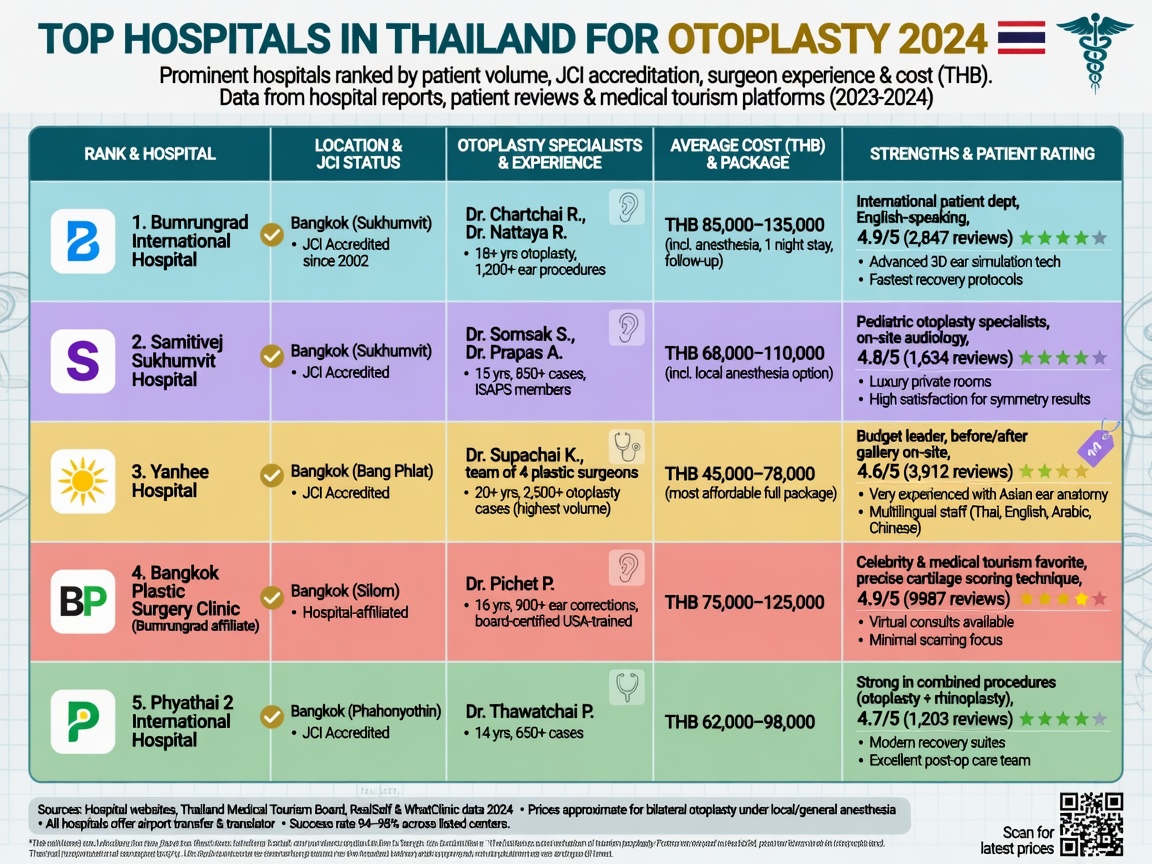
Caption: Compare JCI-accredited Thai hospitals by location, specialization, and international patient services
What to Look for in a Thai Plastic Surgeon
Your surgeon’s credentials matter more than the hospital’s brand name. Confirm that the surgeon is board-certified by the Thai Board of Plastic Surgery — this is different from a general surgeon or ENT specialist who also performs ear procedures. Look for international fellowship training; surgeons who trained in the US, UK, or Australia typically bring Western techniques and patient communication approaches.
During your video consultation, request ear-specific before-and-after photos — not generic plastic surgery results. A surgeon who performs many otoplasty cases will have a portfolio of ear results. Look for natural-looking corrections where ears look proportional and symmetrical, not “pinned flat.”
Red flags to watch for: the surgeon who pushes surgery without thorough discussion, can’t clearly explain their technique choice (Mustarde vs. Furnas vs. combination), provides unverifiable credentials, or seems rushed during the consultation. “Ask directly: ‘How many otoplasty procedures do you perform annually?’ and ‘What is your revision rate?’ — a confident, experienced surgeon will answer transparently.”
Thailand vs. Other Countries for Otoplasty
Thailand offers the most competitive otoplasty pricing among major medical tourism destinations when accounting for surgery, travel, and accommodation costs (Statista, 2025). When you combine procedure price with travel expenses and in-country accommodation, Thailand consistently delivers the best overall value. But value means nothing without quality — and quality is where Thailand’s 60+ JCI-accredited hospitals provide peace of mind.
Cost Comparison by Country
| Country | Cost Range (USD) | JCI Hospitals | Key Consideration |
|---|---|---|---|
| Thailand | $1,600 – $2,500 | 60+ | Best value + highest JCI density |
| South Korea | $2,500 – $4,000 | ~30 | Strong cosmetic reputation, higher cost |
| Mexico | $2,000 – $3,500 | ~10 | Close to US, variable quality standards |
| Turkey | $1,800 – $3,000 | ~20 | Lower cost, less plastic surgery focus |
| India | $1,500 – $2,500 | ~40 | Comparable cost, fewer JCI plastic surgery depts |
| United States | $5,000 – $8,000 | Widely available | Highest cost, no travel needed, easy follow-up |
When you add flights ($500-$1,500), accommodation for 10-14 days ($300-$2,100), meals, and incidentals, Thailand’s total package still lands 50-60% below Western prices. South Korea may lead in rhinoplasty, but for otoplasty specifically, Thailand’s combination of price, JCI accreditation density, and medical tourism infrastructure is unmatched.
Quality of Care Comparison
Thailand leads Asia in JCI-accredited hospitals with over 60 facilities — this is the strongest available proxy for quality. Many Thai plastic surgeons train or fellowship abroad, bringing Western surgical standards and communication approaches. English proficiency in medical settings is high, particularly at hospitals that cater to international patients.
Thailand’s medical tourism infrastructure is decades established — dedicated international departments, English-speaking coordinators, post-arrival support systems, and recovery-friendly environments are well-developed. This matters because medical tourism isn’t just about the surgery — it’s about the entire experience from airport arrival to departure.
No destination is risk-free. The quality of your specific surgeon and hospital matters far more than the country’s reputation. Due diligence — verifying credentials, reading independent reviews, asking the right questions — is always required, regardless of destination.
Risks, Limitations & When to Choose Alternatives
Honest risk assessment builds trust. The 70% Rule applies to cost savings, not quality — there is no 70% discount on safety. The same international standards apply at JCI-accredited hospitals, but traveling abroad for surgery introduces unique considerations.
Risks of Otoplasty in Thailand
Limited follow-up care after returning home: If a complication arises weeks after surgery, your Thai surgeon can’t see you in person. Most offer video consultations, but physical examination isn’t possible remotely. Ask your local doctor before traveling if they’d be willing to help with post-op follow-up if needed.
Communication gaps: Despite English-speaking staff, medical instructions can lose nuance in translation. Request written post-op instructions in English and confirm your understanding during the discharge process. Write down questions as they occur.
Legal recourse complexity: If something goes wrong, pursuing legal action in Thailand is complex and expensive for international patients. Medical malpractice laws differ significantly from Western countries. This reality underscores the importance of prevention — choosing the right surgeon and hospital from the start.
Travel health risks: Long flights increase DVT risk (wear compression socks, stay hydrated, move regularly). Airport and food exposures can cause illness, so build in buffer days before surgery.
When to Choose Alternatives
Consider staying local for otoplasty if: you have a complex medical history, you’re uncomfortable with the travel logistics, or the cost savings don’t outweigh your peace of mind. Some patients choose South Korea for its renowned plastic surgery culture, Mexico for proximity to the US, or India for comparable pricing. The right choice depends on your priorities — cost, convenience, comfort, or a specific surgeon’s reputation.
When to Seek Expert Help
If you have underlying health conditions (diabetes, bleeding disorders, cardiac issues), consult your primary care physician before making any travel arrangements. Your local doctor can assess whether surgery abroad is appropriate and help coordinate care after you return. For children, involve your pediatrician in the decision — they can provide an independent perspective on timing and readiness.
Frequently Asked Questions
Is otoplasty in Thailand safe for children?
Otoplasty in Thailand is safe for children aged 5-7 and older when performed at JCI-accredited hospitals by board-certified plastic surgeons. The minimum age ensures cartilage development and the child’s ability to cooperate with post-operative care. Thailand’s 60+ JCI-accredited hospitals follow the same pediatric safety protocols as Western facilities. Parental consent and presence are required throughout the recovery period.
How long do I need to stay in Thailand after otoplasty?
Most surgeons recommend staying in Thailand for 7-10 days after surgery. This timeframe allows for suture removal at day 7-10, at least one follow-up appointment, and initial healing before flying home. Flying earlier than 3-5 days post-op increases bleeding risk due to pressure changes. Plan your total trip length at 14-21 days including pre-op consultation and recovery buffer.
Does Thai health insurance cover otoplasty for international patients?
Thai health insurance generally does not cover elective cosmetic surgery for international visitors. Most patients pay out-of-pocket for otoplasty packages. Some travel insurance policies offer limited coverage for post-surgical complications, but you must verify they cover elective procedures before booking. The all-inclusive package price typically covers the surgery itself, hospital stay, anesthesia, and follow-up.
What is the difference between Mustarde sutures and Furnas technique?
Mustarde sutures create the natural antihelical fold using permanent stitches through the cartilage. This technique addresses a missing or underdeveloped fold — the most common cause of protruding ears. Furnas technique sutures the conchal bowl to the mastoid bone behind the ear, addressing protrusion caused by a deep conchal bowl. Many surgeons combine both for optimal results. Your surgeon’s technique choice depends on your ear anatomy.
Can I fly immediately after ear pinning surgery?
Flying within 3-5 days after otoplasty is not recommended due to increased bleeding risk and cabin pressure changes. Wait at least 7-10 days and discuss timing with your surgeon. During the flight, use a neck pillow to avoid sleeping on your ears, stay hydrated, and move periodically to prevent DVT. Carry your pain medication prescriptions and post-op instructions in your carry-on.
What happens if I need a revision after returning home?
Revision rates for otoplasty range from 5-10%, typically within the first year. Most Thai hospitals offer video follow-up consultations for international patients. If revision is needed, you may need to return to Thailand or find a local plastic surgeon willing to perform a revision (some Western surgeons are reluctant to revise another surgeon’s work). Ask about revision policies before booking — some packages include it, most don’t.
Conclusion
For patients considering ear correction, otoplasty in Thailand delivers the same surgical standards as Western countries at 60-70% lower cost — making the procedure accessible to thousands who would otherwise forgo it. The combination of JCI-accredited hospitals, board-certified plastic surgeons, and established medical tourism infrastructure makes Thailand a leading destination, provided you do your due diligence. The 70% Rule — saving two-thirds on cost while maintaining quality — works when you verify accreditation, credentials, and read independent patient reviews before booking.
The key to a successful outcome lies in preparation, not just pricing. Start with hospital verification on the JCI database. Request video consultations with multiple surgeons. Ask about their otoplasty volume, revision rates, and specific technique approach. Plan your recovery timeline including 7-10 days in Thailand and a comfortable environment for healing. The right choice is the one where cost savings and safety standards align — and for thousands of patients annually, that’s Thailand.
Always verify surgeon credentials and hospital accreditations before booking. Your safety depends on research, not reputation.
`