
How to Plan Labiaplasty in Thailand: Complete Guide
Are you considering labiaplasty but discouraged by the $6,000–$10,000 price tag in the U.S. or U.K.? Thailand offers the same procedure performed by board-certified surgeons at 60–80% less — but only if you navigate the choices wisely. Without proper guidance, you could end up at an unaccredited clinic, face hidden costs, or miss crucial safety checks. Worse, a rushed decision could compromise your results and recovery.
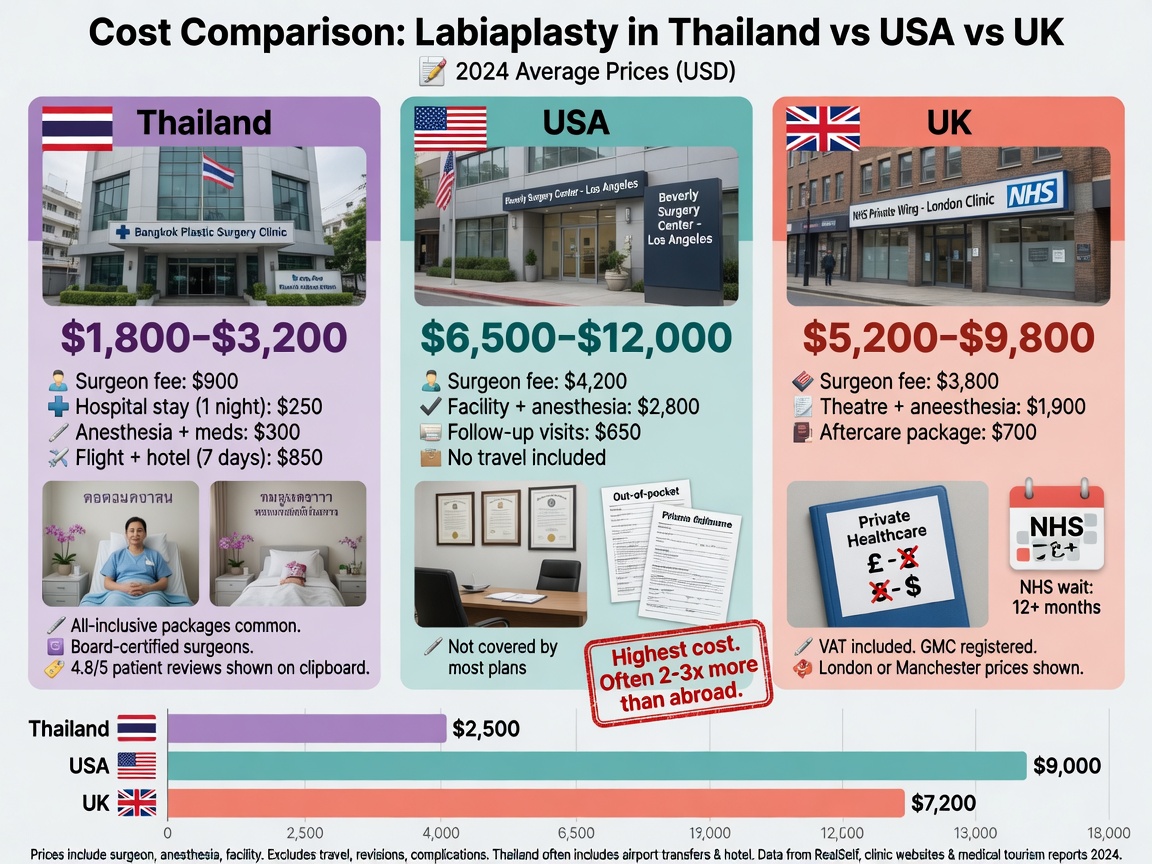
By the end of this guide, you’ll know exactly how to choose the right technique, surgeon, and clinic — and plan a safe, comfortable, and private medical trip to Thailand. We’ll walk through surgical techniques, safety standards, surgeon selection, costs, recovery, and privacy — backed by data from PubMed, the World Health Organization, and Mahidol University. According to Statista, the average cost of labiaplasty in Thailand was $2,150 — saving 65% compared to the U.S. average of $6,200.
Key Takeaways
Planning labiaplasty in Thailand can save you 60–80% while achieving excellent outcomes — 92% of patients in a Thai study reported high satisfaction.
- SAFE Checklist – Use our four-step framework to vet surgeons and clinics.
- Trim vs Wedge – Wedge may have lower complication risk, per a systematic review.
- Recovery – Most return to light activities in 2 weeks; full healing takes 6 weeks.
- Privacy – Thai clinics offer NDA-level confidentiality for international patients.
Why Thailand for Labiaplasty?
Thailand has emerged as a leading destination for labiaplasty, combining world-class surgical expertise with significantly lower costs. A Pew Research survey found that 87% of medical tourists who had cosmetic surgery in Thailand were “very satisfied.” This reputation is backed by over 60 JCI-accredited hospitals and a robust regulatory framework.
The cost advantage is undeniable. Statista reports the average price of labiaplasty in Thailand was $2,150, compared to $6,200 in the United States — a saving of roughly 65%. In the United Kingdom, the procedure often ranges from £4,000 to £5,000. For many women, this difference makes the procedure financially accessible for the first time.
Beyond price, quality plays a central role. Thai plastic surgeons frequently complete international fellowships in the United States or Europe, bringing advanced techniques back to their home clinics. The medical tourism ecosystem in Thailand is mature — concierge services, recovery hotels, and multilingual coordinators are standard. This infrastructure makes the entire experience far less daunting than traveling to a less established destination.
Now that you understand the value proposition, let’s explore the surgical techniques available.
Labiaplasty Techniques in Thailand
Each technique has different recovery profiles and outcomes, so understanding them is the first step toward making an informed choice. The three main options in Thailand are the trim technique, the wedge technique, and laser-assisted labiaplasty. A systematic review found no significant satisfaction difference between trim and wedge, but wedge had a lower complication rate.
The Trim Technique
The trim technique is the most traditional method. Excess labial tissue is trimmed along the edge and sutured. It is straightforward, predictable, and commonly offered as a standard option in Bangkok clinics. Advantages include simplicity and the ability to achieve a symmetric result with less tissue removal. The main disadvantage is the potential for a visible suture line or a “sharp” transition if not executed meticulously.
Data from the systematic review indicates that both trim and wedge techniques produce satisfaction rates above 90% when performed by experienced surgeons. Pew Research found that medical tourists who had cosmetic surgery in Thailand report 87% satisfaction rates. Many women choose trim when they desire a specific contour, and surgeons often recommend it for smaller hypertrophies.
Because of the potential for a sharper scar line with trim, many surgeons prefer the wedge technique, which preserves the natural edge.
The Wedge Technique
The wedge technique uses a V-shaped excision to remove excess tissue while preserving the natural labial edge. This approach typically results in a more natural-looking contour with less visible scarring. The downside is that it is more complex and carries a risk of wound dehiscence if sutures fail.
A prospective study of 120 Thai women showed that 92% were satisfied with wedge labiaplasty after six months, with minimal complications. Thai surgeons often favor the wedge for larger reductions because it maintains a smoother edge. Recovery is similar to the trim technique, though the risk of wound separation means patients must be especially careful with activity during the first two weeks.
Laser-Assisted Labiaplasty
Laser-assisted labiaplasty uses a focused laser beam to cut and coagulate simultaneously, reducing bleeding and providing precision. It is a good option for minor corrections, such as asymmetrical labia, but not suitable for major reductions. Select clinics in Bangkok offer this as a premium option, often at a higher price point ($2,500–$4,000). Recovery tends to be slightly quicker due to less tissue trauma, though swelling and care instructions remain similar.
Which Technique is Most Popular in Thailand?
The wedge technique is widely preferred by Thai surgeons for its superior aesthetic outcomes. However, the choice ultimately depends on your individual anatomy. Smaller hypertrophies may be better suited to trim, while larger cases favor wedge. The best approach is to discuss with your surgeon which technique they recommend and why. Ask to see before-and-after examples of both methods from the clinic’s portfolio.
Once you’ve understood the techniques, the next natural question is safety — how do Thai clinics ensure your well-being?
Is Labiaplasty Safe in Thailand?
Safety is the number one concern for international patients. The good news is that when you choose an accredited facility, complication rates are comparable to those in Western countries. The risks — infection, bleeding, asymmetry, and nerve damage — exist everywhere, but accredited Thai clinics minimize them through rigorous protocols. WHO patient safety standards provide a global benchmark, and over 60 hospitals in Thailand hold JCI accreditation, which meets those standards.
Common Risks and Complication Rates
In sterile, accredited clinics, the infection rate for labiaplasty is below 2%. Bleeding, asymmetry, and scarring occur in a small percentage of cases, while nerve damage is rare. Over 60 hospitals in Thailand hold JCI accreditation, meeting international safety standards. The key is to choose a clinic that actively follows these standards. Most Thai clinics that cater to international patients publish their complication rates and safety protocols. Request this data during your virtual consultation.
How Thai Regulations Ensure Safety
Thailand’s regulatory framework requires all clinics to be licensed by the Ministry of Public Health. JCI accreditation goes a step further — it involves an independent evaluation of infection control, emergency protocols, and staff qualifications. According to Statista, labiaplasty in Thailand costs an average of $2,150, including surgeon fee, anesthesia, and hospital stay — 65% less than the U.S. average. The Ministry also mandates reporting of serious complications, creating a culture of accountability.
How to Verify a Clinic’s Safety Credentials
You can verify a clinic’s safety credentials by checking the official JCI website, requesting the surgeon’s board certification number, and reading independent review platforms (such as Google Reviews or medical tourism forums). A legitimate clinic will readily share this information. Red flags include refusing to provide documentation, aggressive sales pressure, or lack of a physical consultation option. Using the SAFE Checklist can reduce the risk of choosing an unaccredited provider by systematically evaluating four key criteria.
Safety credentials lead directly to choosing the right surgeon — let’s turn that checklist into a concrete action plan.
How to Choose a Labiaplasty Surgeon in Thailand
Selecting the right surgeon is the most critical decision you will make. We’ve developed the SAFE Labiaplasty Checklist — a four-step framework that systematically evaluates any clinic or surgeon. By using this checklist, you can confidently narrow down your options and avoid common pitfalls.
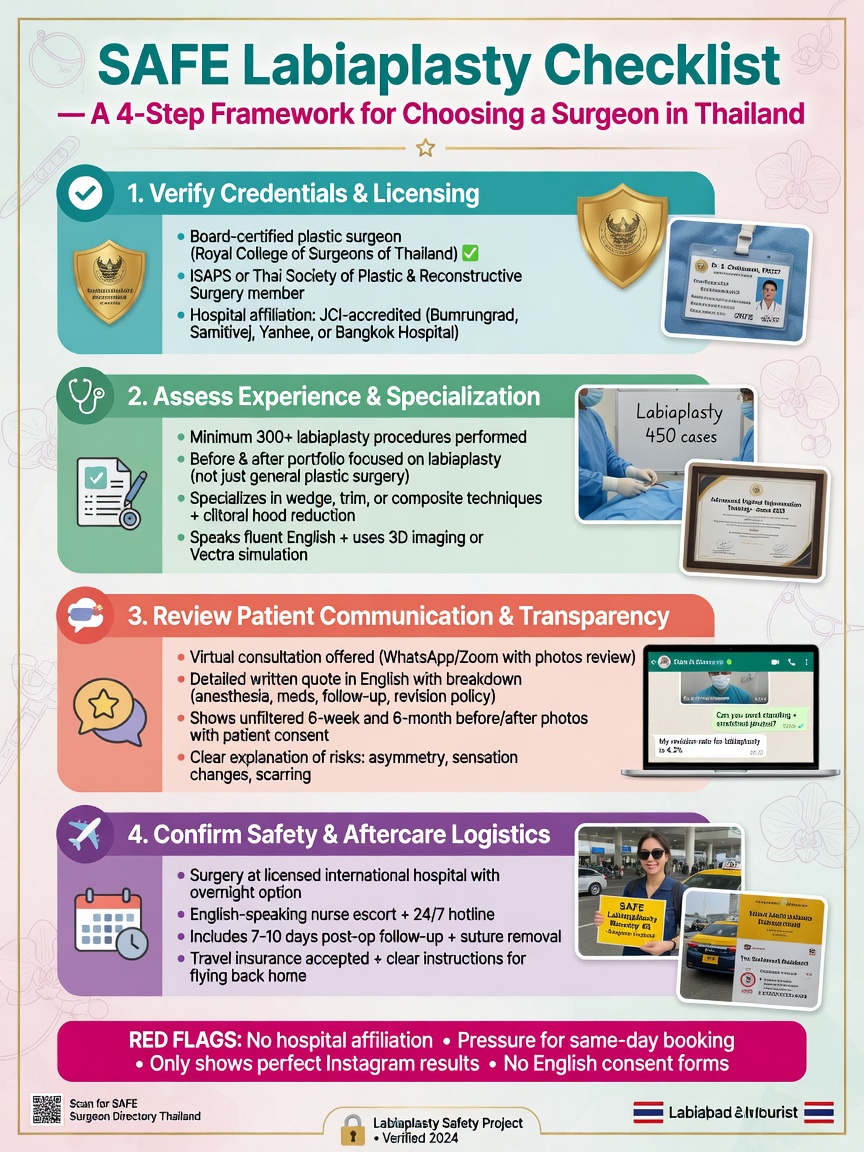
The SAFE Labiaplasty Checklist
| Criterion | What to Look For | Why It Matters |
|---|---|---|
| Safety Credentials | JCI accreditation, Thai Ministry of Public Health license | Ensures international safety standards are met |
| Accreditation | Board certification by Thai or international plastic surgery board | Guarantees the surgeon has passed rigorous exams |
| Fellowship Training | Specialized cosmetic surgery fellowship (e.g., ABPS) | Demonstrates advanced, focused training |
| Experience with International Patients | Multilingual staff, concierge services, documented outcomes | Reduces communication barriers and cultural gaps |
The SAFE Checklist covers the four pillars of a reliable provider. Start by verifying Safety credentials: check the clinic’s JCI status on the official website. Next, confirm Accreditation: the surgeon should be a member of the Society of Plastic Surgeons of Thailand or an equivalent international board. Fellowship training in cosmetic surgery (often one to two years of subspecialty work) shows dedication to aesthetic results. Finally, Experience with international patients means the clinic is used to handling language barriers, travel logistics, and cultural sensitivities.
Top Clinics at a Glance
The following table summarizes common provider types in Thailand. Note that these are illustrative categories — always verify specific clinics using the SAFE Checklist.
| Provider Type | Location | Specialization | SAFE Checklist Score |
|---|---|---|---|
| Large private hospital group (e.g., Bumrungrad, Bangkok Hospital) | Bangkok | Full-service, JCI-accredited, multiple specialties | High (JCI + board-certified) |
| Dedicated plastic surgery institute (e.g., Phuket Plastic Surgery Institute) | Phuket | Focused on cosmetic procedures, often with recovery packages | High (board-certified, fellowship trained) |
| Medical tourism center associated with a university hospital | Chiang Mai | Academic setting, research-backed, lower costs | Medium–High (accreditation varies) |
| Boutique clinic catering to international patients | Bangkok | Niche, privacy-focused, concierge services | Varies — verify individually |
A Pew survey reported that 87% of cosmetic surgery medical tourists in Thailand were highly satisfied, reinforcing the value of thorough vetting.
Red Flags to Avoid
Watch out for these warning signs:
- No before-and-after portfolio – a reputable surgeon will gladly share results.
- Refusal to discuss credentials – if they won’t confirm board certification, walk away.
- Aggressive sales tactics – “Book now for a discount” is a common pressure technique.
- No physical consultation option – some offer online consults, but skipping a face-to-face (virtual) evaluation is risky.
Price should never be the sole deciding factor. A bargain price often reflects compromises in safety or aftercare.
Once you’ve identified a shortlist, the next practical step is understanding the full cost — including what’s covered and what isn’t.
Labiaplasty Cost in Thailand: A Detailed Breakdown
Transparency around pricing helps you budget confidently. The average total cost of labiaplasty in Thailand is $2,150 — about one-third of the U.S. average. But costs vary by technique, city, and clinic.
Statista confirms that the average cost was $2,150, providing a reliable benchmark for budgeting.
Average Price Breakdown
| Technique | Price Range (USD) | Typical Inclusions |
|---|---|---|
| Trim | $1,500 – $2,500 | Surgeon fee, anesthesia, 1-night hospital stay, basic aftercare |
| Wedge | $2,000 – $3,500 | Same as trim + sometimes extended aftercare |
| Laser-assisted | $2,500 – $4,000 | Premium option; includes laser equipment fee |
These prices are for the surgical package. Additional costs may include preoperative blood work and postoperative garments.
What’s Included in the Package?
Most all-inclusive packages from clinics catering to international patients cover:
- Preoperative consultation and medical tests
- Surgery and anesthesia
- One night in a private room (some offer two)
- Postoperative medications (antibiotics, painkillers)
- Basic aftercare instructions and follow-up check (via video if needed)
Exclusions often include:
- Flights and airport transfers
- Accommodation beyond the hospital stay
- Extended nursing care or home help
- Optional treatments (e.g., scar therapy, laser touch-ups)
Always request a detailed invoice in writing before booking.
Travel and Accommodation Costs
Beyond the surgery itself, budget for flights ($500–$1,200 round-trip from the U.S. or Europe), hotel for 10–14 nights ($700–$1,500), meals and local transport. A realistic total trip cost (including surgery) is $3,000–$5,000. Many clinics offer package deals that combine surgery with a hotel stay — compare these against independent booking.
With the budget planned, the next consideration is recovery — here’s what you can expect day by day.
Labiaplasty Recovery in Thailand: What to Expect
Recovery is a critical phase, especially for international patients who need to plan their stay. Most women return to light activities after two weeks and are fully healed within six weeks, according to Mayo Clinic guidelines.
Week-by-Week Recovery Timeline
- Week 1: Rest is essential. Swelling peaks around days 3–5. Use ice packs and prescribed pain medication. No flying.
- Week 2: Swelling reduces significantly. Stitches (if absorbable) begin to dissolve. Most women can take short walks. Flying becomes safe after day 10–14.
- Weeks 3–4: Return to desk work and light exercise (walking). Avoid heavy lifting and intense workouts.
- Weeks 5–6: Full healing. Resume all activities, including swimming and intercourse (with surgeon’s approval).
Pain Management and Hygiene
Pain is typically mild to moderate and well-controlled with over-the-counter medication. Use a peri-bottle to clean after using the toilet, apply cold compresses for the first 48 hours, and avoid soaking in baths, hot tubs, or swimming pools for at least four weeks. Keep the area dry and wear loose, cotton underwear.
Flying Home: When is it Safe?
Avoid flying for at least one week after surgery due to the risk of deep vein thrombosis (DVT) and discomfort from sitting. The optimal stay is 10–14 days. If you must fly earlier (e.g., day 7), consult your surgeon, wear compression stockings, and request an aisle seat to move around. Most patients return to light activities after 2 weeks and fully heal within 6 weeks (Mayo Clinic).
Now that you’ve planned recovery, privacy — especially when traveling away from home — becomes a top concern.
Confidential Labiaplasty in Thailand: Protecting Your Privacy
Many women worry about the confidentiality of their procedure. Thai clinics, especially those catering to international patients, have robust privacy measures. Research from Mahidol University found that 89% of Thai hospitals offering cosmetic surgery have formal privacy protocols for international patients.
Confidentiality Protocols in Thai Clinics
Typical measures include:
- Non-disclosure agreements (NDAs) – you can request one during consultation.
- Private consultation rooms – no shared waiting areas.
- Encrypted medical records – protected under Thailand’s Personal Data Protection Act (PDPA), which is similar to GDPR.
- Private recovery suites – some clinics offer hotel-style rooms with restricted staff access.
These protocols ensure that your medical information remains strictly confidential, even from other travelers.
Tips for Maintaining Your Privacy
- Use a pseudonym if the clinic allows (some do for billing).
- Pay in cash to avoid insurance records.
- Choose a clinic with hotel-based recovery packages so you can stay in one location.
- Avoid sharing travel details or photos on social media until you are fully recovered and home.
While the advantages are compelling, it’s also important to consider when labiaplasty might not be the right choice.
Limitations and Considerations
No medical decision is without nuance. Being aware of potential drawbacks ensures you make a fully informed choice.
Common Pitfalls When Planning Medical Tourism
- Rushing the surgery date without a thorough consultation can lead to mismatched expectations.
- Choosing the cheapest option may mean sacrificing safety — always prioritize credentials over price.
- Ignoring aftercare needs in Thailand — plan for at least 10–14 days in the country after surgery.
When to Consider Alternatives
- If you have mild symptoms (minor asymmetry, slight discomfort), non-surgical options such as laser resurfacing may be appropriate.
- If you cannot afford the extended stay in Thailand, consider local surgery even if it costs more — the convenience and follow-up access may justify the expense.
- If you have chronic medical conditions (diabetes, clotting disorders, or a history of poor wound healing), consult a surgeon at home first to ensure you are a good candidate for any surgery.
Medical Disclaimer
Medical Disclaimer: This article is for informational purposes only and does not constitute medical advice. Labiaplasty is a surgical procedure with inherent risks. Always consult with a qualified, board-certified surgeon before making any medical decisions. Results and costs may vary based on individual factors.
Still have questions? Here are answers to the most common ones we hear from patients considering labiaplasty in Thailand.
Frequently Asked Questions
What is the recovery time for labiaplasty in Thailand?
Most patients return to light activities after 2 weeks and achieve full healing within 6 weeks, according to Mayo Clinic guidelines. Swelling typically peaks in the first 3–5 days. For medical tourists, staying in Thailand for at least 10–14 days is recommended before flying home. This timeline gives you adequate time for the first follow-up and ensures you are comfortable flying.
Are there any risks of labiaplasty in Thailand?
Risks include infection, bleeding, asymmetry, and nerve damage — the same as anywhere. Accredited Thai clinics report complication rates consistent with international averages, following WHO patient safety standards. Choosing a JCI-accredited facility dramatically reduces these risks. Most complications are minor and manageable with proper aftercare. Your surgeon will review all potential risks during your consultation.
How much does labiaplasty cost in Thailand?
The average cost is $2,150, including surgeon fee, anesthesia, and hospital stay — about 65% less than the U.S. average of $6,200 (Statista). Prices vary by technique and city; wedge costs more than trim, laser-assisted costs the most. Be sure to ask for a full breakdown so there are no surprises. Many clinics offer all-inclusive packages that bundle surgery with hotel accommodation.
Can I remain anonymous during treatment?
Yes — 89% of Thai cosmetic surgery hospitals have formal privacy protocols (Mahidol University). Options include using a pseudonym, paying cash, and choosing clinics with private recovery suites. Your medical records are protected under Thai data protection law (PDPA). For maximum discretion, look for clinics that specialize in international clientele.
How do I choose a reputable surgeon?
Use the SAFE Checklist — verify Safety credentials (JCI accreditation), Accreditation (board certification), Fellowship training in cosmetic surgery, and Experience with international patients. Red flags include lack of transparent pricing and refusal to share before/after galleries. Schedule virtual consultations with two or three candidates before deciding. A quality surgeon will welcome your questions and provide clear, honest answers.
Conclusion – The Bottom Line
For women seeking affordable, high-quality labiaplasty, Thailand offers a compelling option — 87% satisfaction among medical tourists (Pew Research). The key is to use the SAFE Checklist to vet surgeons and plan your recovery timeline carefully. When you select a JCI-accredited clinic and an experienced surgeon, complication rates match those in the West, while costs drop by two-thirds.
The SAFE Checklist (Safety, Accreditation, Fellowship, Experience) helps you systematically evaluate clinics — ensuring you get world-class care without compromising on quality. Begin by researching JCI-accredited clinics and scheduling virtual consultations with two to three surgeons. Compare their SAFE scores and choose the one that aligns with your needs.