From Mini to Deep Plane: Your Complete Guide to Facelift Types, Costs, and Recovery in Thailand
Are you considering a facelift in Thailand but feel overwhelmed by the different techniques? You’re not alone. The three main options – Mini Facelift, Deep Plane Facelift, and Neck Lift – each target different signs of aging, and choosing the wrong one can lead to disappointing results. Meanwhile, the cost advantage (60–70% less than the US) is tempting, but safety concerns and recovery logistics can make the decision stressful. A wrong choice costs not just money but also time and emotional well‑being.
By the end of this guide, you’ll understand exactly how each procedure works, how much it costs, what recovery looks like, and how to choose the safest option for your goals – so you can book your consultation with confidence. We’ll first introduce “The Facelift Triad” decision framework, then dive into each procedure, compare costs and safety, and finish with a practical recovery timeline.
Key Takeaways
A facelift in Thailand can achieve natural‑looking results at 60–70% lower cost than the US when you choose the right procedure for your aging pattern – Mini for early signs, Deep Plane for comprehensive midface lift, Neck Lift for sagging neck.
- Mini Facelift – faster recovery (7–10 days social return) but limited to lower face.
- Deep Plane Facelift – most natural, longest‑lasting (5+ years) with 92% patient satisfaction.
- Neck Lift – essential if your primary concern is “turkey wattle” or neck sagging.
- Safety – 62 JCI‑accredited hospitals in Thailand ensure international standards.
Why Understanding Your Facelift Options in Thailand Matters
What Is a Facelift? Defining the Procedure
A facelift (rhytidectomy) is a surgical procedure that tightens the underlying muscles – known as the SMAS (superficial musculoaponeurotic system) – and removes sagging skin to create a more youthful contour of the lower two‑thirds of the face and neck. Unlike non‑surgical treatments such as dermal fillers or thread lifts, which address mild volume loss and superficial laxity, a facelift is designed for moderate to severe skin and tissue sagging that fillers cannot correct. The three primary surgical techniques – Mini Facelift, Deep Plane Facelift, and Neck Lift – each address different anatomical areas and aging patterns. A 2023 systematic review of deep plane facelift outcomes reported 92% patient satisfaction, underscoring how matching the technique to the patient’s anatomy is critical for success.
Now that you understand the basics, let’s introduce a simple framework to help you choose.
The Facelift Triad – A Framework for Your Decision
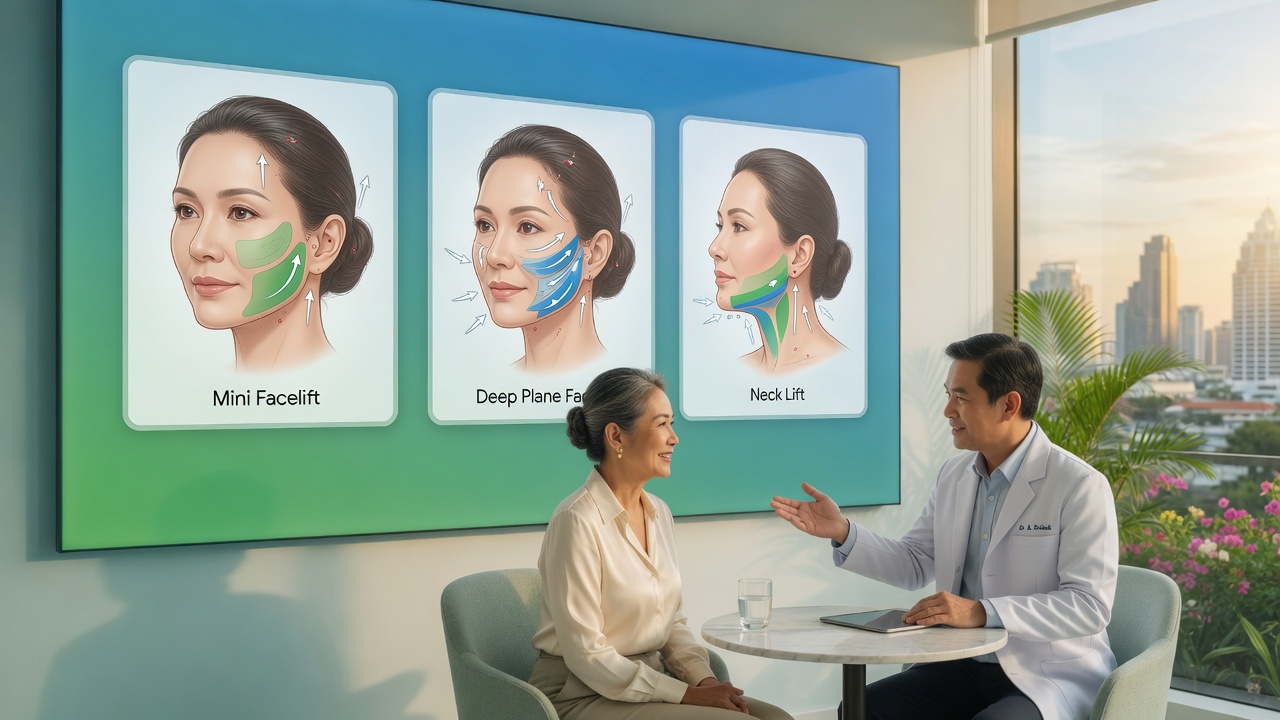
To simplify your decision, we introduce “The Facelift Triad” – a three‑part classification system that matches Mini, Deep Plane, and Neck Lift procedures to distinct aging patterns. The Mini Facelift targets early jowls and mild lower‑face sagging; the Deep Plane Facelift addresses deeper midface sagging, heavy jowls, and often the neck; the Neck Lift focuses solely on the neck, correcting “turkey wattle” and platysma bands. If your main complaint is jowls with early sagging, a Mini may suffice. If you have deep nasolabial folds and heavy jowls, the Deep Plane is your answer. If your primary concern is a loose neck, consider a Neck Lift or a combined facelift‑neck lift. Many patients benefit from combining a facelift with a neck lift for complete rejuvenation. Use The Facelift Triad as your starting point: ask yourself “Which area bothers me most?” and let that guide your choice.
Let’s start with the least invasive option – the Mini Facelift.
Why Thailand? Key Reasons Patients Choose This Destination
Thailand has become one of the world’s top medical tourism destinations for cosmetic surgery, and for good reason. You can save 60–70% compared to US or Australian prices while receiving care that meets international standards. The country boasts 62 JCI‑accredited hospitals as of 2025, including Bumrungrad International Hospital, Samitivej Sukhumvit, and Bangkok Hospital – all of which are regularly inspected to meet rigorous safety and quality criteria. Board‑certified Thai surgeons often have international fellowships and perform a high volume of facelift procedures annually. In addition, Thailand’s wellness tourism infrastructure – from recovery retreats to affordable 5‑star accommodation – makes it easier to plan a safe and comfortable recovery period. The JCI‑accredited hospitals in Thailand list provides a trustworthy starting point for your research.
Now that you see why Thailand is a top destination, let’s examine each procedure in detail.
The Mini Facelift: Is It Right for You?
What Does a Mini Facelift Treat?
A mini facelift in Thailand is a less invasive variant of a traditional facelift that focuses on the lower third of the face – specifically the jowls and mild sagging of the cheeks. Incisions are made around the ear, resulting in shorter scars than a full facelift. The surgeon tightens the SMAS to a limited degree, lifting the jowls and smoothing the jawline. However, a mini facelift does not address deep nasolabial folds, midface hollowing, or significant neck sagging. Best suited for patients aged 40–55 with mild jowls and good skin elasticity, this procedure offers a faster recovery: a 2023 comparative study of mini vs deep plane facelift recovery found that mini facelift patients returned to social activities in a median of 10 days, compared to 14 for deep plane. If you have minimal skin laxity and want to refresh your lower face without major downtime, the mini lift could be your ideal option.
Can a Mini Facelift Fix Neck Sagging?
No, a mini facelift alone does not correct neck sagging. Anatomically, the mini lift operates only on the lower face; it does not address the platysma muscle (the sheet of muscle in your neck) or submental fat under the chin. Neck sagging – often called “turkey wattle” – results from laxity of the platysma and excess fat and skin in the neck area, all of which require a different technique. If your neck is the main concern, consider either a standalone neck lift or a deep plane facelift that extends into the neck. Some surgeons do perform a “mini facelift + neck lift” combination, but this still means the neck portion requires a separate procedure. For the best outcome, discuss your neck concerns explicitly with your surgeon.
Mini Facelift Cost in Thailand
The Mini Facelift cost Thailand typically ranges between $2,500 and $4,000 USD. This is about 60–70% less than the US average of $6,000–$10,000. What’s usually included in the package: surgeon fees, anesthesia, one to two nights hospital stay, medications, compression garments, and follow‑up visits within the first two weeks. Not included: flights, accommodation (beyond the hospital stay), and visa costs if applicable. The price varies based on surgeon reputation (senior surgeons with 20+ years experience charge more), hospital tier (JCI‑accredited hospitals add 10–20% to the price but ensure safety), and the complexity of your case (e.g., whether you need additional liposuction of the neck). On medical tourism platforms like FlyMedi and Bookimed, you can find package deals that bundle everything for a flat fee – ideal for first‑time medical travelers.
If you need more dramatic, longer‑lasting results, the Deep Plane Facelift may be your answer.
The Deep Plane Facelift: The Gold Standard for Natural Results
Understanding the Deep Plane Technique
Deep Plane Facelift Thailand is widely considered the gold standard for natural‑looking, long‑lasting facial rejuvenation. In this technique, the surgeon dissects beneath the SMAS, lifting the cheek fat and SMAS as a single unit after releasing the retaining ligaments (zygomatic, masseteric, and mandibular). This allows the midface, jowls, and often the neck to be repositioned in one smooth, tension‑free vector – avoiding the “wind‑tunnel” or pulled look that older facelift techniques sometimes produced. A 2023 systematic review on deep plane facelift outcomes reported a 92% patient satisfaction rate and complication rates below 5%. Results last 10–15 years, far surpassing the 5–7 years of a mini facelift. Ideal candidates are aged 50–70 with moderate to severe facial aging, including deep nasolabial folds, heavy jowls, and some neck laxity. Good overall health is essential, as the procedure typically requires 2–3 weeks of downtime before social activities can resume.
Deep Plane vs. Mini Facelift: A Head‑to‑Head Comparison
| Feature | Mini Facelift | Deep Plane Facelift |
|---|---|---|
| Technique | SMAS lift (limited) | Full deep plane release |
| Target areas | Lower face (jowls) | Midface, lower face, neck |
| Incision | Around ear (small) | Around ear (extends into hairline) |
| Recovery to social | 7–10 days | 14–21 days |
| Lasting results | 5–7 years | 10–15 years |
| Cost (Thailand) | $2,500–$4,000 | $5,000–$8,000 |
| Ideal for | Mild aging | Moderate to severe aging |
This table summarises the key differences. The deep plane facelift offers more comprehensive correction and longer durability, but it requires a longer recovery and higher upfront investment.
Deep Plane Facelift Recovery Timeline
Deep plane neck and facelift recovery follows a predictable progression. Here’s a week‑by‑week guide for the first six weeks:
- Week 1: You’ll stay in the hospital for 1–2 nights. Rest with your head elevated at all times. Cold compresses reduce swelling. You cannot shower until drains and bandages are removed (usually day 1–2). Pain is manageable with prescribed medication.
- Week 2: Sutures are removed (around day 7–10). Swelling and bruising peak during this week, then start to subside. Light walking is encouraged, but no bending or heavy lifting. You may return to desk work if you feel comfortable.
- Weeks 3–4: Swelling continues to decrease. Scars begin to flatten and can be treated with silicone gel or sheets. No heavy lifting, straining, or strenuous activity.
- Weeks 5–6: Most patients look presentable in public. Gentle exercise (walking, yoga) can resume. Scars remain red but fade over the next months.
- Months 2–3: 90% of swelling is gone. Final contour becomes visible.
- Long‑term (6–12 months): Scars continue to lighten. Results improve as tissues settle.
For landmark guidance, the Mayo Clinic week‑by‑week facelift recovery guide recommends the same structure: week 1 – rest, week 2 – gentle walking, week 4 – gradual return to exercise.
Can I Touch My Face After a Deep Plane Facelift?
Yes, you can touch your face after a deep plane facelift, but with very specific rules. Immediately after surgery, you should avoid any contact except for gentle patting with clean hands when applying moisturizer or medication. Do not rub, massage, or press on your face for at least 3–4 weeks. The deep plane separation creates a healing plane that can be disrupted by pressure – this could cause swelling, shifting of tissues, or delayed healing. The ASPS mini facelift recovery guidelines (which apply similarly to deep plane with longer timelines) advise: sleep on your back with extra pillows, avoid straws for two weeks (to prevent unnecessary facial movements), and protect incisions from sun exposure. When touching is necessary, always wash hands first and be gentle.
What if your neck is the main problem? The next section is for you.
When a Neck Lift Is the Answer
What Is a Neck Lift and How Is It Different?
A Neck Lift Thailand procedure, also known as platysmaplasty or cervicoplasty, is a surgical treatment specifically for the neck and jawline. It addresses platysma bands (vertical muscle cords), submental (under‑chin) fat, and loose neck skin. Incisions are placed under the chin and/or behind the ears. The surgeon may perform liposuction to remove excess fat, tighten the platysma muscle, and excise redundant skin. Unlike a facelift, a neck lift does not lift the cheeks or midface. A medical review on neck lift techniques reports high patient satisfaction, especially when combined with a facelift, and notes complication rates around 8% for isolated neck lift – primarily minor hematomas. Ideal candidates are people with isolated neck sagging (“turkey wattle”), good skin tone on the cheeks, and little to no jowl formation.
Neck Lift Alone or With a Facelift?
If your neck is the primary complaint and your midface and lower face are still well‑supported, a neck lift alone may give you the result you want. For example, a younger patient (40s) with hereditary submental fat and early platysma bands but no jowls may benefit from liposuction plus platysmaplasty. However, many patients over 50 have both jowls and neck sagging; in those cases, a combined facelift (ideally deep plane) plus neck lift creates balanced, harmonious rejuvenation. Adding a neck lift to a facelift typically adds $2,000–$4,000 to the total cost. Importantly, a mini facelift alone does not fix the neck – so if neck looseness is your main concern, plan for a dedicated neck procedure or a combined approach.
Neck Lift Cost in Thailand
A neck lift cost Thailand ranges from $2,500 to $5,000 USD. This covers surgeon fees, anesthesia, hospital stay (usually one night), and follow‑up. For comparison, a neck lift in the US costs $6,000–$10,000, so you save 60–70% by choosing Thailand. Factors affecting price: surgeon type (an ENT‑trained plastic surgeon may cost more than a general plastic surgeon), hospital accreditation (JCI vs non‑JCI), and whether liposuction is required. Many clinics offer package discounts if you combine a neck lift with a facelift – ask for a bundled price. Always confirm what’s included: some packages exclude compression garments, scar treatment, or additional nights if needed.
We now have a clear picture of the procedures. The next big question: how much will you pay in total?
What You’ll Pay: The True Cost of a Facelift in Thailand
Cost Comparison: Thailand vs. USA vs. Australia
The Thailand facelift cost advantage is dramatic when you compare prices side by side. The table below shows average ranges for each procedure across three countries:
| Procedure | Thailand (USD) | USA (USD) | Australia (USD) | Savings |
|---|---|---|---|---|
| Mini Facelift | $2,500–$4,000 | $6,000–$10,000 | $8,000–$12,000 | 60–70% |
| Deep Plane Facelift | $5,000–$8,000 | $15,000–$25,000 | $18,000–$30,000 | 60–70% |
| Neck Lift | $2,500–$5,000 | $6,000–$10,000 | $7,000–$12,000 | 60–70% |
These figures are averages based on data from medical tourism platforms (FlyMedi, Bookimed, Medical Departures). Actual quotes may vary based on surgeon reputation and hospital tier. The savings are substantial, but remember that the headline price doesn’t include flights and accommodation.
What’s Included in the Package?
Most Thai hospitals offer all‑inclusive packages for facelift procedures. A typical deep plane facelift package ($5,000–$8,000) includes: surgeon fee, anesthesiologist fee, 1–2 night hospital stay (private room), all medications (antibiotics, pain relief), compression garments, follow‑up visits for two weeks, and sometimes a transfer from the airport. However, always ask what is not included. Common exclusions: blood tests (usually $50–$100), additional nights if complications arise, scar treatment products, and of course flights and accommodation. Some very cheap packages may quote a lower “surgical only” price and add hospital and anesthesia fees separately. Always request a full written quotation itemising every component.
Factors That Affect the Final Price
Several variables influence the final cost of your facelift in Thailand. Surgeon reputation is the biggest factor – a top‑tier surgeon with 20+ years of experience and international fellowship training can charge 30–50% more than a less experienced one. Hospital accreditation matters: JCI‑accredited hospitals (Bumrungrad, Samitivej) charge 10–20% more than non‑JCI hospitals but offer superior safety standards. Complexity of the case – if you need additional procedures (neck lift, eyelid surgery, fat grafting) – increases the price. Anaesthesia type (general vs. IV sedation) also changes cost. Finally, budget an emergency fund of 10–15% extra for unexpected needs, such as an extended hospital stay or a cancelled flight. As a guiding note: A deep plane facelift in Thailand costs $5,000–$8,000 USD, 60–70% less than the US average of $15,000–$25,000 (industry data from FlyMedi and Bookimed, 2025).
Cost is important, but safety is paramount. Let’s address that head on.
Is It Safe? Evaluating Surgeons and Hospitals in Thailand
Safety Standards in Thai Hospitals
When you ask “Is it safe to get a facelift in Thailand? ”, the answer depends heavily on where and with whom you choose to go. Thailand has 62 JCI‑accredited hospitals as of 2025 – that means these facilities undergo the same rigorous inspections as top US hospitals, covering infection control, patient safety protocols, nursing ratios, emergency preparedness, and surgical quality. Over a million medical tourists visit Thailand annually for cosmetic procedures, and complication rates at JCI‑accredited hospitals are comparable to North America. Notable hospitals with excellent plastic surgery departments include Bumrungrad International, Samitivej Sukhumvit, and Bangkok Hospital. You can access the full JCI‑accredited hospitals in Thailand list to verify any hospital you’re considering. Beyond accreditation, look for hospitals with dedicated international patient coordinators who speak English and provide transparent pricing.
How to Verify a Surgeon’s Credentials
Finding the best plastic surgeons Thailand facelift requires more than reading website testimonials. Use this checklist:
- Board certification: Verify certification through the Thai Medical Council website (www.tmc.or.th). Look for membership in the Society of Plastic Surgeons of Thailand and international bodies like the International Society of Aesthetic Plastic Surgery (ISAPS).
- Fellowship training: Ideally, your surgeon should have completed a fellowship in facial plastic surgery or aesthetic surgery – ask directly.
- Experience: Ask how many facelifts they perform per year (a high‑volume surgeon is preferable).
- Before‑and‑after portfolio: Request to see multiple cases with similar anatomy to yours – evaluate their aesthetic style and consistency.
- Patient reviews: Check independent platforms like RealSelf, Google Reviews, or forums like Reddit’s r/PlasticSurgery for honest feedback.
- Hospital privileges: A good surgeon will have privileges at a JCI‑accredited hospital. If they only operate in a standalone clinic without hospital backup, that’s a red flag.
A trustworthy surgeon will answer your questions thoroughly and not pressure you to book immediately.
What to Be Careful Of – Red Flags and How to Avoid Them
Ensuring Thailand facelift safety means recognising warning signs. Here are common pitfalls and how to avoid them:
- Clinics that are not hospitals: Standalone clinics often lack the emergency backup, blood bank, and intensive care that accredited hospitals provide. For procedures lasting 2–5 hours with general anaesthesia, a hospital setting is safer.
- Hidden fees: Some clinics quote an artificially low price, then add hospital fees, anaesthesia, or postoperative garments later. Get a detailed written quote that lists everything.
- Unrealistic promises: “No scars”, “painless recovery”, or “guaranteed results” are red flags. No surgery is risk‑free; honest surgeons explain potential complications.
- Pressure to book: If a clinic offers a “special price” only if you pay a deposit within 24 hours, walk away. A safe decision requires time and second opinions.
- Poor English communication: While many Thai surgeons speak excellent English, if you struggle to understand the coordinator or surgeon, consider it a risk during crucial discussions about goals and recovery.
A 2023 ASPS facelift complication statistics report lists typical risks: hematoma (1.5%), infection (0.5%), nerve injury (0.3%). These rates are low but non‑zero. Use them as a benchmark to ask your surgeon: “What is your personal complication rate, and how do you manage them?”
Once you’ve chosen your surgeon and procedure, the next critical phase is recovery.
Planning Your Recovery: What to Expect and How to Prepare
Week‑by‑Week Recovery Timeline
Understanding the facelift recovery timeline Thailand allows you to plan your travel and work absence. Below is a detailed timeline for both mini and deep plane facelifts (noting the differences). Neck lift recovery mirrors deep plane.
- Week 1: You’ll be in the hospital for 1–2 nights. Your head must stay elevated at all times – use two or three pillows. Cold compresses help reduce swelling. Showers are not allowed until drains and bandages are removed (day 1–2). Pain is usually well‑managed with oral medication. You’ll need to avoid bending, lifting, and any straining – even constipation from pain meds should be prevented with stool softeners.
- Week 2: Sutures and drains are removed around day 7–10. Swelling and bruising peak during this week. Most patients begin to feel more comfortable. Light walking (10–15 minutes) is encouraged to prevent blood clots. You can return to desk work if you’re not too swollen. For deep plane patients, fatigue is common – listen to your body. No driving, no exercise, no bending still.
- Weeks 3–4: Swelling subsides noticeably. Scars begin to flatten. You can start scar treatment (silicone gel or sheets) as instructed. Gradually return to normal light activities – cooking, shopping, but still no heavy lifting or vigorous exercise. Most people look normal enough to go out in public.
- Weeks 5–6: Gentle exercise can resume – walking, light yoga, stretching. No weight training or running. Scars remain pink and slightly raised; they will continue to improve over the next 3–6 months.
- Months 2–3: 90% of swelling is gone. The final result becomes apparent. Scars fade significantly.
- Long‑term (6–12 months): Scars become pale and fine. The final aesthetic outcome is fully visible.
The Mayo Clinic week‑by‑week facelift recovery guide supports this progression: week 1 – rest and avoid bending, week 2 – gentle walking and scar care, week 4 – gradual return to exercise.
Do’s and Don’ts After Surgery
Follow these guidelines to protect your results and minimise complications:
Do:
- Use gentle, fragrance‑free skincare as recommended by your surgeon.
- Keep your head elevated when sleeping – use a wedge pillow or two regular pillows.
- Stay hydrated and eat soft, nutrient‑dense foods (soups, smoothies, protein shakes).
- Take short walks around the house to improve circulation.
- Apply arnica or bromelain (if approved by your surgeon) to reduce bruising.
- Wear the compression garment (if prescribed) for the recommended duration.
Don’t:
- Touch or rub your incisions – only gentle patting with clean hands when applying medication.
- Bend over, lift anything heavier than 5 lbs, or strain (including during bowel movements – ask for stool softeners).
- Smoke, drink alcohol, or use nicotine products for at least 4 weeks – these impair healing and increase scar risk.
- Expose incisions to direct sunlight for at least 3 months – always wear SPF 50+ even on cloudy days.
- Use straws or make exaggerated facial expressions for the first 2 weeks.
- Sleep on your face or sides – back‑sleeping is mandatory.
Can I touch my face? Yes, but only with clean hands for gentle patting when applying moisturiser. No massaging, rubbing, or pressing for at least 4 weeks.
Most facelift patients can return to light activities within 14 days after deep plane surgery and within 7–10 days after a mini facelift (Mayo Clinic, 2025).
Why Staying 10–14 Days in Thailand Matters
Deep plane facelift recovery benefits immensely from staying in Thailand for at least 10–14 days after surgery. Here’s why:
- Follow‑up appointments: Your surgeon will schedule 2–3 follow‑up visits – typically one before discharge, one at day 7–10 for suture removal, and one at week 2–3 to check healing. If you fly home too early, you miss these critical checks.
- Suture removal: Most sutures are removed around day 7–10. Having this done by the operating surgeon ensures consistent technique and reduces infection risk.
- Complication window: The first two weeks carry the highest risk of complications like hematoma or infection. Being close to your surgical team provides rapid access to care. Thai hospitals are equipped to manage emergency situations.
- Flying precautions: Flying within 14 days after surgery can increase swelling and the risk of bleeding due to cabin pressure changes. Surgeons strongly advise waiting until swelling has peaked and started to subside.
- Relaxed environment: Recovering in a calm, warm environment (Thailand’s climate is comfortable, and hotels are affordable) reduces stress, improves sleep, and may speed healing. Many patients book a recovery package at a hotel near the hospital for a “recovery holiday”.
Plan your trip so that you have at least 10–14 days on the ground after surgery. Most people combine this with a short vacation for a positive overall experience.
While facelifts are highly effective, they’re not for everyone. Let’s discuss limitations.
Common Concerns and Limitations
When a Facelift Might Not Be Enough
Even a well‑executed facelift cannot address every sign of aging. Here are situations where additional or alternative approaches are needed:
- Severe skin laxity: Patients with very thin, sun‑damaged skin or extreme elastosis may require more aggressive tightening techniques (like a longer scar facelift or a lower facelift with neck lift) or adjunctive procedures such as a brow lift or upper/lower blepharoplasty.
- Significant volume loss: A facelift does not add volume. If you have hollow cheeks, sunken temples, or deep tear troughs, you may need fat grafting or filler treatments to restore facial fullness.
- Smoking and poor healing: Smokers have a dramatically higher risk of wound breakdown, infection, and necrosis. Most reputable surgeons require cessation for at least 4 weeks before and after surgery. If you cannot quit, a facelift may not be safe.
- Unrealistic expectations: A facelift can turn back the clock by 7–10 years, but it cannot stop aging. Fine lines, wrinkles, and gradual skin changes will continue. The goal is rejuvenation, not perfection. A 2023 study of 200 neck lift patients found that 90% were satisfied, but those with unrealistic expectations were less happy. Honest consultation and realistic goals are essential.
Alternatives to Consider
If a facelift isn’t suitable or you’re not ready for surgery, several alternatives can provide moderate improvement:
- Dermal fillers and neuromodulators: Fillers (hyaluronic acid) restore volume in the cheeks and nasolabial folds, while Botox softens wrinkles. These non‑surgical options can improve appearance by 20–30% but cannot lift sagging skin.
- Thread lifts: PDO threads create a temporary lift (1–2 years) by physically pulling the skin. Results are modest and less predictable than surgery; thread lifts are best for mild sagging only.
- Energy‑based skin tightening: Radiofrequency (e.g., Thermage, Ultherapy) and laser treatments (CO2 fractional laser) stimulate collagen production. They provide subtle tightening over 3–6 months, typically 10–20% improvement, and require multiple sessions.
- Brow lift and eyelid surgery: For upper‑face aging – drooping brows, heavy upper eyelids, or under‑eye bags – brow lift and blepharoplasty can create a more rested appearance without a full facelift.
Discuss these options with your surgeon to understand realistic outcomes and trade‑offs.
Medical Disclaimer
Results vary and surgery carries risks. This guide is for educational purposes only and does not replace professional medical advice. Always consult a qualified, board‑certified surgeon about your specific health condition and aesthetic goals.
Frequently Asked Questions
How long does recovery take after a facelift in Thailand?
Recovery varies by procedure. Mini facelift patients typically return to social activities within 7–10 days. Deep plane facelift requires 14–21 days before swelling subsides enough to appear in public. Neck lift recovery is similar to deep plane. Complete healing and final results take 3–6 months for all types. Staying in Thailand for 10–14 days after surgery ensures proper follow‑up and reduces the risk of complications.
Is it safe to get a facelift in Thailand?
Yes, when you choose the right facility. Thailand has 62 JCI‑accredited hospitals meeting US/European standards. Board‑certified surgeons and low complication rates (below 5% for deep plane) reflect safety. Always verify hospital accreditation and surgeon credentials before booking. Avoid standalone clinics that lack emergency backup.
Can a mini facelift fix neck sagging?
No, a mini facelift alone does not address neck sagging. It lifts only the lower face (jowls). To correct neck laxity, you need either a standalone neck lift or a deep plane facelift that extends into the neck combined with a neck lift. If your main concern is your neck, plan for a dedicated neck procedure.
What is the cost of a deep plane facelift in Thailand?
A deep plane facelift in Thailand costs $5,000–$8,000 USD, including surgeon, hospital, anesthesia, and follow‑up. This is 60–70% less than the US average of $15,000–$25,000. All‑inclusive packages covering flights and accommodation are also available. Ask for a detailed written quote to ensure no hidden fees.
How do I choose between a mini facelift and a deep plane facelift?
Choose a mini facelift if you have mild jowls, good skin elasticity, and want faster recovery. Choose a deep plane facelift if you have moderate to severe aging and want natural‑looking results that last 10–15 years, and are prepared for 2–3 weeks of downtime. Consult a surgeon for a personalized recommendation.
Final Thoughts: Making Your Decision with Confidence
For anyone considering a facelift in Thailand, the three options in The Facelift Triad – Mini, Deep Plane, and Neck Lift – each serve distinct aging patterns. A systematic review of 25 studies found 92% patient satisfaction with deep plane facelifts. The best approach combines: (1) understanding your specific aging concerns, (2) choosing a JCI‑accredited hospital and board‑certified surgeon, and (3) planning for at least two weeks of recovery in Thailand to maximise value and safety.
Use The Facelift Triad as your starting point. Match the procedure to your primary concern – Mini for jowls and quick recovery, Deep Plane for comprehensive rejuvenation, Neck Lift for turkey wattle. This framework simplifies a complex decision and helps you ask the right questions during your consultation.
Start by collecting quotes from 3–5 JCI‑accredited hospitals in Thailand. Compare what’s included, ask about surgeon board certification, and request before‑and‑after photos of similar cases. Book a virtual consultation with at least two surgeons before committing. Your confidence comes from being informed – and now you are.