
Breast Lift Techniques: A Comprehensive Guide to Choosing the Right Procedure
If you’re exploring breast lift options, you’ve likely encountered three incision patterns — periareolar, vertical, and anchor. The confusion is understandable: each has different scars, recovery timelines, and results. Choosing without understanding your own breast anatomy can lead to disappointment or unnecessary scarring.
By the end of this guide, you’ll be able to identify your ptosis grade using the 45‑55 rule and match it to the technique that gives you the best outcome with the scar trade‑off you’re comfortable with. We’ll first cover the three incision patterns and the Ptosis‑Scar Spectrum framework, then dive into each technique in detail. Understanding breast lift techniques is the first step toward a confident decision.
Key Takeaways
There is no single best breast lift technique — the right choice depends on your ptosis grade, which can be self‑assessed using the 45‑55 rule.
- Mild sagging (grade 1): Periareolar lift — minimal scar, faster recovery
- Moderate sagging (grade 2): Vertical lift — effective lift with one vertical scar
- Severe sagging (grade 3): Anchor lift — maximum correction but longest scar
Understanding the Three Breast Lift Techniques
Breast lift techniques fall into three main categories: periareolar (donut), vertical (lollipop), and anchor (inverted‑T). The choice between them is not subjective — it’s determined by the degree of breast sagging, called ptosis, which surgeons grade from 1 (mild) to 3 (severe). Matching your ptosis grade to the right technique means you get effective correction with the least invasive approach and the most acceptable scar trade‑off.
What Are the Three Incision Patterns?
Each technique uses a distinct incision pattern designed to remove a specific amount of excess skin:
- Periareolar (donut): A single circular incision around the areola. Removes minimal skin. Best for mild sagging where the nipple has just begun to descend.
- Vertical (lollipop): A circular incision around the areola plus a vertical line down to the breast crease. Removes a moderate amount of skin. Best for moderate sagging where a simple donut incision would leave excess tissue.
- Anchor (inverted‑T): A circular incision around the areola plus a vertical line and a horizontal incision along the breast crease. Removes the most skin. Best for severe sagging with significant skin excess.
Think of the scar as a map of how much skin is removed: more skin means more scar but also more correction.
The Ptosis‑Scar Spectrum: Matching Technique to Sagging Grade
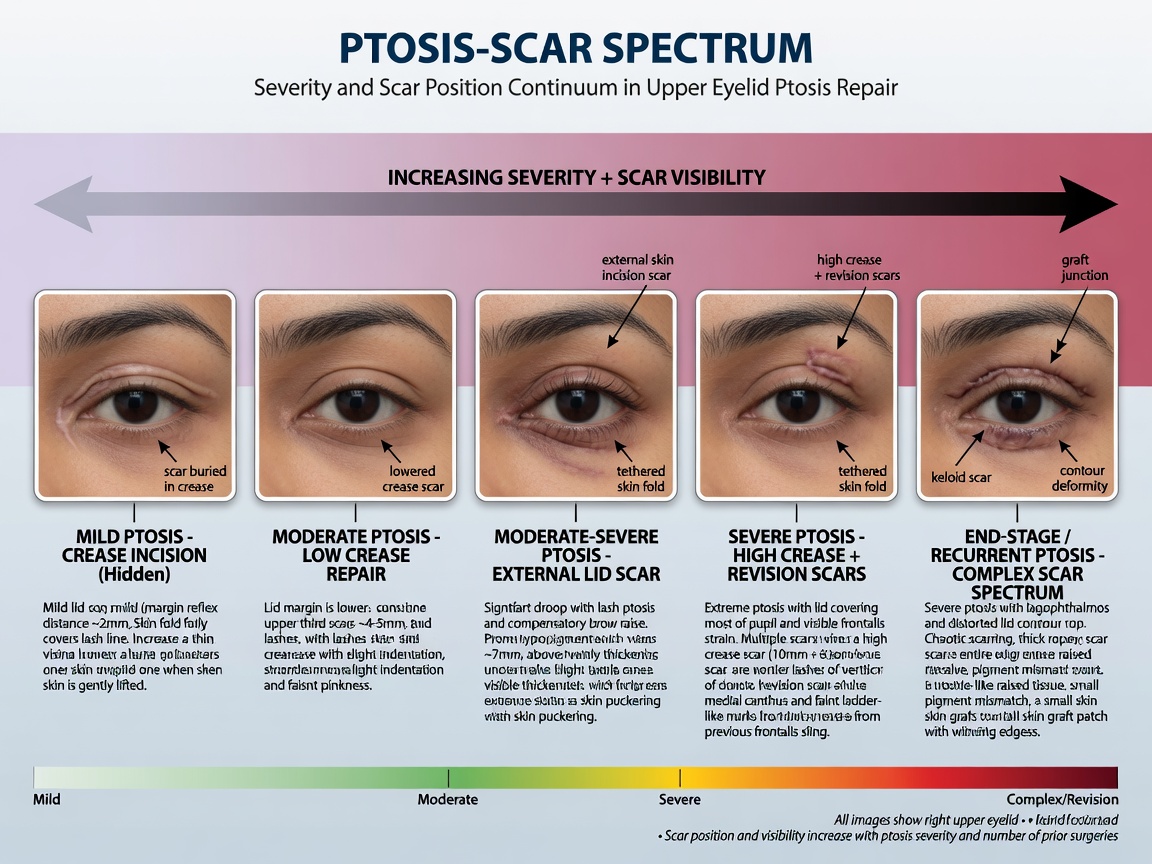
The Ptosis‑Scar Spectrum is a framework that links sagging severity directly to the appropriate lift technique. As ptosis severity increases, the incision extends to remove more excess skin. This framework helps patients and surgeons align on the trade‑off between correction and scarring.
A key self‑assessment tool is the 45‑55 rule: if the nipple is at or below the inframammary fold, you likely need a lift. The distance between the nipple and the fold helps classify grade 1, 2, or 3. Here’s how it maps out:
- Grade 1 (mild) → Periareolar lift
- Grade 2 (moderate) → Vertical lift
- Grade 3 (severe) → Anchor lift
A patient with grade 2 ptosis may want the minimal scar of a periareolar lift, but the correction would be inadequate — leading to disappointment. The Ptosis‑Scar Spectrum exists to prevent that mismatch.
Side‑by‑Side Comparison of Techniques
The table below summarizes how each technique compares across key factors. Use your ptosis grade as a guide: locate your grade in the “Best For” column, then evaluate the scar and recovery for that technique.
| Technique | Incision Pattern | Best For (Ptosis Grade) | Scar Type | Typical Recovery | Cost Range (Thailand) |
|---|---|---|---|---|---|
| Periareolar | Circular around areola | Grade 1 (mild) | Minimal, concealed | 1–2 weeks | $3,000–$4,000 |
| Vertical | Circular + vertical | Grade 2 (moderate) | Moderate, visible but fine | 2–3 weeks | $4,000–$5,000 |
| Anchor | Circular + vertical + horizontal | Grade 3 (severe) | Most extensive, along crease | 3–4 weeks | $5,000–$6,000 |
Cost ranges shown are for Thai medical tourism context and may vary by clinic and individual complexity.
Periareolar (Donut) Breast Lift for Mild Sagging
On the Ptosis‑Scar Spectrum, the periareolar lift sits at the mild end with minimal scar for minimal correction. This technique is ideal for patients whose sagging is subtle — typically after breastfeeding or mild age‑related changes.
What Is a Periareolar Lift?
A periareolar breast lift uses a single circular incision at the border of the areola, removing a small crescent of skin and lifting the nipple‑areola complex slightly. It is ideal for grade 1 ptosis, where the nipple sits at or just below the inframammary fold and there is minimal excess skin. Benefits include a well‑concealed scar, faster recovery, and preserved nipple sensation in many cases. A patient who has lost some breast volume after breastfeeding and noticed the nipple pointing slightly downward is a typical candidate.
Scar Appearance and Healing
The scar from a periareolar lift is a circular line at the junction of the areola and breast skin. It is usually well‑concealed by the areola border. Healing follows a predictable pattern: the scar appears red or pink for the first four to six weeks, then gradually fades to a pale tone over six to twelve months. Most patients find the final scar acceptable. Recommended scar management includes silicone sheets, sun protection, and gentle massage after four weeks. The scar is often described as looking like a natural areola border — many people cannot distinguish it from the original edge.
Recovery and Results
Recovery from a periareolar lift is generally faster than other techniques. Most patients return to non‑strenuous office work after one week. Heavy lifting should be avoided for four weeks, and exercise can typically resume at six weeks. Results are immediate, but the final shape emerges after three to six months when swelling fully resolves. Periareolar lift results may last five to ten years, but the lift is subtle, and ptosis can recur if the skin weakens due to aging, weight changes, or pregnancy. Maintaining a stable weight helps prolong results.
Vertical (Lollipop) Breast Lift for Moderate Ptosis
In the Ptosis‑Scar Spectrum, the vertical lift occupies the middle ground — more correction than periareolar, less scar than anchor. It is often called the workhorse of breast lifts because it offers an excellent balance of lift and scar length.
The Vertical Incision Explained
A vertical breast lift uses an incision around the areola plus a vertical line down to the inframammary fold. This allows removal of a wedge‑shaped piece of skin, pulling the breast upward and reshaping it. The lollipop analogy helps: the areola is the “candy” and the vertical line is the “stick.” This technique is ideal for grade 2 ptosis, where the nipple sits below the fold with significant skin excess, but the case is not severe enough for a full anchor. The vertical incision often heals into a thin, nearly invisible line — many patients find it acceptable, especially when the scar sits in the natural shadow of the lower breast.
Scar and Aesthetic Outcome
The vertical scar initially appears red and fades over six to twelve months. Many patients report it becomes much less noticeable than expected. Beyond scar appearance, the vertical lift reconstructs the lower breast pole, improving projection — a key benefit over the periareolar lift. Compared to the periareolar technique, the vertical lift provides better correction and shape but leaves a more visible scar. Compared to the anchor lift, it offers less extensive scarring but cannot achieve the same degree of correction for severe sagging.
Vertical vs. Periareolar: When to Upgrade
The key difference between these techniques is how much skin they remove and where. The vertical lift removes more skin and reshapes the lower pole, making it better suited for moderate sagging. If you have borderline grade 1–2 ptosis, a periareolar lift may be tempting to minimize scarring, but the result may be insufficient — potentially requiring a revision later. Many plastic surgeons recommend erring toward a vertical lift if there is any doubt, because a second lift is more complicated than the first. A patient who cannot accept a vertical scar might choose periareolar, but they should understand the risk of underwhelming correction.
Anchor (Inverted‑T) Breast Lift for Severe Sagging
On the Ptosis‑Scar Spectrum, the anchor lift sits at the far end — maximum correction demands maximum scar. This trade‑off is worth it for patients with grade 3 ptosis who need substantial reshaping.
Full Guide to the Anchor Lift
An anchor breast lift uses an inverted‑T incision: a periareolar incision plus a vertical line and a horizontal incision along the breast crease. This allows removal of the maximum amount of excess skin, reshaping the breast completely. It is ideal for grade 3 ptosis, where the nipple sits well below the fold, there is significant skin excess, and the breast has lost its shape. The horizontal scar sits in the natural fold of the breast, making it less visible when standing, though it may be visible when lying down. The anchor lift is often described as the most transformative technique — patients see a dramatic improvement in shape and nipple position.
Anchor Lift Scars: What to Expect
The anchor lift produces three incision lines: around the areola, vertically down the breast, and horizontally along the breast crease. The horizontal scar typically measures 10 to 15 centimeters. Healing follows a longer trajectory than other techniques: the scar remains red and raised for three to six months, then fades over one to two years. It may remain slightly visible but often blends into the natural crease. Recommended scar management includes silicone sheets, massage, and strict sun avoidance. Many patients report that the horizontal scar in the crease is less noticeable than they feared because it hides in the natural shadow.
Longevity and Recovery of Anchor Lift
Recovery from an anchor lift is longer and more involved compared to other techniques. Most patients need three to four weeks off work, should avoid heavy lifting for six to eight weeks, and can resume full exercise at eight to ten weeks. The horizontal incision takes longer to heal, which contributes to the extended recovery. Is this the hardest cosmetic surgery recovery? While anchor lift recovery is more demanding than periareolar or vertical lifts, it is manageable with proper support — comparable to procedures like a tummy tuck.
In terms of longevity, anchor lift results are the most durable of all breast lift techniques, often lasting ten to fifteen years or more, provided weight remains stable and the patient does not become pregnant. Patients often plan for at least two weeks of minimal activity and arrange for help at home during the initial recovery phase.
Cost and Recovery Considerations
A breast lift in Thailand typically costs between $3,000 and $6,000 depending on the technique, compared to $8,000–$15,000 in the United States — a savings of 50–60 percent. This section breaks down the costs and recovery timeline to help you plan.
Average Costs by Technique in Thailand
Costs vary by technique complexity, with the anchor lift being the most expensive due to the longer operating time and more extensive incision.
| Technique | Estimated Cost (Thailand) |
|---|---|
| Periareolar | $3,000–$4,000 |
| Vertical | $4,000–$5,000 |
| Anchor | $5,000–$6,000 |
These estimated packages typically include surgery, anesthesia, one night hospital stay, medications, and follow‑up visits. Additional costs include flights, accommodation, visa fees, and pre‑operative tests. A patient choosing an anchor lift in Bangkok can expect to pay around $5,500 for the package, plus $500–$1,000 for travel and accommodation.
Recovery Timeline and Tips
A realistic recovery timeline for medical tourists looks like this:
- Week 1: Rest, drains removed, light activity only
- Week 2: Return to desk work; continue avoiding lifting and strenuous movement
- Weeks 3–4: Resume driving and gentle exercise like walking
- Weeks 6–8: Full exercise permitted, including upper body workouts
- Months 3–6: Final results visible as swelling resolves
For medical tourists, plan to stay in Thailand for at least one to two weeks after surgery. Have a local contact available, follow post‑operative care instructions strictly, and avoid flying for two weeks. Most patients schedule a two‑week stay, using the first week for rest and the second for light sightseeing before the flight home.
Common Pitfalls and When to Choose Alternatives
While breast lift surgery can provide excellent results, it is not the right choice for everyone. Understanding the limitations and alternatives helps set realistic expectations.
Common Pitfalls
- Choosing a periareolar lift for moderate sagging: This leads to inadequate correction and a high likelihood of needing revision surgery within a few years.
- Underestimating scar visibility: Scars are permanent and take one to two years to mature. While they fade significantly, they will never disappear completely. Realistic expectations are essential.
- Expecting a lift to replace volume loss: A breast lift reshapes existing tissue but does not add volume. If you have significant volume loss, combining the lift with an augmentation (mastopexy‑augmentation) may be more appropriate.
- Ignoring the impact of weight changes: Significant weight fluctuations after surgery can alter results. Achieving a stable weight before surgery is recommended.
When to Choose Alternatives
If your sagging is minimal and you are primarily concerned about volume loss rather than nipple position, a breast augmentation alone may suffice. If you have very mild sagging and wish to avoid any visible scarring, non‑surgical options like radiofrequency skin tightening may provide subtle improvement, though results are far less dramatic than a surgical lift. For patients with severe skin laxity or significant weight loss history, a combination of lift and implant may offer the best outcome.
Frequently Asked Questions
Which breast lift incision is best?
The best incision depends on your degree of breast sagging, not on personal preference. For mild sagging (grade 1), a periareolar (donut) incision is best. For moderate sagging (grade 2), a vertical (lollipop) incision provides better correction. For severe sagging (grade 3), an anchor (inverted‑T) incision is required. The trade‑off is that longer incisions allow more skin removal and longer‑lasting results. Ultimately, your surgeon will recommend the technique that achieves the desired lift with the least scarring.
How long does a breast lift last?
A breast lift can last 10–15 years or longer with stable weight and good skin elasticity. The longevity depends on the technique used — anchor lifts tend to be most durable, while periareolar lifts may show recurrence sooner if sagging is borderline. Factors like pregnancy, significant weight changes, and aging can affect results over time. Most patients maintain noticeable improvement for many years, though natural aging continues.
What is the newest technique for breast lift?
The newest techniques focus on minimizing scars and using internal sutures for longer‑lasting results. The vertical scar lift has been refined with shorter horizontal components, and some surgeons use the lollipop pattern without the horizontal line. Internal bra techniques and fat grafting are combined with lifts to improve shape and reduce recurrence. However, the three classic incisions — periareolar, vertical, and anchor — remain the standard, with new variations improving outcomes.
What is the 45–55 rule for breasts?
The 45–55 rule is a quick self‑assessment tool for deciding if you might need a breast lift. If the nipple is at or below the breast crease (inframammary fold), or if more than 45 percent of the breast tissue hangs below the fold, sagging is likely significant enough to consider a lift. This rule is a starting point — a surgeon measures breast top and bottom pole proportions to determine the best technique. It helps patients understand that their subjective feeling of sagging can be objectively measured.
What is the hardest cosmetic surgery to recover from?
Recovery difficulty varies by procedure, but many patients find anchor breast lift recovery demanding due to the extended incision. The horizontal scar requires longer healing time, and restrictions on arm movement and lifting can last six to eight weeks. Compared to procedures like liposuction or mini‑facelifts, an anchor lift has a more prolonged recovery period. However, with proper planning and support, most patients manage well and are satisfied with the trade‑off.
Conclusion
The best choice among breast lift techniques is the one that matches your specific degree of sagging — not the one with the shortest scar or the lowest price. The Ptosis‑Scar Spectrum provides a clear decision framework: grade 1 sagging calls for a periareolar lift, grade 2 for a vertical lift, and grade 3 for an anchor lift. Understanding this relationship helps you approach your consultation with confidence and realistic expectations.
The Ptosis‑Scar Spectrum exists to prevent the mismatch between what you hope for and what a technique can deliver. When patients understand that correction and scarring are linked, they can make peace with the trade‑off and focus on results that last.
Start by assessing your own ptosis grade using the 45‑55 rule. Then consult a board‑certified plastic surgeon who can confirm your grade and recommend the appropriate technique for your body. This information is for educational purposes and does not replace a professional medical consultation.