
This content is for informational purposes only and does not constitute medical advice. Always consult with a qualified healthcare provider.
Bariatric Surgery for Lower BMI Asian Patients: Key Criteria
If you’re of Asian descent considering bariatric surgery, you’ve likely encountered confusion about BMI cutoffs – Western standards say BMI ≥30 is obesity, but many Asian patients qualify for surgery at BMI 27.5 or even 25 with diabetes. This discrepancy stems from well-documented biological differences that the latest guidelines now reflect. Using the wrong threshold could mean delaying treatment that might prevent diabetes progression or cardiovascular damage – or worse, undergoing a procedure you don’t need because your risk profile differs. In this guide, you’ll learn the exact Asian-specific BMI criteria, the 2022 guideline updates that expanded eligibility, and a step‑by‑step framework to assess your own candidacy. We’ll cover why Asian thresholds are lower, what health conditions qualify, common disqualifiers, and the most authoritative guidelines you should trust.
Key Takeaways
Bariatric surgery for lower BMI Asian patients uses different eligibility criteria (BMI ≥27.5 vs. ≥35 for non-Asians) due to higher metabolic risk at lower weight.
- Lower thresholds (BMI 27.5) are supported by WHO, ASMBS 2022, and Asia-Pacific guidelines for Asian patients with comorbidities
- Type 2 diabetes remission occurs in 68% of Asian patients with BMI 27–30 after gastric bypass (2023 study)
- The Asian BMI-Benefit Assessment Framework provides a structured 5‑step decision path for patients and clinicians
Understanding the Need for Asian-Specific BMI Criteria
Asian populations have a higher percentage of body fat and more central adiposity at any given BMI compared to Caucasians. This means metabolic risks – including type 2 diabetes, hypertension, and cardiovascular disease – accelerate at lower body weight. Understanding this biological reality is the foundation for why bariatric surgery criteria differ for Asian patients.
The CDC and WHO both acknowledge that a BMI of 23 indicates increased health risk for Asians, compared to 25 for general populations. Harvard T.H. Chan School of Public Health research shows that at the same BMI, Asians have 3-5% more body fat – a significant difference that alters risk profiles. The public health implication is clear: using universal thresholds under-diagnoses obesity in Asians, leading to delayed interventions. With this context, we can now explore the precise BMI thresholds and official criteria used to determine surgical eligibility for Asian patients.
Why Do BMI Thresholds Differ for Asian Populations?
Asian populations have a higher body fat percentage at the same BMI compared to Caucasians. According to Harvard T.H. Chan School of Public Health, at the same BMI, Asians typically have 3-5% more body fat. Central adiposity – the accumulation of visceral fat around the abdomen – is also more common in Asians at lower BMI, leading to earlier insulin resistance. A 5’5″ Asian individual with BMI 24 may have the same body fat percentage and metabolic risk as a Caucasian individual with BMI 27. This physiological difference directly leads to the official lower BMI thresholds we’ll cover next.
The Health Risk at Lower BMI
The WHO fact sheet states that health risk for Asian populations begins at a BMI of 23, significantly lower than the global standard of 25. The risk of type 2 diabetes increases dramatically at BMI 25 for Asians – comparable to BMI 30 for Caucasians. For a Japanese man with BMI 25, the probability of developing diabetes within 10 years is equivalent to a Caucasian man with BMI 30. These risk patterns are why official guidelines have established specific BMI cutoffs for Asian patients. Let’s examine those numbers.
What Is Bariatric Surgery for Lower BMI Asian Patients?
Bariatric surgery for lower BMI Asian patients refers to metabolic and weight‑loss procedures (gastric bypass, sleeve gastrectomy) offered to individuals of Asian descent whose BMI is above 27.5 and who have obesity‑related comorbidities such as type 2 diabetes or hypertension. The lower threshold reflects the elevated metabolic risk that Asian patients face at lower body mass. Standard eligibility requires BMI ≥35 with comorbidities; Asian‑adapted criteria lower this to ≥27.5. The goal is not just weight loss – it is primarily metabolic improvement, including diabetes remission and cardiovascular risk reduction.
Definition: A Tailored Approach to Metabolic Surgery
Bariatric surgery for lower BMI Asian patients is a metabolic intervention performed at BMI thresholds of 27.5 (with comorbidities) rather than the standard 35, reflecting higher disease risk at lower weight. This approach is recognized by major medical bodies including the ASMBS and the Asia-Pacific Consensus. For example, a 45-year-old Chinese female with BMI 28.5 and type 2 diabetes would not qualify under standard Western criteria but is eligible under Asian‑adapted guidelines. The CDC obesity data notes that a BMI of 27.5 or higher indicates increased health risk for Asian populations, supporting the lower surgical threshold.
How This Differs from Standard Bariatric Surgery
The key differences between standard and Asian-adapted criteria are best understood through direct comparison:
| Criteria | Standard (General) | Asian-Adapted |
|---|---|---|
| Surgical eligibility (with comorbidity) | BMI ≥35 | BMI ≥27.5 |
| Surgical eligibility (no comorbidities) | BMI ≥40 | BMI ≥32.5 (some guidelines) |
| Qualifying comorbidity examples | T2DM, hypertension, OSA | Same, but risk is higher at lower BMI |
A 2023 study on Asian bariatric criteria details the 68% diabetes remission rate in Asian patients with BMI 27–30, confirming the rationale for lower thresholds. Understanding these differences leads us to examine the exact numbers: what are the official BMI cutoffs for Asian populations?
Lower BMI Thresholds and Criteria for Asian Patients
The WHO recommends BMI ≥27.5 for obesity classification in Asians, and Asia-Pacific guidelines endorse bariatric surgery at this threshold when at least one obesity‑related comorbidity is present. This section provides the exact numbers, country-specific variations, and a direct comparison with Western standards.
Official Asian BMI Cutoffs: WHO and Beyond
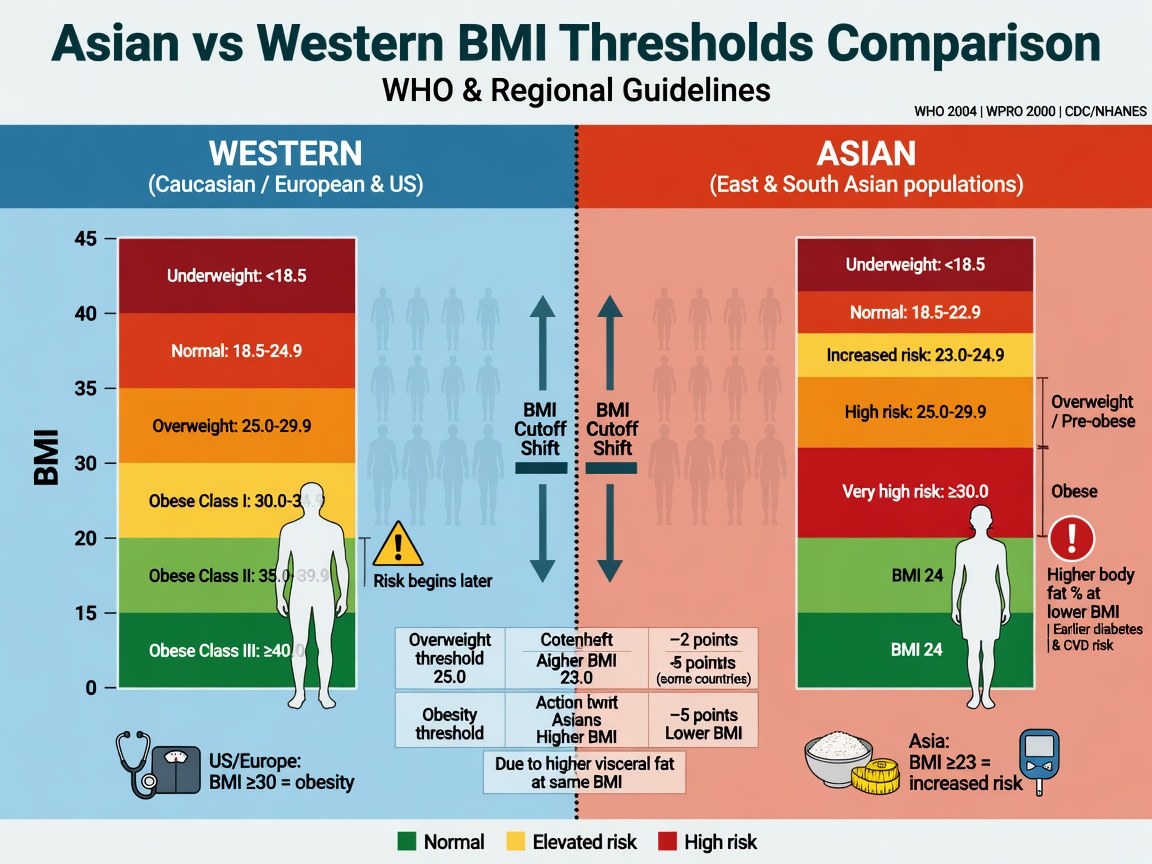
The WHO classification for Asian populations defines normal weight as ≤22.9, overweight as 23–24.9, and obese as ≥25. However, for surgical eligibility, the threshold is BMI ≥27.5 with comorbidity. The WHO guidelines for obesity recommend these lower cutoffs because metabolic risk accelerates at lower BMI in Asians. The NIDDK bariatric surgery facts state that for Asian patients, a BMI of 27.5 may qualify when comorbidities exist, reflecting the need for ethnic-specific guidelines.
Country-specific variations add further nuance. Japan uses BMI ≥32.5 or ≥27.5 with at least one comorbidity. China and India follow the Asia-Pacific consensus (≥27.5 with comorbidity). These numbers become clearer when placed side by side with Western standards.
Comparing Western vs. Asian BMI Thresholds
| Category | Western (General) | Asian‑Specific |
|---|---|---|
| Overweight classification | BMI ≥25 | BMI ≥23 |
| Obesity classification | BMI ≥30 | BMI ≥27.5 |
| Surgical eligibility (no comorbidities) | BMI ≥40 | BMI ≥32.5 (some guidelines) |
| Surgical eligibility (with comorbidity) | BMI ≥35 | BMI ≥27.5 |
The table shows that the Asian thresholds are consistently 2.5–5 BMI points lower than Western standards. This is not about “lowering the bar” but about matching the bar to the correct population’s risk profile.
Why BMI 27.5 Is the Surgical Cutoff for Asians
Epidemiological data shows that at BMI 27.5, the prevalence of type 2 diabetes in Asian populations matches that of Caucasians at BMI 30. The Asia-Pacific consensus chose 27.5 as a compromise between sensitivity and specificity for detecting metabolic disease risk. A Korean study found that the risk of developing diabetes at BMI 27.5 is equivalent to the risk at BMI 30 in Caucasians, justifying the adjusted cutoff. Michigan Medicine eligibility criteria follow the ASMBS 2022 guidelines, stating that Asian patients with a BMI of 27.5 and type 2 diabetes qualify for bariatric surgery. These thresholds are not static – they’ve evolved with new evidence. The most significant update came in 2022.
The 2022 ASMBS and Asia-Pacific Guideline Updates
The 2022 ASMBS guidelines lowered the bariatric surgery eligibility threshold for Asian patients to BMI ≥27.5 with comorbidities, representing the first major revision in 30 years. This section summarizes the key changes, explains the 30/30/30 rule, and compares the Asia-Pacific consensus.
What Changed in the 2022 ASMBS Guidelines?
The 2022 ASMBS guidelines introduced several critical changes for Asian patients. First, they explicitly recognized that Asian race/ethnicity should be considered a risk factor warranting surgery at lower BMI. Second, they expanded the list of qualifying comorbidities to include diabetes, hypertension, dyslipidemia, obstructive sleep apnea, and non-alcoholic steatohepatitis (NASH). The ASMBS 2022 guidelines press release states that for the first time, lower BMI thresholds for Asian patients (BMI ≥27.5 with comorbidities) are explicitly recommended after a 30-year update. The Cleveland Clinic interpretation of guidelines confirms that the 2022 update broadens eligibility for lower BMI Asian patients. Previously, a Chinese man with BMI 30 and hypertension would not qualify; under the 2022 update, his BMI 27.5 with comorbidity makes him a candidate.
The 30/30/30 Rule Explained
The 30/30/30 rule is an informal clinical shorthand, not an official ASMBS guideline. It is sometimes used to describe a patient profile (BMI >30, age >30, and >30% excess weight) that may be considered for surgery without further requirements. However, the ASMBS 2022 guidelines do not include such a rule. For Asian patients, the corresponding concept does not exist – official criteria are based on BMI, comorbidities, and medical history. If your surgeon mentions the 30/30/30 rule, ask how it applies to your specific case, especially if you’re Asian and have a lower BMI. Always rely on official guideline criteria rather than informal rules.
Asia-Pacific Consensus Guidelines
The Asia-Pacific Bariatric Surgery Society (APBSS) and regional experts published consensus guidelines that endorse BMI ≥27.5 with comorbidity for surgery. Key differences from ASMBS include a more conservative approach on BMI without comorbidity (≥32.5) and a stronger emphasis on ethnic-specific metabolic risk. For South Asian (Indian) patients, some experts recommend even lower thresholds (BMI ≥25 with comorbidity) due to exceptionally high diabetes risk. This consensus is based on WHO and regional data, aligning with the global shift toward ethnic-specific criteria. Understanding eligibility isn’t just about BMI – it’s about health conditions. Let’s explore the comorbidities that justify surgery at lower BMI.
Health Comorbidities and Metabolic Benefits at Lower BMI
Metabolic surgery in non-obese Asian patients (BMI <35) results in a 2.1% reduction in HbA1c and a 68% type 2 diabetes remission rate at 2 years. This section explains why lower BMI Asians develop metabolic disease and presents the evidence for surgical benefits.
Why Lower BMI Asians Develop Diabetes and Cardiovascular Risk
The phenomenon of “metabolically obese normal weight” describes Asians with normal BMI (≤23) who have insulin resistance and high body fat. Central adiposity leads to increased visceral fat, lipotoxicity, and β‑cell dysfunction earlier than in other populations. Epidemiologically, Asian patients develop diabetes at lower BMI and younger ages. The WHO obesity fact sheet emphasizes that health risk for Asians begins at BMI 23, with significantly elevated diabetes risk at BMI 25. An Indian male with BMI 25 has a 3x higher risk of developing diabetes than a Caucasian male with the same BMI. Your “metabolic weight” – the weight at which your body starts accumulating health risk – is lower if you’re Asian.
Evidence: Diabetes Remission and Metabolic Improvements
A 2023 study on diabetes remission in lower BMI Asians found 68% diabetes remission at 2 years in Asian patients with BMI 27–30 after gastric bypass. A meta-analysis of metabolic surgery in non-obese Asians showed a 2.1% reduction in HbA1c after metabolic surgery in non-obese Asian patients with BMI <35. Cardiovascular risk reduction is also significant, with improvements in cholesterol, blood pressure, and inflammatory markers. For example, a 55-year-old Malaysian woman with BMI 28.5 and poorly controlled diabetes achieved an HbA1c of 6.1% (down from 9.8%) 18 months after sleeve gastrectomy. However, results vary – not all patients achieve remission.
Risks and Complications to Consider
The risk of death from bariatric surgery is low, around 0.1% in the first 30 days for standard populations, according to the NIDDK bariatric surgery safety page. Top causes include leakage, pulmonary embolism, and infection. For lower BMI patients, some studies suggest lower complication rates, but the evidence is still emerging. While overall mortality is low, patients with BMI 27.5–30 may have different risk profiles than those with BMI >40. Now that you understand the benefits and risks, let’s translate this into a clear eligibility checklist.
Patient Eligibility: Conditions and Disqualifiers
For Asian patients, the key qualifying criterion is BMI ≥27.5 with at least one obesity-related comorbidity (T2DM, hypertension, dyslipidemia, OSA). Those without comorbidities generally require BMI ≥32.5 to be eligible. This section provides a clear checklist of who qualifies and who does not.
Qualifying Health Conditions (Including Diabetes, Hypertension)
The following conditions can qualify an Asian patient for bariatric surgery at lower BMI:
- Type 2 diabetes – the most common qualifier for low BMI Asians
- Hypertension – blood pressure ≥130/80 mmHg or on medication
- Dyslipidemia – high cholesterol or triglycerides
- Obstructive sleep apnea – moderate to severe
- Non-alcoholic steatohepatitis (NASH) – liver inflammation due to fat accumulation
The Michigan Medicine eligibility checklist lists these as qualifying comorbidities under ASMBS guidelines. The ASMBS qualifying conditions expanded the list to include NASH and other serious comorbidities. A Filipino patient with BMI 28 and type 2 diabetes qualifies; the same patient without diabetes would not qualify unless BMI is >32.5.
Common Disqualifiers and How to Address Them
Common disqualifiers for bariatric surgery include untreated eating disorders, active substance abuse, severe uncontrolled psychiatric conditions, and certain advanced medical contraindications. Eating disorders like binge eating disorder and bulimia require pre-treatment. Active alcohol or drug addiction must be in stable recovery before surgery is considered. Many disqualifiers are temporary – addressing them through therapy or medical management can make a patient eligible later. A comprehensive pre-operative psychological and medical evaluation determines whether disqualifying conditions are present or modifiable.
Can You Get Gastric Bypass with a BMI of 30?
Yes, an Asian patient with a BMI of 30 can qualify for gastric bypass if they have at least one obesity-related comorbidity, such as type 2 diabetes or hypertension. This is because the surgical threshold for Asians is ≥27.5 (with comorbidity), so a BMI of 30 exceeds the minimum. Without comorbidities, a BMI of ≥32.5 is generally required. The WHO BMI classification classifies a BMI of 30 as “obese” for general populations but “overweight” for Asian populations; however, for surgical eligibility, the ASMBS uses BMI ≥27.5 with comorbidity. A Korean patient with BMI 30 and type 2 diabetes is eligible. Without diabetes, they would likely need to reach BMI 32.5 or qualify via other comorbidities. Some patients may achieve remission with lifestyle and medication alone.
The Asian BMI-Benefit Assessment (ABA) Framework
The Asian BMI-Benefit Assessment Framework provides a replicable 5‑step decision path: 1) Asian-adjusted BMI, 2) Comorbidity evaluation, 3) Guideline matching, 4) Non-surgical comparison, 5) Shared decision-making. This proprietary framework synthesizes the article’s information into a practical decision tool for patients and clinicians.
Step 1: Calculate Your Asian-Adjusted BMI
Calculate your BMI using the standard formula (weight in kg / height in m²). Then compare to Asian thresholds:
- <23: Ideal weight
- 23–24.9: Overweight (increased risk)
- ≥25: Obese (high risk)
- ≥27.5: Qualifies for surgery with comorbidity
Once you know your BMI category, the next step is to assess any existing health conditions.
Step 2: Identify Comorbidities and Metabolic Risk
Check if you have any of these conditions diagnosed by a doctor:
- Type 2 diabetes
- Hypertension
- Dyslipidemia
- Obstructive sleep apnea
- Non-alcoholic steatohepatitis (NASH)
The more conditions you have, the stronger the case for surgery. Now match your BMI and comorbidities against the official guidelines.
Step 3: Apply the ASMBS 2022 Eligibility Criteria
| Your Profile | Eligibility |
|---|---|
| BMI ≥27.5 + ≥1 comorbidity | Eligible |
| BMI ≥32.5 + no comorbidity | Eligible |
| BMI ≥27.5 + no comorbidity | Not eligible (consider lifestyle) |
Individual surgeon programs may have slightly different criteria. Surgery is one option. Before deciding, evaluate what else is available.
Step 4: Evaluate Non-Surgical Alternatives
For patients with BMI 23–27 and no or mild comorbidities, intensive lifestyle intervention is the first line. For patients with BMI 27–30 with diabetes, surgery may be superior to medication alone, but GLP-1 agonists (like semaglutide) are also effective. This is a decision to make with a doctor. Finally, bring your framework results to a consultation.
Step 5: Make an Informed Decision with Your Surgeon
Take the framework output (BMI category, comorbidity list, guideline match, alternatives) to a bariatric surgeon. Questions to ask: “Based on my Asian-specific criteria, what’s your recommendation? What outcomes can I realistically expect?” The framework is a tool, not a prescription. Print this framework and bring it to your consultation.
Entity Authority and Consistency in Bariatric Surgery
Entity authority in bariatric surgery requires that guidelines from ASMBS, WHO, and regional societies are consistent, updated, and applied uniformly – yet many Asian patients encounter outdated or conflicting information. This section discusses how authoritative entities establish credibility and how patients can verify provider credentials.
The Role of Professional Guidelines
Professional guidelines are developed by expert panels reviewing evidence. Consistency across bodies (WHO, ASMBS, Asia-Pacific) strengthens trust. Some online sources may quote outdated Western thresholds, which can mislead Asian patients. Always verify that the information you’re using comes from the most recent guideline updates.
Structured Data and Medical Credibility
Medical websites should use structured data to signal credibility to search engines. For patients, practical verification includes checking if the hospital is JCI-accredited or if surgeons are board-certified in bariatric surgery. These credentials ensure that the provider follows current, evidence-based standards.
What Patients Should Look for in a Provider
When choosing a provider, look for:
- Board certification in bariatric surgery
- Hospital accreditation (JCI, ASMBS Center of Excellence)
- Direct question: “Do you apply the ASMBS 2022 guidelines for Asian patients?”
- Avoid providers using outdated Western-only thresholds
No medical treatment is one-size-fits-all. Let’s honestly examine the limitations of bariatric surgery for lower BMI Asians.
Limitations and Counterarguments
While the 2022 guidelines expanded eligibility for lower BMI Asian patients, the long-term outcomes in this specific population are still being studied; current evidence supports metabolic benefits but with less certainty than at higher BMI. This section acknowledges situations where surgery is not beneficial and discusses alternatives.
When Surgery Is Not the Right Choice
Surgery is not the right choice in several scenarios:
- BMI 27–30 with no comorbidities – focus on lifestyle and GLP-1 agonists first
- Uncontrolled eating disorder or active substance use – address before considering surgery
- Pregnancy desired within the next 12 months – postpone
- Very elderly or frail patients – risk-benefit may not favor surgery
Surgery is a tool, not a cure, and requires lifelong lifestyle changes.
The Need for Long-Term Data in Lower BMI Asians
Most studies on bariatric surgery focus on Western populations with BMI >35. Emerging data for lower BMI Asians is promising but limited to follow-up periods of 2–5 years. A 2023 meta-analysis of non-obese Asian outcomes included studies with follow-up ranging from 1 to 4 years; longer data is needed to confirm durability of results. Weight recidivism rates in this population are not well established.
Comparing Non-Surgical Options (Medication, Lifestyle)
For patients with BMI 25–30, medication (e.g., GLP-1 receptor agonists like semaglutide) may achieve 10–15% weight loss and diabetes remission in some cases. However, surgery often provides more durable metabolic improvements, especially for diabetes. The decision depends on the patient’s severity of comorbidities, adherence capacity, and personal preference. A comparison table can help:
| Option | Typical Weight Loss | Diabetes Remission | Durability |
|---|---|---|---|
| Lifestyle intervention | 5-10% | Low | Variable |
| GLP-1 medication | 10-15% | Moderate | Requires ongoing use |
| Bariatric surgery | 20-35% | 68% at 2 years | More durable |
To address the most common lingering questions, let’s move to the FAQ section.
Frequently Asked Questions
What is the lowest BMI for bariatric surgery in Asian patients?
The lowest BMI for bariatric surgery in Asian patients is ≥27.5, provided at least one obesity-related comorbidity (e.g., type 2 diabetes, hypertension) is present. This threshold is endorsed by the WHO, ASMBS 2022 guidelines, and the Asia-Pacific consensus. Patients without comorbidities generally need a BMI of ≥32.5 to qualify. For example, a Chinese patient with BMI 28 and type 2 diabetes would meet eligibility criteria. Individual programs may set slightly different cutoffs; a consultation with a bariatric surgeon is essential.
Why is BMI for Asians different?
The BMI cutoff for Asians is different because Asian populations have a higher percentage of body fat and greater central adiposity at the same BMI compared to Caucasians. This means metabolic risks such as type 2 diabetes and hypertension begin at a lower weight. The WHO therefore defines overweight as BMI ≥23 (not ≥25) and obesity as BMI ≥27.5 (not ≥30) for Asians. Harvard research shows a 3-5% higher body fat percentage at the same BMI, directly impacting disease risk. Using universal Western thresholds would significantly underdiagnose obesity-related health risks in Asian individuals.
What is the 30/30/30 rule for bariatric surgery?
The 30/30/30 rule is an informal clinical shorthand, not an official ASMBS guideline, typically referring to a patient with a BMI >30, age >30, and a diagnosis of (or at risk for) metabolic syndrome. In practice, some bariatric programs use it as a screening trigger – if a patient meets these three criteria, further evaluation is recommended. For Asian patients, the corresponding threshold is more like “27.5/30/comorbidity.” The 2022 ASMBS guidelines do not mention this rule; official criteria are based on BMI, comorbidities, and medical history. Always rely on official guideline criteria rather than informal rules when discussing eligibility with your surgeon.
What disqualifies you from bariatric surgery?
Common disqualifiers for bariatric surgery include untreated eating disorders, active substance abuse, severe uncontrolled psychiatric conditions, and certain advanced medical contraindications. Eating disorders like binge eating disorder and bulimia require pre-treatment. Active alcohol or drug addiction must be in stable recovery before surgery is considered. Many disqualifiers are temporary – addressing them through therapy or medical management can make a patient eligible later. A comprehensive pre-operative psychological and medical evaluation determines whether disqualifying conditions are present or modifiable.
Can I get gastric bypass if my BMI is 30 as an Asian patient?
Yes, an Asian patient with a BMI of 30 can qualify for gastric bypass if they have at least one obesity-related comorbidity, such as type 2 diabetes or hypertension. This is because the surgical threshold for Asians is ≥27.5 (with comorbidity), so a BMI of 30 exceeds the minimum. Without comorbidities, a BMI of ≥32.5 is generally required. For example, a Filipino patient with BMI 30 and diabetes meets the ASMBS 2022 criteria. Insurance coverage and surgeon discretion may still apply, so a formal consultation is necessary.
Conclusion
For Asian patients, bariatric surgery eligibility uses lower BMI thresholds (≥27.5 with comorbidities) because metabolic risk accelerates at lower weight. A 68% diabetes remission rate at 2 years demonstrates its effectiveness. The best approach combines understanding your Asian-adjusted BMI, assessing comorbidities, and applying the Asian BMI-Benefit Assessment Framework.
The key insight is that your “metabolic weight” – the BMI where health risks intensify – is lower if you’re Asian. The Asian BMI-Benefit Assessment Framework translates this biological reality into a practical 5‑step decision path that empowers you to have an informed conversation with your surgeon.
Start by calculating your Asian-adjusted BMI and listing any existing health conditions. Then schedule a consultation with a board‑certified bariatric surgeon who understands the 2022 guideline updates. This content is for informational purposes only and does not constitute medical advice. Always consult with a qualified healthcare provider.