Best Hip Replacement in Thailand: Costs, Implants & Recovery
Content for informational purposes only – not a substitute for professional medical advice. Always consult a qualified orthopedic surgeon.
If you’re facing a $35,000–$50,000 bill for hip replacement in the U.S. or U.K., you’ve likely heard that Thailand offers the same procedure for a fraction of the cost. But is the quality comparable, and what about the implants and recovery logistics?
Comparing prices alone can be misleading — $7,000 might sound attractive until you uncover hidden fees, unfamiliar implant options, and recovery challenges abroad. The hip replacement cost Thailand figures you see online rarely tell the full story.
In this guide, we connect the three pillars of a successful hip replacement trip — cost, implant choice, and recovery — so you can make an informed decision and return home with confidence. We’ll start with a transparent cost breakdown, then dive into implant materials and surgeon questions, and finish with a practical recovery roadmap tailored for Thailand.
Key Takeaways
A hip replacement in Thailand costs $7,000–$15,000, compared to $35,000–$50,000 in the U.S., with no compromise on implant quality when you choose a JCI-accredited hospital.
- Ceramic-on-polyethylene implants offer the best balance of durability and cost for most patients
- Hidden costs (pre-op tests, physical therapy, travel) can add $2,000–$4,000 — budget accordingly
- Recovery takes 8–12 weeks in Thailand; plan accommodation near your hospital for the first 4 weeks
Hip Replacement Cost in Thailand: What to Expect
A total hip arthroplasty — commonly called hip replacement — in Thailand costs between $7,000 and $15,000 at a JCI-accredited hospital, compared to $35,000–$50,000 in the United States. That’s a savings of 60–80% for the same surgical procedure and implant quality, according to NIH StatPearls (2024). But understanding where that money goes and what’s not included is essential for accurate budgeting.
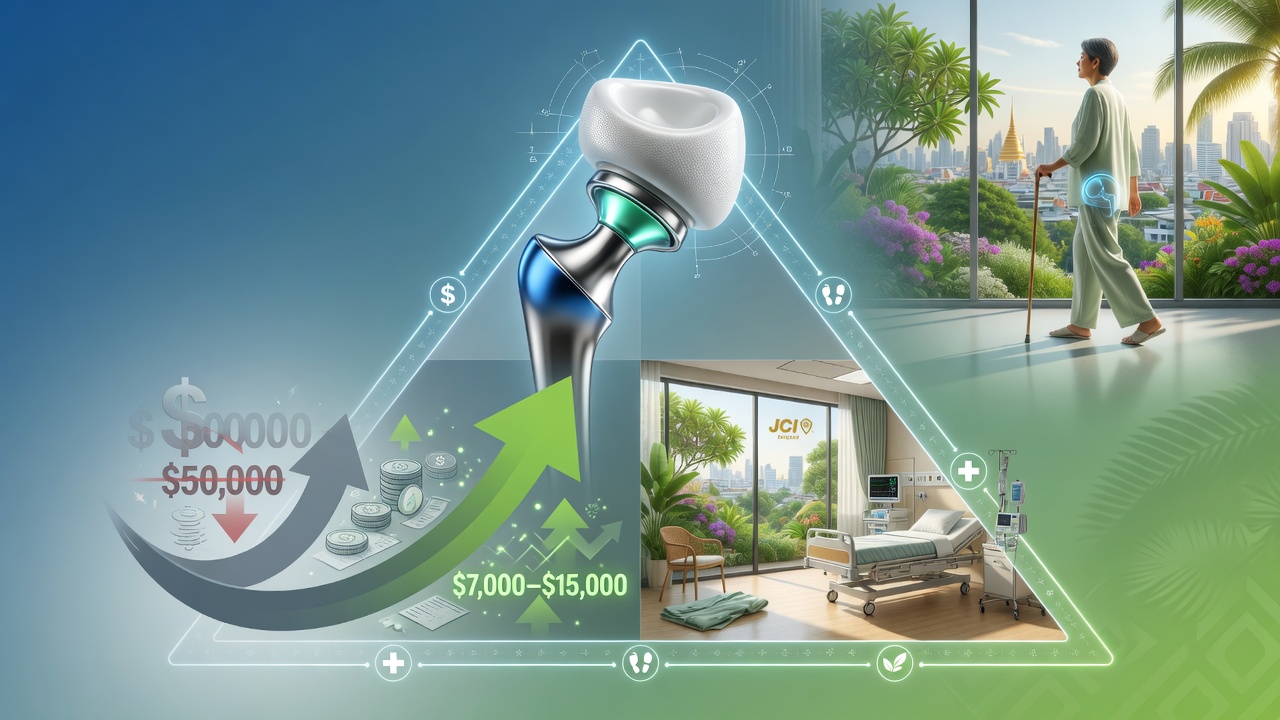
The Implant–Cost–Recovery Triangle starts here: your choice of implant directly influences the final bill, and both affect how your recovery unfolds. A premium ceramic implant adds $2,000–$3,000 to the cost but may reduce revision risk — a trade-off worth examining.
Average Cost Breakdown: Hospital, Implant, and Travel
The total price for hip replacement in Thailand breaks down into several components. Surgery itself — including surgeon fees, anesthesia, and operating room time — typically accounts for $4,000–$8,000. The implant (the prosthetic components) ranges from $2,000 to $5,000 depending on the bearing surface and brand. A standard hospital stay of 3–7 days costs $1,000–$3,000, covering nursing care, medications, and basic meals.
International flights add $1,000–$2,000 round trip from North America or Europe, and accommodation for 4 weeks adds another $1,500–$3,000 depending on your preferences.
Consider a typical patient scenario: a 65-year-old choosing a ceramic-on-polyethylene implant at Bumrungrad International Hospital. The total medical bill comes to approximately $12,000. Adding $1,500 for flights and $2,000 for 4 weeks of accommodation brings the total to $15,500 — still less than half the U.S. average. The CDC reports that roughly 450,000 hip replacements are performed annually in the United States alone, yet the cost disparity remains stark.
| Cost Component | Estimated Range |
|---|---|
| Surgery (surgeon + anesthesia + OR) | $4,000–$8,000 |
| Implant (prosthetic components) | $2,000–$5,000 |
| Hospital stay (3–7 days) | $1,000–$3,000 |
| Flights (round trip) | $1,000–$2,000 |
| Accommodation (4 weeks) | $1,500–$3,000 |
| Total | $9,500–$21,000 |
But the sticker price is only part of the story — hidden costs can add thousands. Let’s look at what those are.
Hidden Costs You Need to Budget For
Pre-operative labs and imaging (blood tests, X-rays, ECG) typically cost $200–$500 and may or may not be included in your hospital package. Post-surgery medications — painkillers, antibiotics, and blood thinners — add $100–$300. Physical therapy is often the biggest surprise: $50–$150 per session, with 2–3 sessions per week for 4 weeks, totaling $400–$1,800.
Other expenses include a medical visa ($50–$200), travel insurance ($100–$300), and airport transfer services ($50–$100). Budget an additional $2,000–$4,000 for these hidden costs. Many hospitals offer comprehensive packages that bundle some of these items — always ask for a “total package” quote upfront to avoid surprises.
Now that you know the cost, the next major decision is choosing the right implant — which also influences price and recovery.
How to Choose the Right Implant for Your Surgery
The type of implant — specifically its bearing surface, the articulating materials in a hip replacement — determines how long your new hip lasts, how much it costs, and what activity levels are safe afterward. Implant choice sits at the center of the Implant–Cost–Recovery Triangle: a premium ceramic implant costs more but may allow faster recovery and lower revision risk.
NIAMS (2024) explains that hip implants are made from metal, plastic, ceramic, or combinations of these materials, each with different wear rates and longevity profiles. Understanding these differences helps you make an informed choice alongside your surgeon.
Ceramic, Metal, and Polyethylene: Pros and Cons
Three main bearing surface types dominate the market. Here’s how they compare:
| Bearing Surface | Wear Rate (mm/year) | Cost Index | Best For |
|---|---|---|---|
| Metal-on-Polyethylene | 0.1–0.2 | $$ | General use, older patients |
| Ceramic-on-Polyethylene | 0.05–0.1 | $$$ | Active patients, optimal balance |
| Ceramic-on-Ceramic | 0.01–0.05 | $$$$ | Young patients, high activity |
Ceramic-on-polyethylene bearings are the most popular choice for hip replacement in Thailand, offering low wear rates (0.1 mm/year) and FDA approval at a mid-range price. Metal-on-polyethylene remains the most common option worldwide — affordable and well-studied, but with higher wear rates over time. Ceramic-on-ceramic offers the lowest wear but carries a small risk of squeaking and comes at the highest price point.
Beyond material, the specific brand matters too. Let’s look at what’s commonly used in Thai hospitals.
Implant Brands Used in Thailand and Their Longevity
Leading hospitals in Thailand use implants from the same global manufacturers you’d find in North America or Europe. Zimmer Biomet is widely available and offers a full range of bearing options, from metal-on-polyethylene to advanced ceramic systems. DePuy Synthes, a Johnson & Johnson subsidiary, is known for its ceramic-on-ceramic systems with strong longevity data. Stryker is a popular choice for robotic-assisted surgery, particularly at hospitals offering the Mako system.
All three brands carry FDA approval or CE marking, meaning they meet international safety and quality standards. Ask your surgeon which brand they use — for example, Bumrungrad regularly uses Zimmer Biomet implants, while Bangkok Hospital may offer Stryker systems.
Armed with this knowledge, you’ll be ready to talk to your surgeon. Here are the specific questions to ask.
10 Questions to Ask Your Surgeon About Implants
Use this checklist during your consultation to ensure you have all the information needed for an informed decision:
- What type of bearing surface do you recommend for my age and activity level, and why?
- Which implant brand will you use, and how many procedures have you performed with this specific system?
- Is the implant FDA-approved or CE-marked? — Request documentation.
- What is the expected lifespan of this implant given my activity level and weight?
- Do you have data on revision rates for this specific implant model?
- Will I have any permanent activity restrictions after surgery with this implant?
- Is a robotic-assisted or minimally invasive approach available for this implant?
- What is included in the package price, and what costs are separate?
- What follow-up care is available after I return to my home country?
- Can I receive a written cost estimate that itemizes the implant separately?
The Agency for Healthcare Research and Quality (AHRQ) emphasizes that informed patients experience better outcomes — asking these questions is your right, not an imposition.
Once you’ve chosen your implant and booked your surgery, the next step is planning your recovery in Thailand. Let’s walk through the timeline and logistics.
Hip Replacement Recovery Timeline and Planning
A structured recovery plan is essential for a successful outcome — and good planning starts with understanding how your implant affects your timeline, the third side of the Implant–Cost–Recovery Triangle. The recovery period typically spans 8–12 weeks, with specific milestones and restrictions that vary by implant type and surgical approach.
Week-by-Week Recovery Milestones (Weeks 1–12)
The timeline below represents typical recovery patterns for a standard posterior-approach hip replacement. Individual results vary based on age, fitness level, and implant choice.
| Week Range | Activity Level | Restrictions | PT Focus |
|---|---|---|---|
| Week 1 | In hospital, walker-assisted mobility | 90-degree rule, no weight-bearing without aid | Bed mobility, breathing exercises, initial walking |
| Weeks 2–4 | Home with walker, short walks | 90-degree rule strictly enforced, no driving | Gait training, gentle range of motion, swelling management |
| Weeks 4–6 | Transition to cane, increased walking distance | 90-degree rule may be relaxed (surgeon decision) | Strengthening, balance exercises, stair practice |
| Weeks 6–12 | Walking without aids, most daily activities | Lifting restrictions (no more than 10–15 lbs) | Full strengthening, return to work (desk jobs), recreational walking |
According to University of Washington Orthopaedics, by week 8 many patients can walk 30 minutes without pain, and by week 12 climbing stairs becomes natural for most. Recovery varies widely — these are typical ranges, not guarantees.
One of the most important restrictions is the 90-degree rule. Here’s what it means and how to prepare your environment.
The 90-Degree Rule and Movement Restrictions
The 90-degree rule prohibits bending your hip beyond a 90-degree angle for the first 6–8 weeks after surgery. This restriction exists to prevent dislocation — when the ball of the prosthetic joint slips out of the socket — which is most common in the early healing period. AHRQ patient safety guidelines (2024) emphasize this rule as a critical preventive measure.
Practically, this means avoiding low chairs, deep sofas, sitting on low toilets, bending to tie shoes, crossing your legs, and picking up objects from the floor. Prepare your environment before surgery: use an elevated toilet seat (adds 4–6 inches), place chairs at knee height or higher, use long-handled grabbers for picking items up, and arrange a shower chair. These adaptations make compliance manageable, especially in an unfamiliar environment like a Thai apartment or recovery hotel.
Now, practical considerations for recovering in Thailand: where to stay, what to eat, and how to get around.
Travel and Accommodation Tips for Thailand Recovery
Logistics matter significantly when recovering abroad. Book a serviced apartment or recovery hotel near your hospital — properties near Bumrungrad (Sukhumvit area) or Bangkok Hospital (Ratchada area) offer easy access to follow-up appointments. Choose ground-floor or elevator-access units with step-free entry.
At airport security, your hip replacement will likely trigger metal detectors. Inform the TSA officer before screening; you’ll undergo a pat-down or body scanner check. Your Thai hospital will provide an implant card with details of your prosthetic — carry this in your hand luggage for verification.
Food safety deserves attention: stick to prepared meals or hospital food for the first two weeks to minimize infection risk from unfamiliar street food. For transport, use taxis or ride-hailing services with driver assistance — avoid motorbikes entirely during recovery.
Consider recovery hotels that offer nursing assistance and physical therapy on-site. Properties like The Dusit Thani’s medical concierge service or specialized recovery accommodation near major hospitals can significantly ease your stay.
Even with the best planning, being aware of potential complications helps you respond appropriately.
Limitations & Considerations
Common Pitfalls
Travel fatigue before surgery. Long-haul flights of 12–20 hours can increase blood clot risk (deep vein thrombosis) and leave you exhausted heading into a major procedure. Arrive in Thailand at least 3–5 days before your scheduled surgery to rest, hydrate, and complete pre-op testing in a relaxed state.
Language barriers for follow-up care. After returning home, communication with your Thai surgeon may be challenging. Ensure your discharge summary includes detailed surgical notes, implant specifications, and post-operative instructions in English. Request digital copies of all X-rays and imaging.
Insurance gaps for complications. Standard travel insurance often excludes pre-planned medical procedures. Verify that your policy covers complications arising from elective surgery abroad, including extended hospital stays and emergency medical evacuation.
When to Stay in Your Home Country
If you have significant comorbidities — such as uncontrolled diabetes, advanced heart disease, or chronic kidney disease — the risk of complications increases substantially. Having surgery close to your primary care team ensures coordinated management of these conditions during recovery.
If you cannot commit to staying in Thailand for at least 4 weeks after discharge, reconsider. Rushing home increases the risk of blood clots, falls during travel, and inadequate follow-up. The cost savings diminish if complications force an early return to your home country’s emergency room.
If your health insurance covers hip replacement at a nearby hospital with a reasonable out-of-pocket cost, the financial incentive for travel diminishes. Run the full numbers before deciding.
Frequently Asked Questions
How much is hip replacement in Thailand?
A total hip replacement in Thailand typically costs between $7,000 and $15,000 at a JCI-accredited hospital. This includes surgery, implant, hospital stay, and follow-up visits. By comparison, the same procedure in the United States ranges from $35,000 to $50,000. Additional costs for travel, accommodation, and physical therapy may add $2,000–$4,000 to your total budget.
Which country is best for hip replacement surgery?
The best country depends on your priorities. Thailand offers the best balance of cost, quality, and medical tourism infrastructure for hip replacement. JCI-accredited hospitals in Bangkok and Phuket use implants from the same global manufacturers — Zimmer Biomet, DePuy Synthes, Stryker — as Western hospitals. For complex revision cases, countries with more integrated follow-up care networks may be preferable.
What questions should I ask before hip replacement surgery?
Ask your surgeon these key questions: (1) What implant brand and bearing surface do you recommend for my age and activity level? (2) How many hip replacements do you perform annually? (3) What is the hospital’s infection rate and complication rate? (4) Is robotic-assisted surgery an option? (5) What is included in the package price versus what costs extra? (6) What follow-up care can I expect after returning home? (7) Are there permanent activity restrictions with the recommended implant?
What is the 90-degree rule with hip replacement?
The 90-degree rule refers to the safety restriction to not bend your hip beyond a 90-degree angle for the first 6–8 weeks after surgery. This includes sitting in low chairs, bending to tie shoes, or crossing your legs. Violating the rule significantly increases dislocation risk. Use elevated toilet seats, long-handled grabbers, and chairs at knee height or higher to comply.
Does a hip replacement set off airport security?
Yes, a hip replacement can trigger metal detectors because most implants contain metal components, including titanium, cobalt-chrome, or ceramic with metal backing. Inform the TSA officer before screening; you will undergo a pat-down or body scanner check. Carry the implant card provided by your Thai hospital — it verifies your implant and speeds up the security process.
Conclusion
For patients facing the daunting cost of hip replacement in their home country, Thailand offers a safe, affordable alternative at $7,000–$15,000 — a 60–80% savings compared to the United States (NIH StatPearls, 2024). The best approach combines three elements: choosing a JCI-accredited hospital with transparent pricing, selecting a ceramic-on-polyethylene implant for optimal longevity, and planning a full 8–12 week recovery in Thailand with appropriate accommodation and physical therapy support.
The Implant–Cost–Recovery Triangle we’ve explored shows that these three factors are interdependent — your implant choice affects both the final bill and your recovery timeline. A slightly more expensive ceramic implant may reduce revision risk, saving thousands in the long run and allowing a faster return to an active lifestyle without lingering restrictions.
Start by requesting detailed cost estimates from two or three JCI-accredited hospitals in Thailand — Bumrungrad International, Bangkok Hospital, and Samitivej are excellent starting points. Compare their packages, ask about implant brands and bearing surfaces, and confirm that physical therapy and post-discharge support are included. Then book a consultation with your preferred surgeon — it’s the first confident step toward pain-free living.