

Fat Transfer in Thailand: Complete Safety & Cost Guide — Regenerative Body Contouring Abroad
If you’re considering fat transfer in Thailand, you’re likely weighing the promise of natural-looking results against concerns about safety and quality. You’re not alone — thousands of medical tourists choose Thailand each year for body contouring procedures, drawn by lower costs and accredited facilities that meet international standards.
But with varying clinic standards and risks like fat embolism (especially in BBL), making a safe decision requires more than browsing price lists. The reality is that choosing the wrong provider can lead to complications that far outweigh any savings.
By the end of this guide, you’ll have the information to evaluate safety, costs, and procedure-specific details so you can choose a clinic and surgeon with confidence. We’ll cover the latest safety data, how Thailand compares to other destinations, pricing breakdowns, and detailed overviews of facial, breast, and buttock fat transfer — all structured around The Informed Choice Framework, a three-pillar decision process evaluating Safety, Surgeon Credentials, and Cost together.
Key Takeaways
Fat transfer in Thailand offers a cost-effective, natural alternative to implants when performed by accredited surgeons. Studies report a 10.9% major complication rate with no reported deaths in recent reviews (PMC, 2023).
- Safety first: Choose JCI-accredited hospitals and board-certified surgeons to minimize risks.
- Procedures vary: Facial, breast, and BBL have different risks, costs, and recovery — read our per-procedure guides below.
- Cost savings: Expect 40-60% savings vs. US/Europe, but never compromise safety for price.
1. Safety of Fat Transfer Procedures in Thailand
Fat transfer safety in Thailand depends on surgeon expertise, clinic accreditation, and patient selection. Recent studies show a 10.9% major complication rate and no deaths when procedures are performed in accredited facilities (PMC, 2023). Understanding these numbers and what they mean for your specific situation is the first step in applying The Informed Choice Framework.
Fat grafting, also called lipofilling or fat transfer, is a procedure that harvests fat from one area of your body through liposuction, processes it, and reinjects it into areas requiring volume restoration. While it is generally considered safe, the outcome hinges critically on where and by whom it is performed.
1.1 Understanding Complication Rates
A 2023 study published in PMC (PubMed Central) analyzed complication rates across multiple fat transfer procedures and found a major complication rate of 10.9%, with zero reported deaths. This is one of the most comprehensive reviews available, and it provides a reliable baseline for understanding what “safe” actually means in this context.
“Major complications” in the study included infections requiring antibiotics or hospitalization, fat necrosis (hardened, non-viable fat), pulmonary embolism, and significant asymmetry requiring revision. Minor complications such as temporary bruising, mild swelling, and contour irregularities were more common but resolved without intervention in most cases.
When compared to other cosmetic procedures, fat transfer holds up well. Breast augmentation with implants carries risks like capsular contracture (10-20% incidence), rupture, and the need for replacement every 10-15 years. Fat transfer to the breast has no foreign body, no risk of capsular contracture, and no implant replacement requirement. However, it does have a higher fat reabsorption rate (30-50%), which may require touch-up procedures.
Critically, complication rates in Thailand’s accredited facilities are comparable to those in Western countries. Hospitals like Bumrungrad International Hospital and Samitivej Hospital publish their outcomes and adhere to international reporting standards. A PMC study confirmed that when procedures are performed in JCI-accredited settings, the safety profile matches US and European benchmarks.
The key takeaway: a 10.9% major complication rate means approximately 89% of patients experience no significant issues. That statistic is meaningful only when the procedure is performed by a qualified surgeon in an accredited facility — which brings us to the factors that determine your personal risk.
1.2 Key Risk Factors and How to Minimize Them
Not every patient carries the same level of risk when undergoing fat transfer. Understanding your personal risk profile helps you make an informed decision about whether and where to proceed.
Patient-specific factors play a significant role. Smoking is one of the most well-documented risk factors — nicotine constricts blood vessels, reducing blood flow to the transferred fat cells and lowering survival rates. Most reputable clinics require patients to stop smoking at least 4-6 weeks before and after surgery. Obesity (BMI over 30) increases the risk of fat necrosis and infection, and some surgeons recommend weight loss before the procedure. Diabetes, if poorly controlled, impairs wound healing and increases infection risk. Unrealistic expectations — expecting a three-cup-size increase from breast fat transfer, for example — lead to dissatisfaction even when the procedure is technically successful.
Surgeon-specific factors are equally critical. Board certification through the Thai Society of Plastic Surgeons ensures a minimum standard of training and expertise. The volume of procedures a surgeon performs matters — those performing 50+ fat transfers annually have significantly lower complication rates. Perhaps most important is technique: for BBL, the difference between the older intramuscular injection method and the modern gluteal pocket approach can mean the difference between a safe procedure and one with elevated fat embolism risk.
How to minimize your risk: Start by optimizing your health — if you smoke, quit at least six weeks before surgery. Work with your surgeon to achieve a healthy BMI before the procedure. Verify that your surgeon is board-certified by the Thai Board of Plastic Surgery and ask specifically about their training in the gluteal pocket technique for BBL. As Cleveland Clinic outlines, ideal candidates are healthy non-smokers with adequate donor sites and realistic expectations.
The Informed Choice Framework’s Safety pillar asks you to evaluate both your personal health status and your surgeon’s qualifications together — because a healthy patient with an inexperienced surgeon faces different risks than a patient with health concerns in expert hands.
1.3 Accreditation and Surgeon Qualifications in Thailand
Thailand’s medical infrastructure provides a strong foundation for safe fat transfer. The country has over 60 JCI (Joint Commission International) accredited hospitals — one of the highest concentrations in Asia. JCI accreditation means the facility meets rigorous international standards for patient safety, infection control, and clinical outcomes.
Hospitals like Bumrungrad International Hospital, Samitivej Hospital, and Bangkok Hospital are among the most well-known JCI-accredited facilities. Bumrungrad alone performs over 500 cosmetic surgeries annually, with dedicated infection control teams and international patient coordinators who speak English, Chinese, Arabic, and other languages.
Surgeon qualifications in Thailand are equally robust. Many Thai plastic surgeons complete their training in the United States, United Kingdom, or Australia before returning to practice. Board certification through the Thai Society of Plastic Surgeons requires extensive surgical training and passing comprehensive examinations. Some surgeons hold dual certification — both Thai and international board credentials.
When comparing to Western standards, accredited Thai hospitals meet or exceed US safety protocols in several respects. Infection control standards at JCI-accredited facilities are identical to those at US hospitals. The cost advantage (40-60% less) does not come from cutting corners on safety — it comes from lower overhead, labor costs, and administrative expenses. As Flymedi Thailand notes, multiple JCI-accredited Thai hospitals offer fat transfer with outcomes comparable to Western centers.
To verify a clinic’s credentials: Check the JCI website for accredited facilities, confirm the surgeon’s name on the Thai Medical Council’s public registry, and ask for the clinic’s complication and revision rates. A reputable clinic will share this information transparently.
Transition: Safety and accreditation are the foundation of The Informed Choice Framework. Next, we explore why Thailand has become a top destination for cosmetic surgery worldwide — and how it compares to other popular medical tourism hubs.
2. Thailand as a Destination for Cosmetic Surgery
Thailand’s JCI-accredited hospitals meet the same safety standards as top US facilities at 40-60% lower cost (Bumrungrad, 2025). For medical tourists seeking fat transfer, this combination of quality and affordability makes Thailand one of the most attractive destinations globally.
Thailand’s reputation in medical tourism is not accidental. The government has invested heavily in healthcare infrastructure, particularly in Bangkok, Phuket, and Chiang Mai. The result is a mature ecosystem that supports international patients from initial consultation through recovery.
2.1 Why Thailand is a Global Leader in Medical Tourism
Thailand’s leadership in medical tourism rests on several interconnected factors. The country has over 60 JCI-accredited hospitals, more than any other Southeast Asian nation. This concentration of accredited facilities means patients have genuine choice — they can compare multiple hospitals and surgeons before deciding.
Surgeon training is a significant advantage. Many Thai plastic surgeons complete fellowships in the United States, United Kingdom, or Australia, bringing international techniques and standards back to their home country. The Thai Society of Plastic Surgeons requires members to maintain continuing education credits and participate in international conferences, ensuring their skills remain current.
Beyond clinical excellence, Thailand offers a comprehensive patient support infrastructure. Most JCI-accredited hospitals have dedicated international patient departments that handle travel arrangements, visa support, airport transfers, and accommodation booking. Recovery hotels near hospitals cater specifically to post-surgery patients, with nursing staff, specialized meals, and wheelchair-accessible rooms.
Bumrungrad International Hospital serves as a model for this ecosystem. Located in central Bangkok, the hospital has treated over 1 million international patients from more than 190 countries. Its international patient coordinators speak 28 languages, and the hospital’s electronic medical records system ensures continuity of care across multiple visits.
2.2 How Thailand Compares to Other Destinations
Each major medical tourism destination offers different advantages. Here’s how they compare for fat transfer procedures:
| Destination | Typical Cost (BBL) | JCI Hospitals | English Proficiency | Best For |
|---|---|---|---|---|
| Thailand | $4,500-$7,500 | 60+ | High | Overall value, BBL, breast fat transfer |
| Mexico | $3,500-$5,500 | 15+ | Moderate | Proximity to US, dental work |
| Turkey | $3,000-$5,000 | 50+ | Moderate | Rhinoplasty, hair transplantation |
| South Korea | $6,000-$10,000 | 30+ | Low-Moderate | Facial contouring, advanced techniques |
As Flymedi demonstrates in its cost comparisons across countries, Thailand offers the best balance of safety credentials, English communication, and affordability for fat transfer procedures.
Thailand’s English proficiency is a key differentiator. English is widely spoken in hospitals, hotels, and tourist areas, which significantly reduces the stress of navigating a foreign healthcare system. South Korea offers advanced surgical techniques but the language barrier can be significant. Turkey leads in rhinoplasty but its fat transfer expertise is less established than Thailand’s. Mexico offers proximity to the US but has fewer JCI-accredited facilities relative to Thailand.
For fat transfer specifically — whether facial, breast, or BBL — Thailand’s combination of surgeon expertise, accredited infrastructure, and English-friendly environment makes it the strongest choice for most medical tourists.
2.3 Key Factors for Choosing a Clinic
When evaluating Thai clinics for fat transfer, apply these criteria systematically:
Verify accreditation first. Check whether the hospital or clinic holds current JCI accreditation. This is your baseline for safety standards. If a clinic claims to be “international standard” without JCI accreditation, ask why.
Confirm surgeon credentials. The Thai Medical Council maintains a public register of licensed physicians. Search for your surgeon’s name and confirm their board certification in plastic surgery. Ask about their specific experience with your procedure — a surgeon who performs 100 BBLs per year is preferable to one who does 10.
Read independent reviews. Platforms like RealSelf, Trustpilot, and the Medical Tourism Association host verified patient reviews. Look for patterns — multiple reviews mentioning the same concern (e.g., “poor follow-up care”) should be taken seriously.
Request a virtual consultation. Most Thai clinics offer free video consultations. Come prepared with specific questions: How many fat transfers do you perform per month? What is your revision rate? Can you show me before-and-after photos of patients with similar anatomy to mine? What is your policy on complications or revisions?
Assess the full package. Ask for a detailed breakdown of what’s included in the quoted price — surgeon fee, anesthesia, facility fee, medications, compression garments, follow-up visits. A lower quote may exclude essential costs that another clinic includes.
Transition: With a destination chosen and clinic selection criteria in hand, your next practical consideration is understanding the full cost picture.
3. Cost & Pricing of Fat Transfer in Thailand
Fat transfer in Thailand costs 40-60% less than equivalent procedures in the US or Europe, with typical prices ranging from $1,500 for facial procedures to $7,500 for BBL. Understanding what drives these prices — and what’s actually included — prevents unpleasant surprises.
The cost advantage of Thailand comes from lower operating costs, not lower standards. Surgeon fees, hospital overhead, and administrative expenses are substantially lower than in Western countries, allowing accredited facilities to offer competitive pricing while maintaining JCI standards.
3.1 Average Costs by Procedure
The following table shows typical price ranges for fat transfer procedures in Thailand:
| Procedure | Typical Price Range (USD) | US Equivalent | Savings |
|---|---|---|---|
| Facial fat transfer | $1,500-$3,000 | $5,000-$8,000 | 60-70% |
| Breast fat transfer | $3,500-$6,000 | $8,000-$15,000 | 50-60% |
| Buttock fat transfer (BBL) | $4,500-$7,500 | $10,000-$20,000 | 50-65% |
These prices typically include the surgeon’s fee, anesthesia, facility fee, and standard post-operative medications. They generally do not include flights, accommodation, or personal expenses during recovery.
Facial fat transfer is the most affordable because it requires less fat harvesting — typically 50-100ml of fat, which can be obtained with minimal liposuction under local anesthesia. Breast and BBL procedures are more expensive because they require larger volumes of fat (300-600ml per breast or per buttock), more extensive liposuction, and general anesthesia.
3.2 What’s Included in the Price?
Standard package pricing for fat transfer in Thailand typically includes:
- Pre-operative consultation (physical exam, blood work, medical clearance)
- The surgical procedure (surgeon fee, operating room, equipment)
- Anesthesia (general or local, depending on procedure)
- Post-operative medications (antibiotics, pain relievers, anti-inflammatories)
- Compression garments (for donor sites)
- Initial follow-up visits (typically 2-3 visits within the first 10 days)
- Medical certificate for travel insurance claims
Common exclusions to budget for:
- International flights: $600-$1,200 depending on origin
- Accommodation: $30-$100 per night (hotel or recovery facility)
- Airport transfers and local transportation
- Extended physiotherapy or lymphatic drainage massage
- Revision procedures (if needed after healing)
Some clinics offer all-inclusive packages that bundle surgery with hotel, transfers, and a recovery nurse. These can provide value and reduce logistical stress, but always compare the itemized costs to ensure you’re not paying for upgrades you don’t need.
3.3 Factors That Influence the Final Cost
Not all Thai fat transfer procedures cost the same. Several variables explain price differences of $1,000-$3,000 for the same procedure type:
Surgeon experience is the most significant factor. Top-tier surgeons — those with international training, 15+ years of experience, and published research — command premium fees. A BBL from a leading Bangkok surgeon may cost $7,000, while a less experienced surgeon in a smaller city may charge $4,500.
Clinic location also matters. Bangkok clinics, particularly those in central business districts, have higher overhead than clinics in Chiang Mai, Pattaya, or Phuket. The trade-off is often access to larger hospital infrastructure (on-site ICU, emergency services) at Bangkok’s JCI-accredited hospitals.
Anesthesia type affects cost. Local anesthesia with sedation is less expensive than general anesthesia, which requires an anesthesiologist. Facial fat transfer is often performed under local anesthesia, contributing to its lower cost.
Additional procedures performed simultaneously (e.g., combining facial fat transfer with a facelift or BBL with liposuction of additional areas) increase total cost but may offer better value than separate procedures.
As Bookimed shows in its listings of fat transfer prices across Thai clinics, comparing detailed quotes from 2-3 providers helps you understand the market range and identify what represents genuine value versus a price that’s too good to be true.
Transition: Now that you understand costs, let’s dive into the most popular individual procedures, starting with the face — where fat transfer offers a natural alternative to fillers and implants.
4. Facial Fat Transfer
Facial fat transfer restores youthful volume using your own fat, typically lasting 1-3 years with a recovery of 5-10 days. The procedure is most effective for patients aged 35-55 who have moderate volume loss but minimal skin laxity.
The face loses volume naturally with age — cheeks hollow, temples sink, and nasolabial folds deepen. Facial fat transfer addresses this by harvesting fat from the abdomen or thighs and reinjecting it into areas where volume has diminished. Unlike dermal fillers, which last 6-18 months, fat transfer can provide longer-lasting results because the transferred fat cells establish a permanent blood supply.
4.1 The Procedure Step-by-Step
Facial fat transfer typically takes 1-2 hours and proceeds through three main stages:
Harvesting: The surgeon identifies a donor site — typically the lower abdomen, inner thighs, or flanks. Tumescent liposuction is performed, where a dilute local anesthetic solution is infused into the donor area, then a small cannula (about 2-3mm) gently suctions the fat. For facial procedures, only 50-100ml of fat is needed, so the donor site incision is tiny (3-4mm) and heals with minimal scarring.
Processing: The harvested fat is processed to separate pure adipocytes (fat cells) from blood, oil, and debris. Two methods are used: centrifugation (spinning at low speed for 2-3 minutes) or decanting (allowing the fat to settle naturally). Centrifugation produces a more concentrated fat graft but may damage some cells. The goal is to prepare 30-60ml of pure, viable fat for injection.
Injection: Using a micro-droplet technique, the surgeon injects tiny amounts of fat (0.1-0.5ml per pass) into multiple layers of the face. Areas commonly treated include the cheeks (for midface volume), nasolabial folds, temples, tear troughs, lips, and jawline. The micro-droplet method ensures each fat particle is close to a blood supply, maximizing survival.
The surgeon typically harvests about 100-200ml of raw fat, of which 50-70% survives after processing and injection. Over-injection by 20-30% is standard to account for expected reabsorption.
4.2 Best Age and Candidate Selection
Facial fat transfer produces optimal results in patients aged 35-55. At this stage, facial volume loss has begun but the skin still has good elasticity to adapt to the restored volume.
Ideal candidates share several characteristics: they have adequate donor fat (a BMI of at least 20-22), are non-smokers or willing to quit for 6+ weeks, have realistic expectations about improvement (not perfection), and are in good overall health without uncontrolled medical conditions.
Patients in their 30s often see the most dramatic results because their skin still retracts well, and volume loss is just beginning. A 35-year-old with early cheek hollowing may need only one session with excellent, long-lasting results.
Patients in their 40s and 50s benefit from volume restoration but may also need complementary treatments. A 50-year-old with both volume loss and skin laxity may achieve better results combining fat transfer with a mini facelift or energy-based skin tightening.
Contraindications include severe facial laxity (where a facelift is more appropriate), autoimmune disorders, active skin infections, and a history of bleeding disorders. As Cleveland Clinic states, ideal candidates are healthy non-smokers with adequate donor sites. Patients with very low body fat (BMI under 18.5) may not have enough harvestable fat for meaningful results and should consider hyaluronic acid fillers as an alternative.
4.3 Recovery, Results, and Longevity
First week (days 1-7): Expect significant swelling and bruising, particularly in the injection areas. The face may look rounder than the final result — this is normal. Most patients use cold compresses and keep their head elevated for the first 48 hours. Pain is mild to moderate, managed with over-the-counter or prescribed pain relievers. Dissolvable sutures at the donor sites typically disappear within 7-10 days.
Second week (days 8-14): Swelling reduces markedly. Most patients return to work around day 10, though some residual swelling may still be noticeable. Light exercise like walking is permitted, but strenuous activity should wait until week 4.
Months 1-3: As swelling fully resolves, the true result begins to emerge. About 30-50% of transferred fat may be reabsorbed during this period. The remaining fat cells establish a blood supply and become permanent.
Months 3-6: Final results are visible. The face looks naturally fuller in treated areas, with subtle improvement in skin texture from the regenerative effects of adipose-derived stem cells.
Longevity: Results typically last 1-3 years. Fat that survives the first 3 months is generally permanent, but ongoing age-related volume loss in surrounding areas can make the results appear to diminish. Many patients opt for a touch-up procedure after 2-3 years or maintain results with smaller amounts of hyaluronic acid filler.
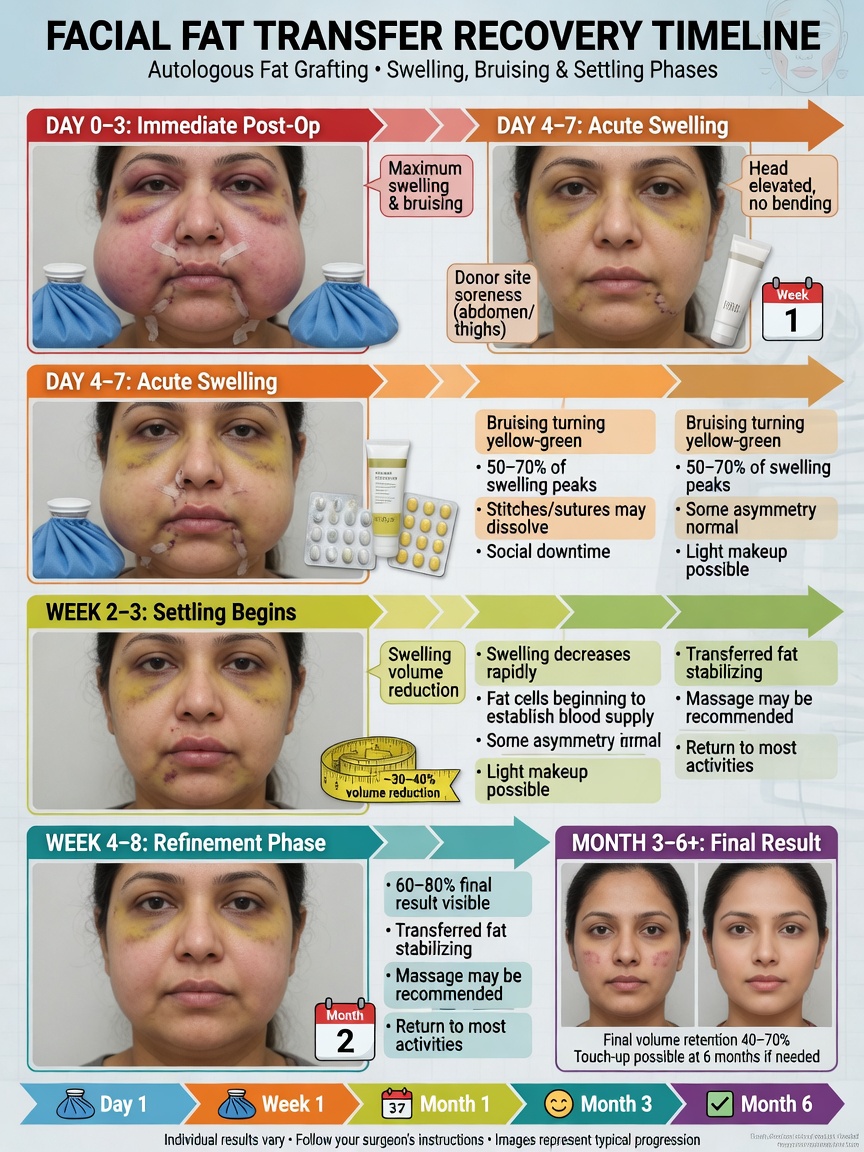
Caption: Facial fat transfer recovery typically requires 10 days before returning to work, with final visible results at 3-6 months post-procedure.
Patients often see 60-70% fat survival at one year, with maintenance using hyaluronic acid fillers becoming an option after two years. Viewing before-and-after galleries of patients with similar facial structure helps set realistic expectations for your individual outcome.
Transition: Moving down the body, breast fat transfer offers an implant-free augmentation option with unique considerations around volume, shape, and cancer detection.
5. Breast Fat Transfer
Breast fat transfer increases volume by 1-2 cup sizes using your own fat, with no implant-related risks and a natural feel that many patients prefer. The 45-55 rule is critical for achieving natural-looking results that mimic breast anatomy.
Breast fat transfer, sometimes called autologous fat grafting to the breasts, has gained popularity as women seek alternatives to implants. The procedure avoids foreign materials, eliminates the risk of capsular contracture, and produces results that look and feel completely natural.
5.1 Breast Augmentation with Fat Grafting vs. Implants
The choice between fat transfer and implants comes down to priorities — each approach offers distinct advantages and limitations:
| Factor | Fat Transfer | Implants |
|---|---|---|
| Volume increase | 1-2 cup sizes | 2-4 cup sizes |
| Feel | Completely natural | Can feel less natural, especially in thin patients |
| Scarring | Tiny incisions (3-4mm) | 3-5cm incisions (periareolar, inframammary) |
| Recovery | 1-2 weeks | 4-6 weeks for full recovery |
| Capsular contracture risk | 0% | 10-20% over lifetime |
| Rupture/leak risk | 0% (no foreign material) | 1-2% per year (modern implants) |
| Longevity | 1-2 cup sizes permanent; may need touch-up | 10-15 years before replacement |
| Mammogram impact | Benign calcifications possible | Implants obscure 10-20% of breast tissue |
| Fat necrosis risk | 5-10% | N/A |
Breast fat transfer is ideal for women with small-to-moderate breasts (A to small C cup) who want a natural increase without implants. It also works well for women with breast asymmetry related to implant removal (explanting) or congenital differences.
Implants remain the better choice for women seeking a dramatic size increase (two or more cup sizes), those with very little body fat (BMI below 20), and those who want a single procedure with predictable, long-lasting volume.
5.2 The 45-55 Rule for Natural Results
The 45-55 rule is a technical principle that experienced breast fat transfer surgeons follow to achieve natural-looking breast shape. During injection, the surgeon distributes fat in a specific ratio: 45% to the upper pole of the breast and 55% to the lower pole.
Why does this ratio matter? A natural breast has a gentle slope — fuller in the lower pole (below the nipple) with a gradual transition to the upper pole. When fat is distributed evenly or biased toward the upper pole, the result can look unnaturally round or “top-heavy,” resembling an overfilled implant rather than a natural breast.
The 45-55 ratio mimics the natural breast shape of most women. It produces a result that looks and feels like a naturally full breast, not an augmented one. Patients report higher satisfaction with this approach because the results are subtle and proportionate to their body frame.
The technique in practice: After processing the harvested fat, the surgeon injects it through 2-3 small entry points (typically in the inframammary fold or around the areola). Using a fanning technique, fat is distributed in multiple layers and planes, with careful attention to the upper-to-lower pole ratio. The surgeon monitors breast shape throughout the procedure, adjusting the distribution as needed.
Caption: The 45-55 rule ensures fat is distributed to mimic natural breast anatomy, preventing an unnaturally round or top-heavy appearance.
The total volume injected per breast depends on your starting size and desired outcome, but typically ranges from 150-300ml per breast. A good candidate starts with at least an A or small B cup and can expect to increase by about one cup size per session.
5.3 Safety and Cancer Detection Considerations
The relationship between breast fat transfer and breast cancer detection deserves careful attention. Fat transfer can cause benign calcifications in breast tissue that may appear similar to microcalcifications associated with early breast cancer on mammograms.
What happens: When fat is injected into breast tissue, some cells undergo necrosis (die), and the body responds by forming small calcifications. These are benign — they represent healing, not disease — but they can create diagnostic uncertainty. Radiologists trained to recognize fat transfer-related calcifications can usually distinguish them from suspicious patterns, but informing your radiologist about your procedure is essential.
Modern techniques minimize interference. Skilled surgeons inject fat primarily into the subcutaneous plane (beneath the skin but above the breast gland) rather than into the glandular tissue itself. This approach significantly reduces the formation of glandular calcifications. The subglandular technique also preserves access for future mammograms and breast self-examinations.
Evidence on cancer safety is reassuring. A long-term study from Cirumed found no increased risk of breast cancer in patients who underwent fat grafting. The study followed patients for up to 10 years and concluded that fat transfer does not raise cancer risk and does not delay cancer detection when proper imaging protocols are followed.
Practical recommendations: Before your procedure, discuss your mammogram history with the surgeon. After recovery, schedule routine mammograms as recommended for your age group. Always inform the radiology technician about your fat transfer procedure. Some women choose to establish a baseline mammogram before surgery, then repeat 6-12 months after to document any benign calcifications for future reference.
Transition: The most requested — and most technically demanding — fat transfer procedure is the Brazilian Butt Lift. Understanding modern safety techniques is essential before considering this option.
6. Buttock Fat Transfer (BBL)
Modern BBL techniques using the gluteal pocket approach have reduced fat embolism risk from 20% to under 10%, making the procedure significantly safer when performed by trained surgeons in accredited facilities. Thailand offers high-quality BBL at 50-65% less than US prices, with experienced surgeons who specialize in the modern technique.
The Brazilian Butt Lift remains one of the most popular cosmetic procedures worldwide, but its safety history has been concerning. The shift from deep intramuscular injection to subfascial placement has fundamentally changed the risk profile — and understanding this difference is the most important decision you’ll make about your BBL.
6.1 Modern Safety Techniques for BBL
The historical problem: Traditional BBL technique involved injecting fat directly into the gluteal muscle (intramuscular injection). The gluteal region contains large blood vessels — the superior and inferior gluteal veins — that travel through the muscle. When fat was injected into the muscle, it could accidentally enter these veins, travel to the lungs, and cause a fat embolism. This was responsible for the disproportionately high mortality rate in BBL compared to other cosmetic procedures.
The modern solution: The gluteal pocket technique, also called subfascial or superficial injection, places fat into the plane just above the gluteal muscle (the subfascial layer). This area has far fewer large blood vessels, dramatically reducing the risk of intravenous injection. The surgeon inserts the cannula at a superficial depth, typically no more than 1-2cm below the skin surface, and deposits fat in controlled micro-droplets.
Evidence of improvement: A Cirumed study documented that complication rates dropped from approximately 20% under the old intramuscular technique to under 10% with the modern subfascial approach. Multiple large-scale reviews have confirmed that when BBL is performed exclusively in the subfascial plane, fat embolism rates approach zero.
What this means for you: When researching Thai surgeons, ask two specific questions: “Do you use the gluteal pocket technique exclusively?” and “Do you ever inject into the muscle?” The correct answer is “Yes, exclusively subfascial” and “No, never.” Any surgeon who still performs intramuscular injection is using an outdated, higher-risk technique.
Additional safety measures that experienced BBL surgeons use include:
- Using blunt-tipped cannulas (less likely to penetrate vessels)
- Performing “test injection” with a small volume before each new puncture
- Limiting total fat injection to 500ml per side (excessive volume increases pressure)
- Keeping the patient awake or lightly sedated to detect early signs of embolism
Surgeons trained in the gluteal pocket method have near-zero fat embolism rates. The key is verifying that your surgeon is one of them.
6.2 Limitations of Fat Transfer for Buttock Enhancement
Understanding what BBL can and cannot achieve helps set realistic expectations — and prevents disappointment after recovery.
Volume limits: The typical BBL transfers 300-500cc of purified fat per buttock. This produces a noticeable but natural improvement — moving from flat to moderately full, or from moderate to full. A dramatic transformation from flat to very full buttocks in a single session is not realistic. Patients seeking a radical increase may need 2-3 procedures spaced 6-12 months apart, or may be better suited to implants (though implants carry their own risks).
Fat survival: Of the fat transferred, 50-70% typically survives at one year. The remaining 30-50% is reabsorbed by the body during the first 3-6 months. This means the immediate post-operative result (which includes swelling) is not the final result. The surgeon typically over-injects by 20-30% to account for expected reabsorption.
Donor fat requirements: BBL requires significant fat for harvesting — typically 600-1000ml of raw fat to obtain 300-500ml of purified, injectable fat. Patients need adequate fat deposits in the abdomen, thighs, flanks, or lower back. A Kamol Hospital publication emphasizes that BBL results depend on patient anatomy and fat availability.
Ideal candidates have a BMI between 22-28, adequate fat in at least two donor areas, good skin elasticity, and realistic expectations about the degree of enhancement possible. Patients with BMI below 20 may not have sufficient donor fat. Patients with BMI above 30 face higher risks of fat necrosis and poor wound healing.
6.3 Recovery and Expected Results
BBL recovery is more involved than facial or breast fat transfer because of the dual nature of the procedure — liposuction of donor areas plus fat injection into the buttocks.
First two weeks: You cannot sit or lie directly on your buttocks. A special BBL pillow (donut-shaped) is essential — it allows you to sit with your thighs bearing the weight while the buttocks remain pressure-free. The donor areas (abdomen, flanks, thighs) are wrapped in compression garments and are sore. Walking is possible but uncomfortable. Most patients take 2 weeks off work.
Weeks 3-6: Pressure on the buttocks is gradually reintroduced. Short periods of sitting (15-20 minutes) are allowed while using the BBL pillow. Swelling in both donor and recipient areas begins to subside. Light exercise (walking) is encouraged to maintain circulation.
Months 1-3: The final result slowly emerges as swelling fully resolves. Fat reabsorption is most active during this period. You may notice the buttocks become smaller than they appeared at 2 weeks — this is normal and expected.
Months 3-6: The final result is visible and stable. The buttocks should feel soft and natural, with a rounded, lifted appearance. The donor areas are fully healed with minimal visible scarring.
Revision rate: Approximately 10-15% of BBL patients opt for a touch-up procedure, either to correct asymmetry, add more volume, or enhance the result. This is higher than for facial fat transfer because BBL involves larger volumes and more movement during recovery, which can affect fat survival.
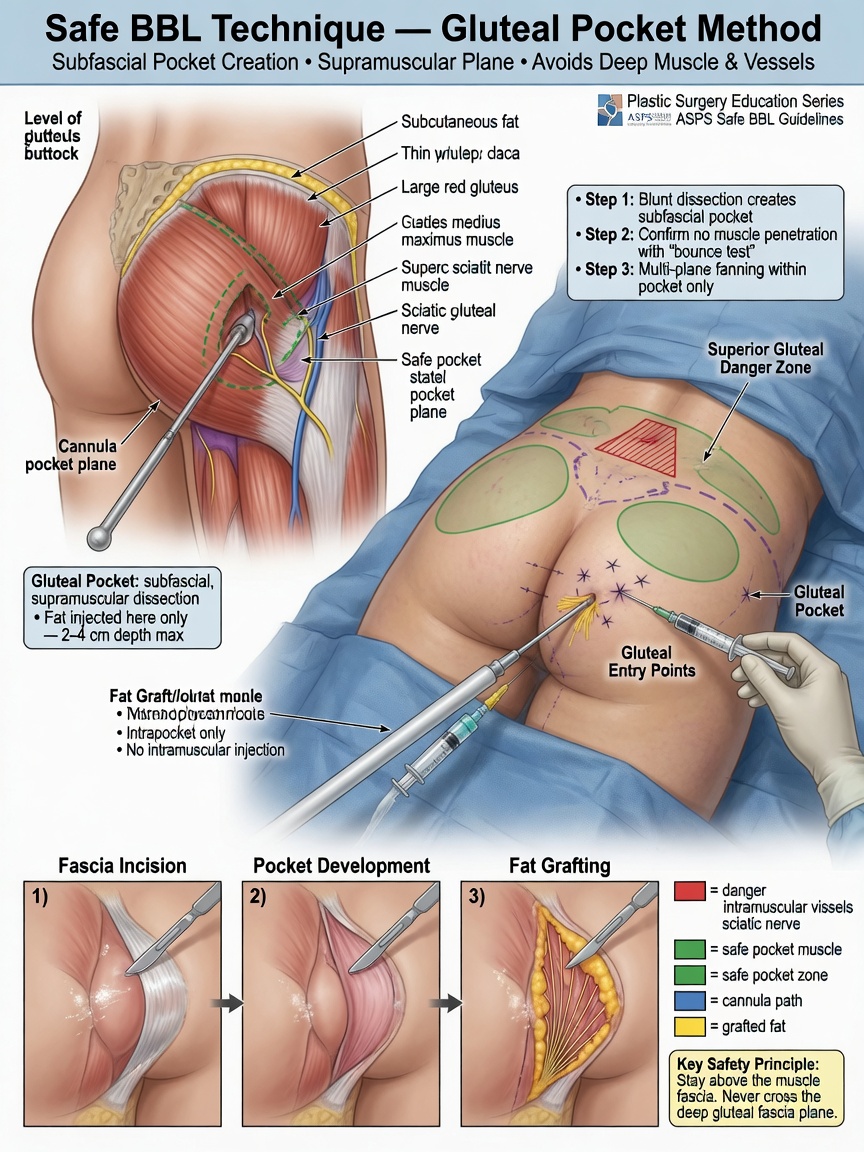
Caption: The gluteal pocket technique places fat above the muscle layer (subfascial plane), avoiding large blood vessels and significantly reducing fat embolism risk.
Patients use a special “BBL pillow” for sitting during the first 2 weeks, and many rent recovery hotel rooms with specialized beds that allow stomach or side sleeping. Planning for this recovery period is essential — rushing back to normal activities can compromise results.
Transition: While BBL can be safe and effective when done correctly, no procedure is without limitations. Understanding common pitfalls and alternative approaches is the final step in applying The Informed Choice Framework.
7. Limitations & Alternatives — Common Pitfalls to Avoid in Fat Transfer
No procedure works for everyone. Understanding when fat transfer is not the right choice — and what alternatives exist — is essential for a successful outcome. The Informed Choice Framework’s third pillar (Cost) must be balanced against the first two (Safety and Surgeon Credentials) to avoid common mistakes.
7.1 Common Pitfalls When Choosing a Fat Transfer Provider
Pitfall 1: Choosing price over safety. A quote that seems too good to be true — a BBL for $2,500, for example when the market range is $4,500-$7,500 — almost certainly means corners are being cut. This could mean a non-accredited facility, a surgeon without board certification, or outdated techniques that increase complication risk. How to avoid: Use JCI accreditation as a minimum threshold, then compare prices among accredited providers.
Pitfall 2: Not verifying BBL-specific training. Fat transfer to the face and breasts requires different skills than BBL. A surgeon who is excellent at facial fat grafting may not have the specific training in the gluteal pocket technique needed for safe BBL. How to avoid: Ask directly about their BBL technique. If they describe “intramuscular injection” or cannot clearly explain the gluteal pocket approach, consider another surgeon.
Pitfall 3: Ignoring your body fat percentage. Fat transfer requires donor fat. If your BMI is below 20, you may not have enough fat to achieve meaningful results. Some clinics still proceed with inadequate volume, leading to poor outcomes with low fat survival. How to avoid: Be honest about your anatomy during the consultation. A reputable surgeon will tell you if you’re not a good candidate and recommend alternatives.
Pitfall 4: Underestimating recovery requirements. BBL requires 2 weeks with no sitting, breast fat transfer requires 1-2 weeks before returning to normal activities, and facial fat transfer needs 10 days of social downtime. Patients who plan insufficient recovery time risk compromising their results. How to avoid: Plan for the maximum recovery time recommended for your procedure, plus a few buffer days.
7.2 When to Choose Alternatives
Scenario 1: Body fat too low. If your BMI is below 20 or you cannot spare 200-300ml of harvestable fat, fat transfer may not be appropriate. Alternative: For facial volume loss, hyaluronic acid fillers provide immediate results with no donor site requirement. For breast augmentation, saline or silicone implants remain the standard option. For buttock enhancement, gluteal implants (though more invasive and with longer recovery) can achieve volume increases not possible with fat transfer.
Scenario 2: Desire for dramatic volume increase. Fat transfer is best for moderate, natural enhancement. If you want to go from an A cup to a D cup or from flat to very prominent buttocks in one session, fat transfer likely cannot achieve this. Alternative: Breast implants remain the most reliable method for large volume increases. For buttocks, gluteal implants or staged fat transfer (2-3 sessions) can achieve more dramatic results, though each approach carries its own considerations.
Scenario 3: Significant skin laxity. Fat transfer adds volume but does not significantly tighten skin. If you have substantial skin laxity — from aging, significant weight loss, or after pregnancy — fat transfer alone may leave you with loose skin over fuller contours. Alternative: For the face, a facelift or mini facelift combined with fat transfer addresses both volume loss and skin laxity. For the body, a body lift or tummy tuck may be needed to remove excess skin before considering fat transfer for contouring.
Medical disclaimer: This guide provides educational information about fat transfer procedures. It does not constitute medical advice. Consult with a board-certified plastic surgeon for a personalized evaluation of your candidacy, risks, and expected outcomes. All surgical procedures carry inherent risks, including infection, bleeding, scarring, and adverse reactions to anesthesia. Individual results vary.
8. Frequently Asked Questions
8.1 Is fat transfer safe in Thailand?
Fat transfer in Thailand is safe when performed in JCI-accredited hospitals by board-certified plastic surgeons. Recent studies report a 10.9% major complication rate across all types, with no reported deaths (PMC, 2023). Thailand has over 60 JCI-accredited facilities meeting international standards. Choose a surgeon who is a member of the Thai Society of Plastic Surgeons. Always verify credentials and ask about their specific experience with your procedure.
8.2 How long does facial fat transfer last?
Facial fat transfer results typically last 1-3 years. About 30-50% of transferred fat is reabsorbed within the first 3-6 months. The remaining fat cells establish a blood supply and can persist for years. Age, lifestyle, and metabolism influence longevity. Touch-up procedures are common after 2-3 years to maintain volume.
8.3 What is the 45-55 rule for breast fat transfer?
The 45-55 rule refers to the distribution of injected fat: 45% to the upper pole of the breast and 55% to the lower pole. This ratio mimics natural breast shape, preventing a top-heavy or unnatural appearance. It respects the breast’s anatomy and is considered a best practice for aesthetic outcomes. Surgeons trained in this technique achieve results that look and feel like natural breasts.
8.4 How much does a BBL cost in Thailand?
A Brazilian Butt Lift (BBL) in Thailand costs $4,500 to $7,500, depending on the clinic location, surgeon experience, and what’s included. This typically covers surgery, anesthesia, facility fee, and follow-up visits. Travel, accommodation, and compression garments may cost extra. Package deals can save 10-20% compared to booking separately. Always verify what’s included before comparing prices.
8.5 Can fat transfer interfere with mammograms?
Yes, fat transfer to the breasts can cause benign calcifications that may resemble microcalcifications on a mammogram. Inform your radiologist about your procedure so they can interpret images correctly. Modern techniques inject fat into the subcutaneous plane to minimize glandular interference. Routine mammograms remain essential for breast cancer screening. A baseline mammogram before surgery and a follow-up 6-12 months after can document any changes for future reference.
9. Conclusion
For medical tourists seeking natural enhancement through fat transfer in Thailand, the combination of JCI-accredited facilities, experienced surgeons, and 40-60% cost savings makes it a compelling option. Current evidence shows a 10.9% major complication rate when procedures are performed correctly (PMC, 2023). The key is applying The Informed Choice Framework: evaluate safety, surgeon credentials, and total cost together — never one in isolation.
The Informed Choice Framework reminds you that the best decision balances three factors equally. A low price with unknown surgeon credentials is risky. An expensive clinic without outcome data is a gamble. By systematically assessing each pillar — verifying JCI accreditation, confirming board certification, understanding what’s included in the price — you can confidently choose a provider that delivers safe, natural results. This framework applies whether you’re considering facial fat transfer for $1,500 or a BBL for $7,500 — the principles remain the same.
Your next step: research 2-3 JCI-accredited clinics in Thailand, request virtual consultations, and ask about their complication rates and revision policies. Start with the Thai Society of Plastic Surgeons directory to find board-certified surgeons. Take your time — a well-researched decision today prevents regrets tomorrow. Prices and data verified as of April 2026.