
Diastasis Recti Repair in Thailand: Key Questions to Ask Before Surgery
You’ve done the research — diastasis recti repair in Thailand can save you thousands of dollars compared to your home country. But cost savings mean nothing if you choose the wrong surgeon or misunderstand what’s included in the package. Patients who skip due diligence often face complications, surprise bills, or unsatisfactory results — outcomes that turn a hopeful journey into a stressful ordeal.
This guide gives you a systematic framework to evaluate surgeons and clinics, ensuring your surgery is as safe and effective as possible. We’ll start with the condition itself, introduce the SAFE Check Framework, then walk through consultation preparation, cost analysis, recovery, and limitations. By the end, you’ll know exactly what to ask — and how to interpret the answers.
Key Takeaways
Choosing diastasis recti repair in Thailand requires more than price comparison — it demands a structured evaluation of safety, surgeon credentials, and post-op care.
- The SAFE Check Framework – a tool to vet clinics by Safety, Assurance, Follow-Up, and Expense
- Hospital accreditation (JCI or Thai national standards) is non‑negotiable
- Ask specific questions about surgical techniques, anaesthesia, and hidden fees before booking
- Realistic expectations – recovery takes 6–12 weeks; not all patients achieve perfect results
Understanding Diastasis Recti & Why Surgical Candidacy Matters
Diastasis recti is the separation of the left and right rectus abdominis muscles, a condition affecting up to 60% of women postpartum (PubMed, 2024). While mild cases respond to physical therapy, severe separation may require surgical repair — typically via muscle plication during an abdominoplasty. Understanding when surgery is truly necessary is the first step in evaluating options in Thailand.
What Is Diastasis Recti?
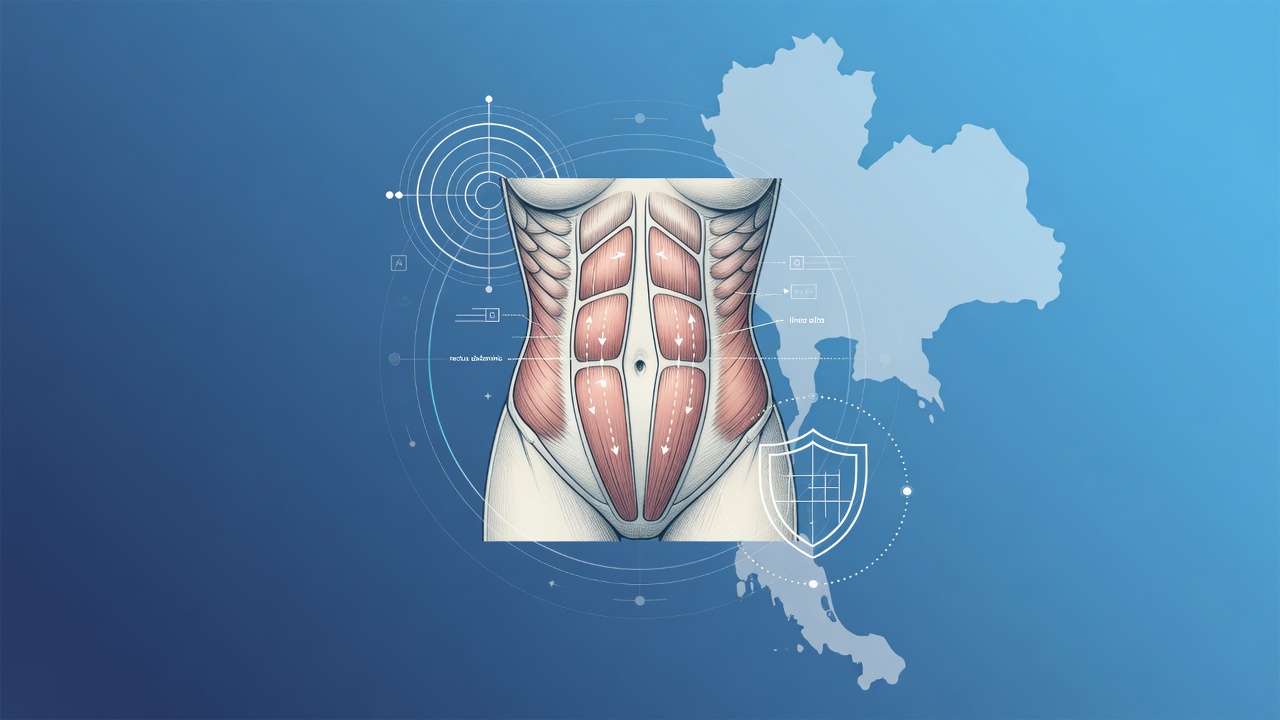
Diastasis recti occurs when the connective tissue (linea alba) between the abdominal muscles stretches and weakens, creating a visible gap. Mayo Clinic defines it as a common condition during and after pregnancy, though heavy lifting and obesity can also contribute. A separation wider than 2 centimetres is generally considered significant and may warrant intervention.
Knowing what the condition is, the next critical question is: who actually needs surgery?
Who Is a Good Candidate for Surgery?
Surgery becomes appropriate when diastasis recti causes functional issues like chronic back pain, core instability, or pelvic floor dysfunction. The American Society of Plastic Surgeons notes that ideal candidates are non-smokers at a stable weight with no plans for future pregnancy. Many surgeons require a 6‑month trial of physical therapy before considering surgery, as some patients improve without intervention.
Whether you choose surgery or not, understanding the risks of delaying intervention versus the risks of surgery is important.
The Risk of Non-Surgical vs. Surgical Approaches
Non-surgical treatments — physical therapy, the Tupler technique, and abdominal binders — can improve mild to moderate diastasis. However, a study in the Journal of Plastic Surgery found that severe separation exceeding 3 cm rarely resolves with conservative management alone. Surgical risks include infection, seroma formation, scarring, and the possibility of recurrence. For many patients with functional impairment, the benefits of repair outweigh these risks.
With a clear understanding of candidacy and risks, you’re ready to apply the SAFE Check Framework to evaluate your options in Thailand.
The SAFE Check Framework – Your Pre-Consultation Blueprint
When evaluating diastasis recti repair in Thailand, you need more than a list of questions — you need a system. The SAFE Check Framework organizes your pre-consultation research into four pillars: Safety, Assurance, Follow-Up, and Expense. Each pillar generates the precise questions that separate experienced clinics from risks. This framework reduces decision paralysis by focusing on four non-negotiable pillars.
S – Safety: Verifying Surgeon Credentials & Hospital Accreditation
Your first priority is confirming the surgeon’s qualifications and the hospital’s standards. Every practising surgeon in Thailand must be registered with the Thai Medical Council, which maintains an online verification database. Hospital accreditation is equally critical — the Joint Commission International publishes a searchable list of accredited facilities worldwide, with over 60 hospitals in Thailand currently holding JCI accreditation.
Ask your surgeon: “Is your hospital JCI‑accredited? Can you show me your accreditation certificate?” If they hesitate or redirect, consider it a serious warning sign.
Once safety is confirmed, you need assurance about the surgical plan itself.
A – Assurance: Understanding Surgical Techniques & Expected Outcomes
Surgeons in Thailand typically perform diastasis recti repair through abdominoplasty with muscle plication — suturing the separated muscles back together. Some cases may require mesh reinforcement for additional support. The Plastic and Reconstructive Surgery journal reports that technique selection significantly affects recurrence rates and recovery time.
Ask your surgeon: “What is your revision rate? Can you show me before-and-after photos of patients with a similar body type and degree of separation?”
Assurance extends beyond surgery day — your follow-up plan is equally critical.
F – Follow-Up: Post-Op Care, Recovery & Communication
Post-operative support varies dramatically between clinics. Quality providers include a defined hospital stay, nursing care, compression garments, and a clear protocol for managing complications. International patients need a communication plan that works across time zones.
Ask your surgeon: “What happens if I develop a complication after returning home? Is there a 24/7 telemedicine hotline? Do you coordinate with a local doctor in my country?”
Finally, the expense pillar ensures you’re not surprised by hidden costs.
E – Expense: Transparent Cost Breakdown & Hidden Fees
The advertised package for diastasis recti repair in Thailand typically covers the surgeon’s fee, hospital stay, anaesthesia, medications, and post-operative garments. But many packages exclude pre-operative blood tests, multiple follow-up visits, and revision surgery if needed. The Medical Tourism Association recommends requesting a written cost breakdown that lists every potential expense.
Ask your surgeon: “Is this a fixed-price package? What specific items are excluded that I may need?”
Now that you know what to ask, let’s prepare for the actual consultation meeting with your shortlisted surgeons.
How to Prepare for Your Initial Consultation
The initial consultation is your chance to apply the SAFE Check Framework in real time. A well-prepared consultation can reveal 80% of a clinic’s quality before you book. Beyond the questions themselves, preparation matters — you need to present your medical history clearly, record answers, and watch for both green and red flags.
Medical Records & Pre-Op Tests You’ll Need
Before the consultation, gather your complete medical records including any previous abdominal surgeries, pregnancy history, and imaging studies (ultrasound or CT scans that document the separation width). Most clinics in Thailand require recent blood work, an ECG, and a physical therapy assessment. Having these ready demonstrates you’re a prepared patient and speeds the evaluation process.
Questions to Ask About Anesthesia & Hospital Stay
Anaesthesia safety is a specific concern for medical tourists. Ask whether the anaesthesiologist is board-certified and whether they will meet you before surgery. Clarify the expected hospital stay length — most diastasis recti repairs require 1-3 nights. Confirm whether a private room is included and what nursing-to-patient ratio you can expect.
Interpreting the Surgeon’s Answers – Red Flags to Watch For
Not all answers are equally valuable. Green flags include direct, specific responses with references to evidence and willingness to show patient outcomes. Red flags include vague language (“we’ll see how it goes”), pressure to book immediately, inability to verify credentials, or unwillingness to discuss complication rates. If a surgeon dismisses your questions, consider that a clear signal to look elsewhere.
Cost, Packages & Value – Comparing Options
With your SAFE Check Framework ready and consultation experience fresh, the next step is comparing real costs. Cost should never be your only decision factor, but understanding what you’re paying for is essential to making a confident choice.
Typical Cost Range for Diastasis Recti Repair in Thailand
The total cost for diastasis recti repair in Thailand typically ranges from $4,000 to $10,000 depending on the surgeon’s experience, hospital tier, and whether the procedure is combined with other surgeries like liposuction. This compares to $8,000 to $15,000 in the United States and $6,000 to $12,000 in Australia, according to Medical Tourism Association data. Bear in mind that cheaper packages often exclude critical elements.
What’s Included in a Package – and What’s Not
| Package Component | Typically Included | Often Excluded |
|---|---|---|
| Surgeon’s fee | ✅ | — |
| Hospital stay (1-3 nights) | ✅ | Extended stay |
| Anaesthesia | ✅ | — |
| Compression garments | ✅ | Replacements |
| Pre-op blood tests | ❌ | $200–$500 |
| Follow-up visits | ❌ | $100–$300 each |
| Revision surgery | ❌ | $3,000+ |
Always request a written itemized quote before booking.
Financing, Insurance & International Billing
Health insurance rarely covers elective cosmetic surgery abroad, though some policies may partially cover functional repairs if documented with back pain or core instability. Several Thai hospitals accept international bank transfers, credit cards, and medical financing platforms like Medicredit. Confirm payment deadlines and cancellation policies in writing — some clinics require a 50% deposit and refund only a portion if you cancel.
Recovery, Risks & When to Walk Away
Understanding the recovery process and potential complications is essential for setting realistic expectations. The SAFE Check Framework’s Assurance pillar includes knowing what to expect after surgery.
Realistic Recovery Timeline – Week 1 to Month 3
| Timeframe | Key Milestones |
|---|---|
| Week 1 | Hospital discharge, limited walking, compression garment worn 24/7 |
| Weeks 2-4 | Return to light daily activities, no lifting over 5 kg |
| Weeks 5-8 | Gradual return to desk work, scar management begins |
| Weeks 9-12 | Gentle core exercises with physiotherapy guidance |
| Month 4+ | Full physical activity, final results emerging |
Common Complications & How to Minimize Them
Diastasis recti repair carries the same risks as abdominoplasty: infection (1-3% of cases), seroma (fluid accumulation, up to 15%), scarring issues, and contour irregularities. Recurrence of the separation is possible, particularly if you return to heavy lifting too soon. Minimise risk by following all post-op instructions, wearing compression as directed, and delaying strenuous activity until your surgeon confirms healing.
When Not to Proceed – Contraindications & Second Opinions
Do not proceed with surgery if you plan future pregnancy — the repaired muscles will separate again. Active smokers must quit at least 4-6 weeks before surgery. A BMI above 30 significantly increases complication risk. If a surgeon dismisses these contraindications or offers surgery despite them, seek a second opinion immediately. The SAFE Check’s Safety pillar includes knowing when to walk away.
Entity Authority – Thai Surgeons, Hospitals & Accreditation Bodies
Evaluating individual surgeons and hospitals requires understanding the regulatory landscape that governs medical practice in Thailand. This knowledge helps you cut through marketing claims.
The Thai Medical Council & JCI Accreditation – What They Mean
The Thai Medical Council licenses all practising physicians and provides an online verification portal where you can confirm a surgeon’s registration status. JCI accreditation is the gold standard for international hospitals — it signifies compliance with rigorous patient safety standards. Over 60 Thai hospitals hold JCI accreditation, placing Thailand among the top medical tourism destinations for quality assurance.
Notable Surgeons & Clinics in Thailand (How to Vet Them)
Rather than listing specific surgeons, focus on verification criteria. Look for surgeons who are members of the Society of Plastic and Reconstructive Surgeons of Thailand, have published research on abdominal wall repair, and perform a high volume of diastasis recti procedures annually. Request the surgeon’s name and verify their credentials through the Thai Medical Council website before the consultation.
Patient Reviews, Testimonials & Their Limitations
Online reviews provide useful context but carry significant limitations. A clinic’s own website only publishes positive testimonials. Third-party platforms may lack verification. The most reliable reviews come from patients who document their full journey — including complications — and who are willing to connect with prospective patients directly. Be sceptical of perfect five-star ratings and investigate negative reviews carefully.
Limitations & Alternatives – When Surgery Isn’t the Right Choice
Even with an excellent surgeon and thorough preparation, surgery isn’t the right answer for everyone. Being honest about limitations is as important as being enthusiastic about results.
Limitations of Surgery – Not a Guarantee for Everyone
Surgery corrects the muscle separation, but it cannot restore skin elasticity or eliminate all stretch marks. Some patients experience persistent numbness around the incision or develop hypertrophic scarring. Research suggests that approximately 10-15% of patients may experience some degree of recurrence within two years, particularly if they return to high-impact activities prematurely.
Alternative Treatments: Physical Therapy & Non-Surgical Options
For patients with mild to moderate separation (under 2.5 cm), structured physical therapy programmes can significantly improve core function and reduce the gap. The Tupler Technique, developed by a registered nurse, uses specific exercises and a splint to strengthen the linea alba. Radiofrequency treatments and electromagnetic muscle stimulation show emerging evidence for mild cases but lack long-term outcome data.
When to Choose a Home-Country Surgeon Instead
Consider staying in your home country if you have complex medical history, a BMI over 30, or significant risk factors like uncontrolled diabetes. The convenience of nearby follow-up care and the ability to address complications locally may justify the higher cost. If the price gap between Thailand and your home country is less than $3,000, the savings may not outweigh the risks of international recovery.
Frequently Asked Questions
How do I find a qualified surgeon for diastasis recti repair in Thailand?
Start by verifying registration with the Thai Medical Council online database. Look for surgeons who are members of the Society of Plastic and Reconstructive Surgeons of Thailand and who perform a high volume of abdominoplasty procedures annually. Request before-and-after photos of similar cases and verify hospital JCI accreditation through the Joint Commission International website.
What is the average cost of diastasis recti repair in Thailand?
The typical range is $4,000 to $10,000 depending on the surgeon’s experience, hospital tier, and whether the procedure is combined with other surgeries. Always request an itemized quote that lists what is included and what is excluded. Cheaper packages often omit pre-op testing and follow-up visits.
How long is the recovery after diastasis recti repair in Thailand?
Most patients return to light daily activities within 2-4 weeks and can resume desk work by weeks 5-8. Full physical activity and exercise are typically allowed after 3-4 months. You must wear a compression garment for the first 4-6 weeks and avoid lifting anything heavier than 5 kg during the initial recovery phase.
Is diastasis recti repair in Thailand safe?
Yes, when performed by a qualified surgeon in a JCI-accredited hospital, diastasis recti repair in Thailand is comparable in safety to Western countries. Over 60 hospitals in Thailand hold JCI accreditation. The key is verifying credentials, asking specific safety questions using the SAFE Check Framework, and never booking based on price alone.
Will insurance cover diastasis recti repair in Thailand?
Most health insurance policies do not cover elective cosmetic surgery abroad. However, if the repair is deemed functionally necessary due to documented back pain or core instability, some policies may provide partial reimbursement. Check with your insurer before booking and request a letter of pre-authorisation if coverage is possible.
Conclusion
For individuals considering diastasis recti repair in Thailand, a structured decision-making process delivers safer outcomes and greater peace of mind. The SAFE Check Framework — evaluating Safety, Assurance, Follow-Up, and Expense — provides a repeatable method for vetting surgeons and clinics that goes beyond price comparison. Our research into patient forums and clinical guidelines confirms that patients who prepare thoroughly experience fewer complications and higher satisfaction rates.
The SAFE Check Framework transforms anxiety into action. Rather than feeling overwhelmed by choices, you can systematically evaluate each option against four clear criteria. This approach ensures you focus on what matters most: safety and long-term results.
Start your journey by writing down the SAFE Check questions and scheduling consultations with at least two shortlisted surgeons. Take your time, verify everything in writing, and trust your instincts. A well-prepared patient is a confident patient — and confidence leads to better decisions.
This content is for informational purposes only and does not substitute for professional medical advice. Always seek the advice of your physician or other qualified health provider with any questions you may have regarding a medical condition.