
Liposuction in Thailand: VASER vs Traditional, Costs, Clinics, Recovery, and What to Expect
Deciding to undergo liposuction in Thailand is exciting, but the choices can feel overwhelming — VASER or traditional? Which clinic is safe? How much will it really cost? Without a clear framework, you risk wasting money and time while settling for subpar results. Many patients book based on the cheapest price or flashy before/after photos, only to discover hidden fees, longer recoveries, or disappointing outcomes.
By the end of this guide, you’ll have a structured 3-Pillar Evaluation Framework — comparing technique, cost, and clinic credentials — to confidently choose the right path for your body and budget. We’ll compare VASER vs traditional liposuction, break down real cost ranges by area, show you how to evaluate clinics, detail the recovery timeline, and set realistic expectations.
This guide is based on published data from accredited Thai clinics and medical tourism platforms to provide a comprehensive, balanced overview.
Key Takeaways
Choosing liposuction in Thailand requires evaluating three pillars: technique, cost, and clinic credentials — each directly affects your safety, recovery, and results.
- VASER liposuction offers gentler fat removal and typically 2–3 days faster recovery than traditional methods.
- Cost ranges from $1,500–$4,000 per area depending on clinic reputation and package inclusions.
- Accredited clinics (JCI, Thai FDA, or hospital-based) provide higher safety standards and better emergency support.
Liposuction Options: VASER vs Traditional
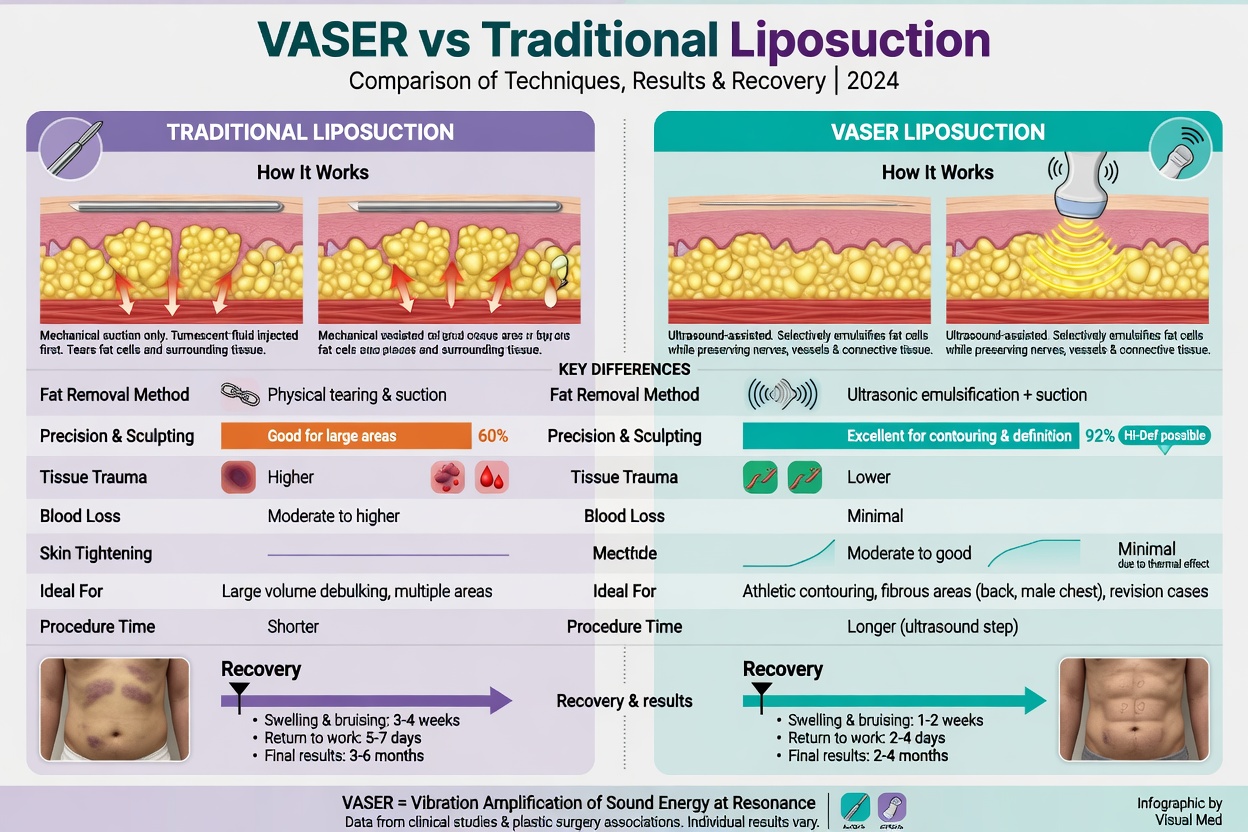
VASER liposuction and traditional suction-assisted liposuction are the two most common body contouring techniques used in Thailand. VASER uses ultrasonic energy to liquefy fat before gentle removal, leading to less tissue trauma and faster healing (Maxi Clinic, 2025). Understanding this difference is the first pillar of your decision framework — it directly affects cost, recovery, and which body areas can be treated effectively.
How VASER Liposuction Works
VASER liposuction technique relies on ultrasonic energy to transform the fat removal process. VASER stands for Vibration Amplification of Sound Energy at Resonance — the ultrasonic probe emits sound waves that break fat cells into a liquid emulsion. This emulsified fat is then gently suctioned out through small cannulas, causing significantly less damage to connective tissue, blood vessels, and nerves compared to traditional methods.
The result is smoother contouring, noticeably less bruising, and a shorter recovery period. VASER also excels at treating fibrous areas like the back and male chest, where traditional methods struggle.
A typical abdomen treatment with VASER requires only 1–2 small incisions hidden in natural skin creases. Many clinics combine VASER with other techniques for optimal results across multiple body areas. According to clinical data, patients often report 2–3 days less downtime when choosing VASER over conventional methods.
How Traditional Suction-Assisted Liposuction Works
Traditional liposuction uses a stainless steel cannula attached to a vacuum. The surgeon manually moves the cannula back and forth to physically break up and suction out fat cells. This method is highly effective for large-volume fat removal — typically 3–5 liters or more — and can be performed under local or general anesthesia depending on the extent of treatment.
However, traditional liposuction recovery involves more tissue trauma, leading to increased bruising, swelling, and longer downtime. A typical traditional lipo of the abdomen might require 3–4 days of bed rest and up to 2 weeks of significant swelling before you see meaningful improvement. Traditional methods may also produce less even contours if the surgeon lacks experience, particularly in areas with fibrous tissue.
Comparison Table: VASER vs Traditional Liposuction
| Factor | VASER Liposuction | Traditional Liposuction |
|---|---|---|
| Technology | Ultrasonic energy emulsifies fat | Mechanical suction breaks fat |
| Energy Used | Low-frequency ultrasound | Vacuum pressure only |
| Incision Size | 2–4 mm | 4–6 mm |
| Recovery Time | 3–5 days to return to light activity | 5–7 days to return to light activity |
| Bruising | Mild to moderate | Moderate to significant |
| Best Areas | Multiple areas, fibrous zones (back, chest) | Large volume, single areas |
| Cost per Area | $2,000–$4,000 | $1,500–$3,000 |
| Ideal Candidate | Seeks faster recovery, less downtime | Budget-conscious, large volume needed |
VASER wins on gentleness and speed, but traditional liposuction remains more budget-friendly for single large-area procedures.
Which Technique Is Right for You?
Choose VASER if you value faster recovery, less bruising, and plan to treat multiple body areas. Choose traditional liposuction if you’re on a tight budget or need a large volume of fat removed from a single area. Your surgeon’s assessment — considering skin elasticity, overall health, and your aesthetic goals — should ultimately guide this decision.
Now that you know the difference between VASER and traditional, the next pillar is understanding what you’ll actually pay. Let’s break down the costs.
How Much Does VASER Liposuction Cost in Thailand?
VASER liposuction in Thailand costs between $1,500 and $4,000 per area depending on clinic location, surgeon experience, and package inclusions (FlyMedi, 2025). Prices vary significantly based on the body area treated, the clinic’s reputation, and whether you choose a boutique clinic or a hospital-based facility. Understanding these variables is Pillar 2 of your evaluation framework.
Typical Cost Ranges by Body Area
VASER liposuction Thailand cost varies predictably by body area and fat volume:
| Body Area | Low Range (USD) | High Range (USD) | Notes |
|---|---|---|---|
| Abdomen | $1,500 | $2,500 | Common for 1–2 liters of fat |
| Thighs (inner and outer) | $1,800 | $3,000 | Often combined with knees |
| Arms | $1,500 | $2,200 | Smaller area, quicker procedure |
| Back/Bra Line | $1,800 | $3,000 | Fibrous area benefits from VASER |
| Chin/Neck | $1,200 | $2,000 | Small volume, high precision |
| Male Chest | $2,000 | $4,000 | Gynecomastia treatment, complex |
Prices tend to be higher in central Bangkok and popular tourist destinations like Phuket, while clinics in Pattaya or Chiang Mai may offer lower rates. Surgeon reputation also commands a premium — internationally recognized surgeons charge more but bring extensive experience.
What’s Included in Typical Packages?
VASER liposuction packages typically bundle several components into a single price. Standard inclusions are:
- Surgeon’s fee and operating room costs
- Anesthesia (local or general)
- Compression garments (1–2 sets)
- Post-operative medications (pain relief, antibiotics)
- Follow-up appointments (1–3 visits)
- Some packages include airport transfer and accommodation
Always ask what’s excluded. Some clinics charge extra for compression garments beyond the first set, additional nights in recovery accommodation, or specific garment types like foam boards for even pressure. All-inclusive packages often provide better value and peace of mind for international patients.
Why Prices Vary Between Clinics
VASER liposuction price differences stem from several factors. Surgeon experience and reputation drive the largest variation — a surgeon with 15+ years of VASER-specific experience charges more than a general practitioner. Clinic type matters too: hospital-based facilities (like Bangkok Hospital) cost more than standalone boutique clinics but offer stronger emergency support. Location plays a role — clinics in central Bangkok pay higher rent and pass those costs to patients. Package inclusions also differ: some clinics quote a base price and add charges for compression garments, medications, or follow-up visits. Always request a detailed written quote before booking, and don’t automatically choose the cheapest option. Check reviews, accreditation, and surgeon credentials first.
Understanding costs is useless without knowing where to go. Let’s move to Pillar 3: choosing the best clinic.
Choosing the Best Liposuction Clinic in Thailand
Choosing a safe liposuction clinic in Thailand requires systematic evaluation of accreditation, surgeon credentials, and patient feedback — not just price. Many international patients rely on platforms like FlyMedi or Bookimed to compare clinics, but verifying the information yourself is essential. This section gives you the criteria to evaluate any clinic with confidence.
Accreditation and Safety Standards
Safe clinics for Thailand liposuction hold internationally recognized accreditation that proves they meet rigorous safety standards. Joint Commission International (JCI) accreditation is the gold standard — it means the hospital or clinic passes regular inspections covering infection control, emergency protocols, and patient safety management. Thai FDA approval for medical devices and pharmaceuticals provides another layer of protection.
Hospital-based clinics offer superior safety infrastructure. If a complication occurs during surgery, hospital facilities provide immediate access to emergency care, blood transfusions, and specialized medical teams. Standalone boutique clinics may be perfectly safe for routine procedures, but always verify their emergency transfer arrangements.
Always verify a clinic’s JCI status on the JCI website or ask directly during your consultation. Reputable clinics proudly display their accreditation.
Evaluating Surgeon Credentials
Choosing a liposuction surgeon in Thailand requires checking several credentials:
- Thai Medical Council registration (verify the license number)
- Board certification in plastic surgery (not just general surgery)
- Minimum 5 years of experience specifically with VASER liposuction
- Before/after portfolio showing consistent, natural results
- Positive patient reviews on independent platforms (not just the clinic’s website)
- English language proficiency for clear communication
Request a video consultation before booking. This lets you assess the surgeon’s communication style, willingness to answer questions, and transparency about risks and realistic outcomes. Reputable surgeons will discuss limitations and potential complications, not just highlight successes.
Top Clinics Overview (for Reference)
Several clinics are commonly cited by international patients for VASER liposuction in Thailand:
- Bangkok Hospital — JCI accredited, part of the Bangkok Dusit Medical Services network, offers comprehensive cosmetic surgery with strong emergency support (Bangkok Hospital, 2025).
- KKC Clinic — Specializes in VASER liposuction with an international patient focus, located in Bangkok.
- Maxi Clinic — Provides detailed VASER information and has experience treating international patients.
- Clinic Booking platform — Aggregates multiple clinic listings; use it for comparison but always verify clinic credentials directly.
Note that platforms like FlyMedi and Bookimed act as intermediaries — they help you compare options but you should contact clinics directly for the most accurate pricing and package details.
Your clinic choice also affects your recovery experience. Let’s dive into what happens after surgery.
Recovery After Liposuction in Thailand
The liposuction recovery timeline in Thailand follows a predictable pattern: the first week requires rest and compression garments, with most swelling subsiding by week four and final results visible around six months (Beauty Butler Thailand, 2025). Understanding this timeline helps you plan your travel, accommodation, and time off work.
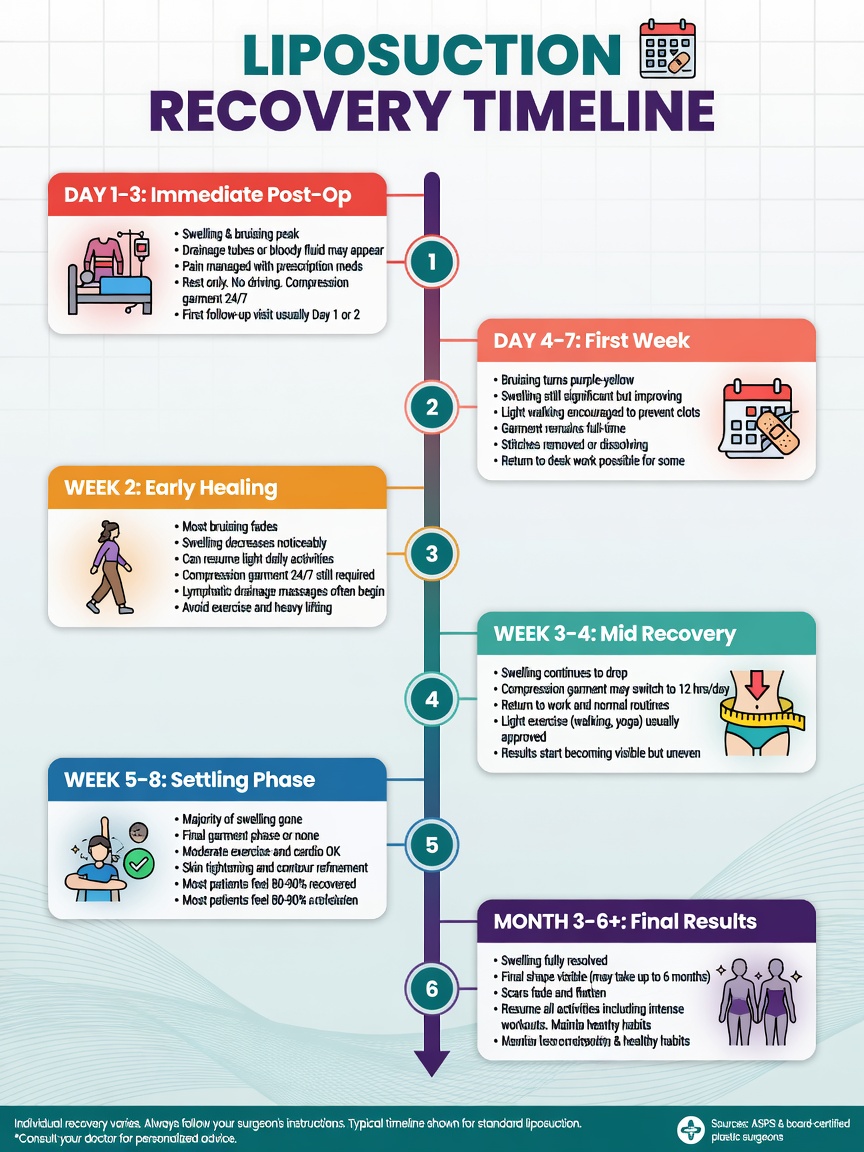
Week-by-Week Recovery Timeline
Liposuction recovery progresses through clear phases:
Days 1–3: You’ll rest in recovery accommodation. Drains may be placed to remove excess fluid. Start wearing compression garments immediately. Minimal activity — walking to the bathroom only. Mild to moderate pain managed with prescribed medication.
Week 1: Drains removed (if placed). Swelling peaks during days 3–5. You can walk slowly but should avoid stairs and exertion. Compression garments worn 23 hours daily. Follow-up appointment to check healing.
Weeks 2–4: Swelling begins noticeably decreasing. Most patients return to desk jobs after week 2. Compression garments still required most of the day. Light walking encouraged for circulation.
Weeks 4–6: Swelling mostly resolved. Compression garment may be reduced to nighttime only. Light exercise allowed (walking, stretching, no heavy lifting). New body contour becomes visible.
Months 3–6: 70–80% of final results visible by month 3. Full results at 6 months, especially with VASER, which continues stimulating collagen production for subtle skin tightening.
VASER recovery is typically 2–3 days faster than traditional liposuction at each stage due to reduced tissue trauma.
Compression Garments and Post-Op Care
Compression garments after liposuction are not optional — they are essential for proper healing. They reduce swelling, support skin contraction to the new body contour, and minimize the risk of seroma (fluid accumulation).
Key guidelines:
- Wear compression garments 23 hours daily for the first 2–3 weeks.
- Reduce to 12 hours daily (typically at night) during weeks 4–6.
- Have at least two garments to rotate — wash one while wearing the other.
- Foam boards or pads may be placed under garments for even pressure on specific areas.
- Plan to buy your garments in Thailand before surgery — they are often cheaper and professionally fitted.
Your clinic will provide specific garment instructions based on your procedure and body areas treated.
When Can You Fly Home?
Recovering from liposuction in Thailand as an international patient requires planning your travel timeline. Most surgeons recommend staying in Thailand 7–14 days post-surgery. The first week allows for drain removal, initial swelling management, and your first follow-up. The second week gives your body time to stabilize before the flight.
Flying too soon increases the risk of deep vein thrombosis (DVT). Wait at least 3–5 days, and only fly when your surgeon clears you. Your surgeon will give you a specific clearance timeline based on your procedure and individual healing progress.
Return to desk jobs is possible after 1–2 weeks. Physical labor or exercise should wait 3–6 weeks depending on the extent of your procedure.
Recovery directly affects your results. Let’s talk about what those results should look like.
Expected Results: Before and After Liposuction
Realistic expectations are crucial for liposuction satisfaction — final results take 3–6 months to fully develop and depend on factors like weight stability, skin elasticity, and the surgeon’s technique (Clinic Booking, 2025). Understanding this timeline prevents disappointment during the initial swollen phase.
When Will You See Final Results?
The liposuction results timeline varies by individual but follows a predictable pattern. Immediately after surgery, you will look swollen and lumpy — do not judge the result at this stage. The swelling is your body’s natural response to trauma and will take weeks to subside.
- 2–4 weeks: Swelling begins reducing significantly. Your new shape becomes visible, though still blurred by residual swelling.
- 3 months: 70–80% of the final result is apparent. Most patients feel satisfied with their contour at this point.
- 6 months: Final results are visible. VASER patients may continue seeing subtle improvements due to ongoing collagen remodeling.
Results are permanent if you maintain a stable weight, but liposuction is not a weight loss tool — it removes stubborn fat deposits that resist diet and exercise.
Are Results Permanent?
Liposuction results are permanent in one sense and conditional in another. The fat cells removed during surgery are gone permanently — they do not grow back. However, the remaining fat cells in your body can enlarge if you gain weight. If you gain 10 pounds after liposuction, the fat distributes proportionally across remaining cells, which can alter your silhouette.
Maintaining a stable weight through diet and exercise is essential for preserving results. Liposuction also cannot prevent natural aging or skin laxity over time.
How to Spot Authentic Before/After Photos
Real patient results from liposuction require honest evaluation of clinic portfolios. Unfortunately, some clinics use misleading or retouched photos. Use these criteria to spot authentic images:
- Same lighting, pose, and background in both before and after photos.
- Consistent body positioning — standing at the same distance and angle.
- No obvious retouching, filters, or airbrushing.
- Look for identifying marks (tattoos, scars, moles) to confirm same patient.
- Legitimate clinics have hundreds of examples, not just a few cherry-picked best results.
Ask the clinic for photos of patients with similar body type and fat volume as yours. If a clinic hesitates or only shows dramatic transformations, proceed with caution.
We’ve covered technique, cost, clinics, recovery, and results. Let’s answer some common questions.
Frequently Asked Questions
Q1: Is VASER liposuction better than traditional?
Yes, for most patients, VASER liposuction is gentler and offers faster recovery — typically 2–3 days less downtime (Maxi Clinic, 2025) — because it uses ultrasonic energy to liquefy fat before removal. This results in less bruising, smoother contours, and less damage to surrounding tissues. However, traditional liposuction may be more cost-effective for single large-area fat removal, especially when removing 3+ liters.
Q2: How much does VASER liposuction cost in Thailand?
VASER liposuction in Thailand typically costs between $1,500 and $4,000 per treatment area. The total price depends on the number of areas, surgeon reputation, clinic location, and whether the package includes compression garments and follow-up care. Always request a detailed written quote before booking.
Q3: How long do I need to stay in Thailand after liposuction?
Most surgeons recommend a minimum stay of 7–14 days after liposuction in Thailand. The first week is critical for rest, drain removal (if applicable), and initial swelling management. The second week allows for follow-up visits and clearance to fly home.
Q4: Will I have scars after liposuction in Thailand?
Yes, but scars are typically very small — 3–6 mm tiny incisions placed in natural skin creases. They fade significantly over 6–12 months. VASER liposuction uses even smaller incisions than traditional methods due to the smaller cannulas. Proper wound care and avoiding sun exposure during the first year can minimize scar visibility.
Q5: Are liposuction results permanent?
Yes, fat cells removed by liposuction are permanently gone. However, if you gain weight after surgery, the remaining fat cells in untreated areas can expand, altering your silhouette. Maintaining a stable weight through diet and exercise is essential to preserving your results long-term. Liposuction is a contouring tool, not a weight loss solution.
Q6: How can I verify a clinic’s accreditation?
Start by asking the clinic for their JCI or Thai FDA accreditation number — then verify it directly on the accrediting body’s website. Reputable clinics will also be listed on platforms like FlyMedi or Bookimed. During your consultation, request to see the surgeon’s Thai Medical Council license number. Walk away if they refuse to provide it.
Final Thoughts: Making an Informed Decision
Choosing liposuction in Thailand requires balancing three pillars: technique, cost, and clinic credentials. VASER liposuction offers gentler recovery and better contouring for multiple areas, while traditional methods remain cost-effective for large single-area procedures. With transparent pricing around $1,500–$4,000 per area and rigorous clinic evaluation using the criteria in this guide, you can confidently make a decision that matches your body, budget, and safety expectations. Always begin with a consultation with a JCI-accredited clinic.
The 3-Pillar Evaluation Framework — compare techniques first, then costs and packages, then clinic credentials — streamlines your decision. It prevents you from being swayed by the lowest price or flashy photos. Start with Pillar 1: understand the difference between VASER and traditional, because your technique choice dictates the rest of your journey.
Ready to take the next step? Research three JCI-accredited clinics in Thailand, request a video consultation with each, and ask for a detailed package quote for the areas you want treated. Most clinics offer free online consultations — use them to gauge their responsiveness and expertise before you travel.