Laparoscopic vs Open Surgery in Thailand: What You Need to Know
You’ve already done the basic research — you know laparoscopic surgery involves small incisions and faster recovery, while open surgery is more invasive but sometimes necessary. But when it comes to choosing between them for your medical trip to Thailand, the decision involves more than just procedure details. Every day you wait, you’re missing out on potentially faster recovery, lower costs, and peace of mind. At the same time, choosing the wrong approach or provider could lead to complications, unexpected bills, or a frustrating recovery abroad.
By the end of this guide, you’ll have a clear, step‑by‑step framework — the Informed Choice Protocol — to confidently evaluate laparoscopic vs open surgery Thailand based on procedure, cost, safety, provider quality, preparation, recovery, and legal considerations. We’ll start with the key differences between the two procedures, then explore costs, safety, how to choose a hospital, what to ask your surgeon, what recovery looks like, and finally the legal and logistical details that make or break a medical tourism experience.
Key Takeaways
When choosing between laparoscopic and open surgery in Thailand, the right choice depends on your specific medical condition, budget, and recovery expectations.
- Laparoscopic surgery offers shorter hospital stays (1–3 days) and faster recovery (1–2 weeks) but costs 20‑30% more than open surgery.
- Open surgery may be necessary for complex or emergency cases and offers clearer access for surgeons.
- Thailand’s JCI‑accredited hospitals provide world‑class safety standards at competitive prices.
- Use the Informed Choice Protocol to systematically evaluate all factors before deciding.
Key Differences: Laparoscopic vs Open Surgery
Laparoscopic and open surgery differ fundamentally in incision size, recovery time, and when each is medically recommended. NIH research shows laparoscopic surgery leads to shorter hospital stays and less postoperative pain (NIH StatPearls, 2025). This makes laparoscopy the default choice for many routine procedures, but open surgery remains essential for complex or emergency cases.
| Feature | Laparoscopic Surgery | Open Surgery |
|---|---|---|
| Incision Size | 3–5 small incisions (< 1 cm each) | Single larger incision (5–10 cm) |
| Hospital Stay | 1–3 days | 3–7 days |
| Recovery Time | 1–2 weeks to normal activities | 3–6 weeks to normal activities |
| Pain Level | Significantly less postoperative pain | Moderate to severe; often requires stronger pain management |
| Suitability | Routine procedures (e.g., gallbladder removal) | Complex/emergency cases (e.g., trauma, adhesions) |
Understanding the Two Approaches
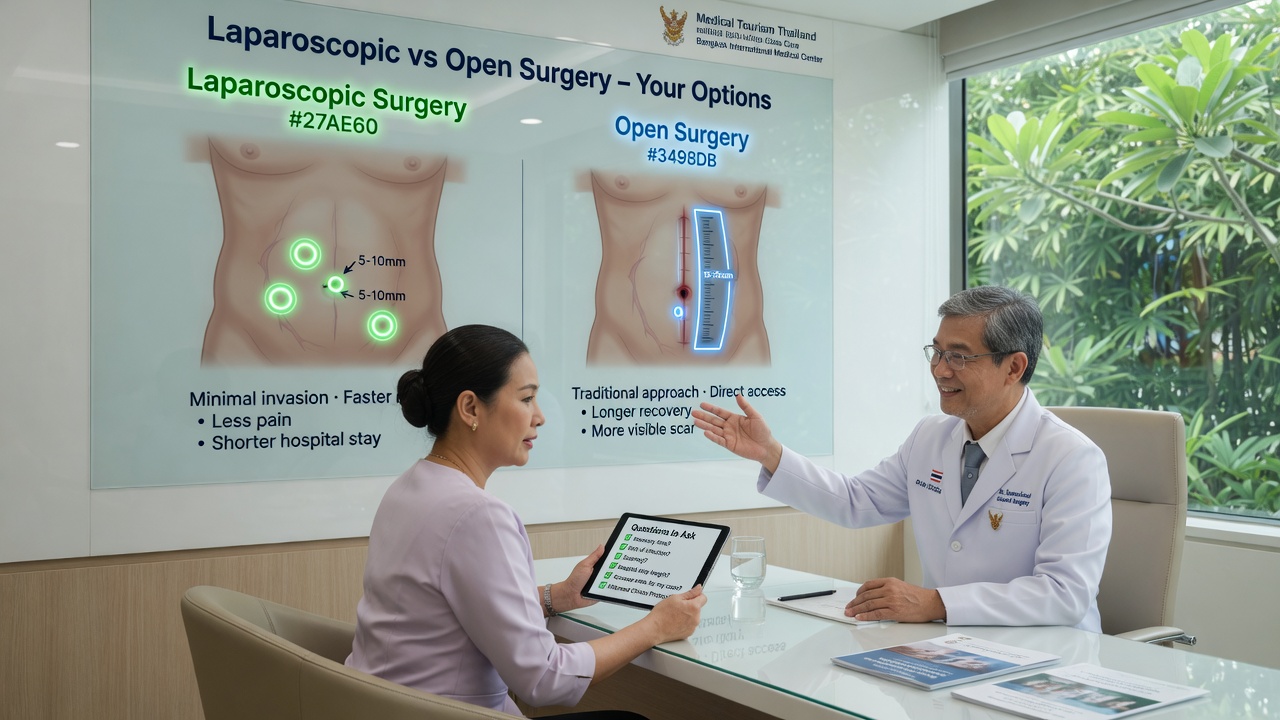
Laparoscopic (keyhole) surgery uses 3–5 small incisions (less than 1 cm each) and a camera to guide instruments inside the abdomen. A common example is gallbladder removal (cholecystectomy). Open surgery requires a single larger incision (5–10 cm) for direct access to organs, often used in emergency laparotomy for trauma or when adhesions from prior surgeries make laparoscopy difficult. Patient factors such as BMI, previous abdominal procedures, and surgical history determine which approach is safer.
Now that you understand the basic difference, let’s quantify the advantages in terms of recovery and comfort.
Comparing Recovery, Scarring, and Hospital Stay
Laparoscopic patients return to work 2‑3 weeks faster than open surgery patients (NIH Systematic Review, 2025). Hospital stay for laparoscopy averages 1–3 days; for open surgery it’s 3–7 days. Recovery to normal activities takes 1–2 weeks with laparoscopy versus 3–6 weeks with open surgery. Pain levels are significantly lower after laparoscopy, so open surgery patients often require stronger pain management. For example, a laparoscopic hernia repair typically allows discharge within 24 hours, while an open repair may require a 2‑day hospital stay and several weeks off work.
While these benefits are significant, there are critical scenarios where open surgery remains the safer approach.
When Open Surgery Is the Better Choice
Prior abdominal surgeries causing adhesions, severe obesity (BMI >40), or emergency conditions such as uncontrolled bleeding or a perforated ulcer often make open surgery the better choice. In these cases, laparoscopy may be technically difficult or carry higher complication risks. FDA complication data notes that conversions from laparoscopic to open occur in 2–5% of cases, usually due to poor visibility or unexpected findings (FDA, 2025). The key takeaway: laparoscopy is not universally superior — surgeon experience and patient‑specific factors always guide the final decision.
With the procedural differences clear, the next step in the Informed Choice Protocol is understanding how these choices affect your budget and safety.
Cost, Safety & Finding the Right Provider in Thailand
Thailand offers competitive pricing for both approaches, with laparoscopy costing 20–30% more than open surgery — but the shorter hospital stay often balances the total bill. Accredited hospitals maintain infection rates comparable to Western centers.
Cost Comparison: What to Expect for Each Procedure
Laparoscopy cost Thailand typically ranges from $3,000 to $6,000 for an all‑inclusive package at a JCI‑accredited hospital (FlyMedi Thailand pricing, 2025). Open surgery runs $2,500 to $4,500. The exact price depends on the hospital tier (e.g., Bumrungrad vs. a public facility), procedure complexity, and length of stay. For instance, a laparoscopic cholecystectomy at Samitivej Hospital may cost around $4,000, while the same open procedure might be $3,200. Always request an itemized quote before committing.
| Procedure | Typical Cost (USD) | Hospital Stay | Package Inclusions |
|---|---|---|---|
| Laparoscopic cholecystectomy | $3,000–$6,000 | 1–3 days | Surgeon, anesthesia, hospital stay, medications |
| Open cholecystectomy | $2,500–$4,500 | 3–7 days | Same as above, plus extended nursing care |
| Laparoscopic hernia repair | $2,800–$5,500 | 1–2 days | Surgeon, mesh, hospital stay |
| Open hernia repair | $2,200–$4,000 | 2–4 days | Same as above |
(Prices approximate as of 2026.)
Cost is only half the equation. Understanding the safety record of each procedure ensures you’re not compromising quality for price.
Safety and Risk Profiles: What the Data Says
Is laparoscopic surgery safe? Yes — in experienced hands, the overall complication rate is under 2% (FDA complication data, 2025). Risks include trocar injury (rare), infection, and bleeding. For open surgery, wound infection rates are higher (2–5%) and the longer recovery increases the risk of deep‑vein thrombosis. Thailand’s top hospitals follow CDC guidelines for surgical site infection prevention, achieving rates below 1% — on par with U.S. academic medical centers (CDC SSI guidelines, 2025). The Thai Ministry of Public Health enforces strict infection control protocols, adding an extra layer of safety for medical tourists.
Always consult your surgeon for personalized risk assessment — your health profile matters more than any general statistic.
How to Choose an Accredited Hospital and Surgeon
Best hospitals in Thailand for surgery include Samitivej, Bumrungrad, and Vejthani — all are JCI‑accredited and have dedicated international patient departments. When vetting a surgeon, check:
- Board certification in general surgery or a subspecialty
- Laparoscopic fellowship and years of experience
- Total number of the specific procedure performed
- Complication and conversion rates (ask directly)
Contact the hospital’s international coordinator to verify credentials. You can also check the Thai Ministry of Public Health’s list of accredited facilities (Ministry of Public Health standards, 2025).
Once you’ve chosen your procedure and provider, it’s time to prepare. The next step of the Informed Choice Protocol covers the essential questions and logistics you need to handle before surgery.
Your Essential Pre-Surgery Preparation
A well‑prepared patient experiences less anxiety and achieves better outcomes. This section covers the critical questions for your surgeon, Thailand‑specific visa and insurance details, and a practical pre‑op checklist.
Questions to Ask Your Surgeon Before the Procedure
Asking these 7 questions before surgery can reduce decisional conflict and improve postoperative satisfaction (American College of Surgeons, 2025). Tailor them for laparoscopic vs open surgery:
- How many laparoscopic procedures have you performed? – Surgeon volume directly correlates with lower complication rates (Mayo Clinic, 2025).
- What are the risks specific to my case? – Factors like obesity or prior surgeries can change the risk profile.
- What is the typical recovery timeline? – Ask about hospital stay, return to work, and return to normal activities.
- Will you use a specific technique (e.g., single‑incision laparoscopy)? – Some approaches offer even smaller scars.
- What is your conversion rate to open surgery? – A rate above 5% may indicate inexperience.
- What aftercare support does the hospital provide for international patients? – Telemedicine, nurse visits, recovery hotels.
- What is included in the quoted price, and what might be extra? – Avoid surprise charges.
Armed with the right questions, you also need to handle the administrative side – visas, insurance, and understanding your rights.
Visa, Insurance, and Legal Considerations
Thailand offers a Medical Treatment Visa (MTV) valid up to 90 days. You’ll need a treatment plan from the hospital and proof of payment. Step‑by‑step:
- Obtain a detailed treatment plan from your chosen hospital.
- Apply for the MTV at the Thai embassy in your home country.
- Ensure your international health insurance covers elective surgery abroad — many Thai hospitals accept direct billing.
Patient rights in Thailand are similar to those for Thai citizens. The Thai Medical Council regulates surgeon standards, and patients can file complaints through the Ministry of Public Health (FlyMedi medical tourism guide, 2025). Always verify current visa requirements before booking, as policies can change.
Pre‑Op Checklist for International Patients
Before you depart, run through this checklist:
- [ ] Compile all medical records and a current medication list.
- [ ] Download communication apps (WhatsApp, Line) for hospital contact.
- [ ] Pack loose, comfortable clothing and necessary toiletries.
- [ ] Arrange accommodation near the hospital for the first week after discharge.
- [ ] Confirm your surgeon’s credentials and hospital accreditation.
Preparing for recovery is just as important as preparing for the procedure itself. Let’s look at what you can expect after surgery in Thailand.
Recovery, Aftercare, and Coming Home
Laparoscopic patients recover faster and need shorter stays, but both approaches require careful aftercare planning. Every hospital offers different levels of support for international patients.
Recovery Timeline: What to Expect Week by Week
Patients should plan a minimum of 2 weeks in Thailand after laparoscopic surgery and 4 weeks after open surgery (Samitivej Hospital, 2025). Here’s a side‑by‑side view:
| Time After Surgery | Laparoscopic | Open |
|---|---|---|
| Week 1 | Discharge 1–3 days; walking by day 2 | Hospital stay 3–7 days; limited mobility |
| Weeks 2–4 | Return to light work (office); minor lifting restrictions | Still need significant rest; wound care; avoid driving |
| Weeks 4–6 | Full recovery; heavy lifting allowed by week 6 | Return to work if recovery progressing; no heavy lifting |
| Full Recovery | 4–6 weeks (most patients) | 6–8 weeks for full activity |
Aftercare Packages and Telemedicine Follow‑Ups
Most JCI‑accredited hospitals offer comprehensive aftercare: nurse home visits, telemedicine follow‑ups via video call at 1 week and 1 month, and wound care guidance. Bumrungrad and Samitivej even partner with nearby “recovery hotels” — hotels with nursing‑qualified staff and medical concierge services. Telemedicine means you can stay connected with your surgeon after returning home, reducing anxiety and ensuring continuity of care.
Travel Tips and When You Can Fly
Travel after surgery Thailand depends on your procedure and recovery progress. For laparoscopic surgery, you can fly as early as 7 days post‑op if there are no complications, but 14 days is safer. For open surgery, wait at least 2–3 weeks; for long‑haul flights, 4 weeks is recommended. Always obtain a “Fit to Fly” certificate from your surgeon before departure. On the flight, wear compression stockings, stay hydrated, and walk the aisle periodically to prevent DVT (CDC travel after surgery guidelines, 2025).
Now that you’ve learned the entire Informed Choice Protocol — from understanding the procedures to planning your recovery — let’s address some common questions patients have.
Limitations & Important Disclaimer
No single surgical approach is right for everyone. The Informed Choice Protocol is a decision‑making framework, not a substitute for professional medical advice.
Common Pitfalls When Choosing Surgery Abroad
- Choosing laparoscopy solely for cost without verifying the surgeon’s expertise — this raises complication and conversion rates.
- Not verifying hospital accreditation — unaccredited facilities may lack infection control protocols.
- Underestimating recovery time — a tight schedule can force early flying, risking complications.
- Action: Always check official JCI accreditation on the hospital’s website and ask for the surgeon’s credential documents.
When to Seek Expert Help
- Complex medical history (multiple comorbidities, prior abdominal surgeries) — consult a surgeon experienced in both approaches.
- Emergency symptoms during recovery (fever, severe pain, bleeding) — contact the hospital’s international patient hotline or seek local emergency care.
Disclaimer: This article is for informational purposes only and does not constitute medical advice. Always consult with a qualified healthcare professional for personalized medical guidance based on your health condition.
Frequently Asked Questions
What is the difference between laparoscopic and open surgery?
Laparoscopic (keyhole) surgery uses small incisions and a camera while open surgery uses a single larger incision for direct access. This difference leads to shorter hospital stays, less pain, and faster recovery with laparoscopy, but open surgery offers better visibility for complex cases. For example, a laparoscopic cholecystectomy usually allows discharge within 24 hours, while open may require 3‑5 days in hospital. The choice depends on your specific condition, previous surgeries, and surgeon’s recommendation.
Is laparoscopic surgery safe in Thailand?
Yes, laparoscopic surgery in JCI‑accredited Thai hospitals has complication rates below 2%, comparable to Western centers. Thai hospitals follow rigorous infection control protocols set by the Ministry of Public Health. Over 2 million medical tourists choose Thailand annually, with laparoscopic procedures being among the most common. Still, risk depends on your health status and the surgeon’s experience. Choose a board‑certified surgeon with a high volume of laparoscopic procedures for the best outcomes.
How much does laparoscopic surgery cost in Thailand?
Laparoscopic surgery in Thailand typically costs between $3,000 and $6,000 depending on the procedure, hospital, and package inclusions. This is 50–70% less than comparable surgery in the United States or Europe. Costs usually cover surgeon fees, hospital stay, anesthesia, and medications. Additional costs may include pre‑op tests, aftercare, and accommodation for recovery.
What questions should I ask my surgeon before laparoscopic surgery?
Ask about your surgeon’s experience with the specific procedure, including how many they have performed. Inquire about the risks specific to your case, such as bleeding, infection, or conversion to open surgery. Ask about the expected recovery timeline and any aftercare support available. Clarify costs: what is included in the package and what might be extra. Finally, ask about hospital accreditation and how complications are handled. Your surgeon should answer these thoroughly before you consent.
How long do I need to stay in Thailand after surgery?
For laparoscopic surgery, plan a minimum of 2 weeks in Thailand after discharge; for open surgery, at least 4 weeks. This allows for initial recovery, follow‑up appointments, and wound care. Your surgeon will provide a clearance letter when it’s safe to fly. The Medical Treatment Visa allows up to 90 days, which is ample time for most recoveries. Always arrange accommodation near the hospital for the first week after discharge.
Conclusion
Choosing between laparoscopic vs open surgery Thailand is a major decision that affects your health, budget, and recovery. This guide has walked you through the Informed Choice Protocol – six steps covering procedural differences, costs, safety, provider selection, preparation, and aftercare. By understanding each factor, you can make a confident, informed choice tailored to your medical needs.
The Informed Choice Protocol isn’t just a list – it’s a framework that encourages systematic evaluation. From understanding why open surgery may be necessary despite laparoscopy’s benefits, to preparing the right questions and planning your recovery, each step builds on the last to give you the full picture.
Your next step is to start implementing the Protocol: contact a JCI‑accredited hospital like Samitivej or Bumrungrad, request a treatment plan, and schedule a consultation. Use the questions from this guide to evaluate your surgeon. With the Protocol in hand, you’re ready to take control of your medical tourism journey.