
How to Verify a Surgeon in Thailand: Complete Guide
Medical Disclaimer: This guide is for informational purposes only and does not constitute medical advice. Verify all credentials through official channels.
You’ve decided to explore medical tourism in Thailand – but how do you know the surgeon is truly qualified? Without a reliable verification process, even the most promising treatment can turn into a costly nightmare. Scams, misrepresented credentials, and hidden fees are real risks. A single misstep can derail your health and waste thousands of dollars. By the end of this guide, you’ll have a complete Four‑Pillar Framework – covering surgeon verification, travel preparation, cost planning, and safety confirmation – so you can proceed with confidence. We’ll walk you through each pillar step by step, with official resources, red flags, and budget insights to keep you safe.
Key Takeaways
Verifying a surgeon in Thailand requires a structured approach – the Four‑Pillar Framework – to replace fear with actionable steps.
- Check official channels: Use the Medical Council of Thailand database to confirm license numbers.
- Prepare documents: Passport, visa, travel insurance, and proof of 20,000 baht funds.
- Budget realistically: Consultations cost $30‑50; procedures save 50‑70% vs US prices.
- Confirm accreditation: Look for JCI or ISO certification on hospital websites.
Why Due Diligence Is Non‑Negotiable for Medical Tourism
The Risks of Skipping Verification
A single unverified surgeon can undermine everything you hope to gain from medical tourism. Without due diligence, you may encounter fake credentials, unlicensed clinics, or inflated bills. Cases of misrepresentation have been documented, and the consequences extend beyond financial loss – they can affect your long‑term health. UK Government travel advice warns travelers to verify medical credentials before their trip, underscoring the serious risks of skipping verification.
The good news is that a simple, repeatable process – the Four‑Pillar Framework – can protect you.
How the Four‑Pillar Framework Protects You
The Four‑Pillar Framework gives you a structured method to replace anxiety with action. Pillar 1: Verify – confirm your surgeon’s credentials through official Thai databases. Pillar 2: Prepare – gather travel documents, vaccines, and insurance. Pillar 3: Budget – understand costs and the 20,000 baht entry rule. Pillar 4: Confirm – ensure your hospital meets international accreditation standards.
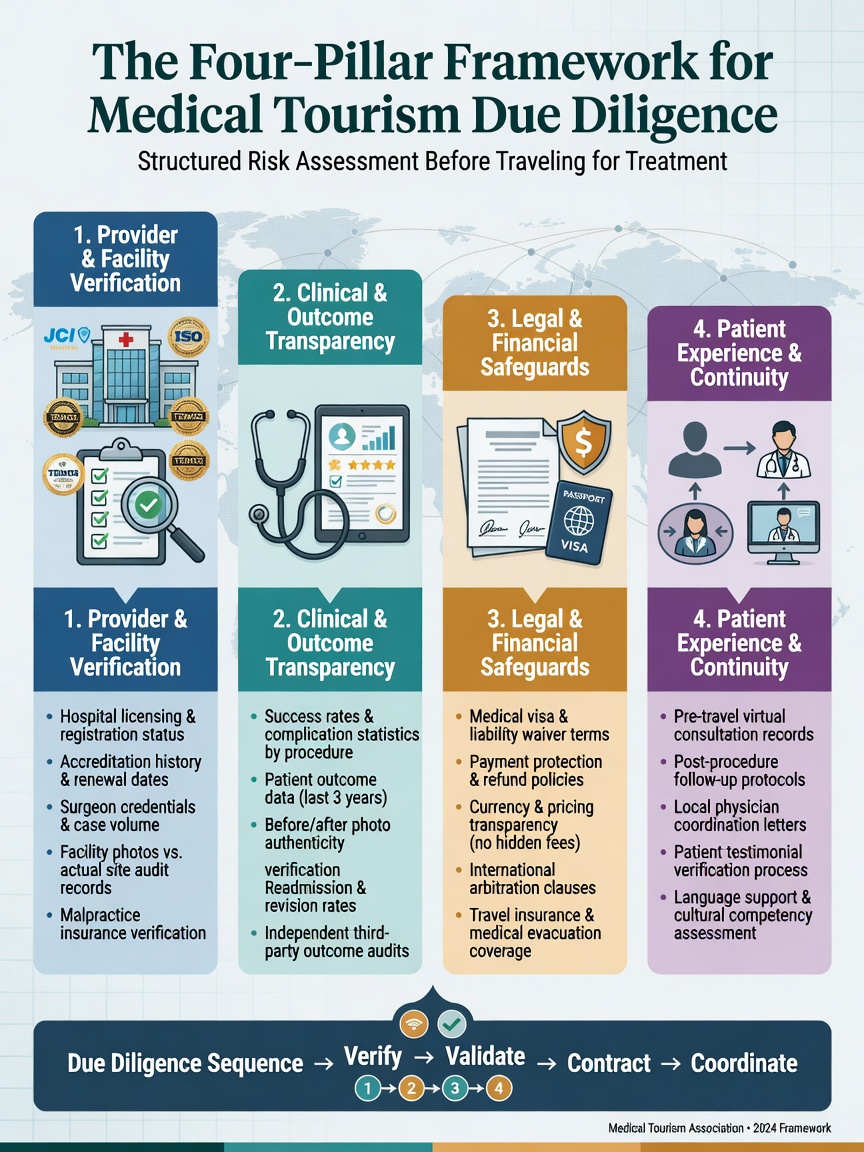
Caption: The Four‑Pillar Framework provides a step‑by‑step path to safe medical tourism in Thailand.
Let’s start with the most critical pillar: verifying your surgeon’s credentials.
How to Verify a Surgeon in Thailand Before You Travel
Why Surgeon Verification Matters
How to verify a surgeon in Thailand begins with recognising that your surgeon’s qualifications are the foundation of safe care. Without this step, you risk trusting someone who may not have the training or legal standing to perform your procedure. Connecting back to the risks outlined earlier, verification is your first line of defence.
Here’s the step‑by‑step process that thousands of international patients use.
Step 1: Request the Surgeon’s Full Name and Thai License Number
Your first concrete action is to ask the clinic for the surgeon’s full name in Thai and their Thai medical license number. The Medical Council of Thailand database uses Thai script, so requesting the name in Thai ensures an accurate search. Use a clear script: “Could you please provide me with the surgeon’s full name (in Thai) and their medical license number?” Refusal to provide this information is a major red flag. A Reddit discussion among patients confirms that obtaining the license number is the essential first step.
With the name and number, you can now check the official database.
Step 2: Check the Medical Council of Thailand Database
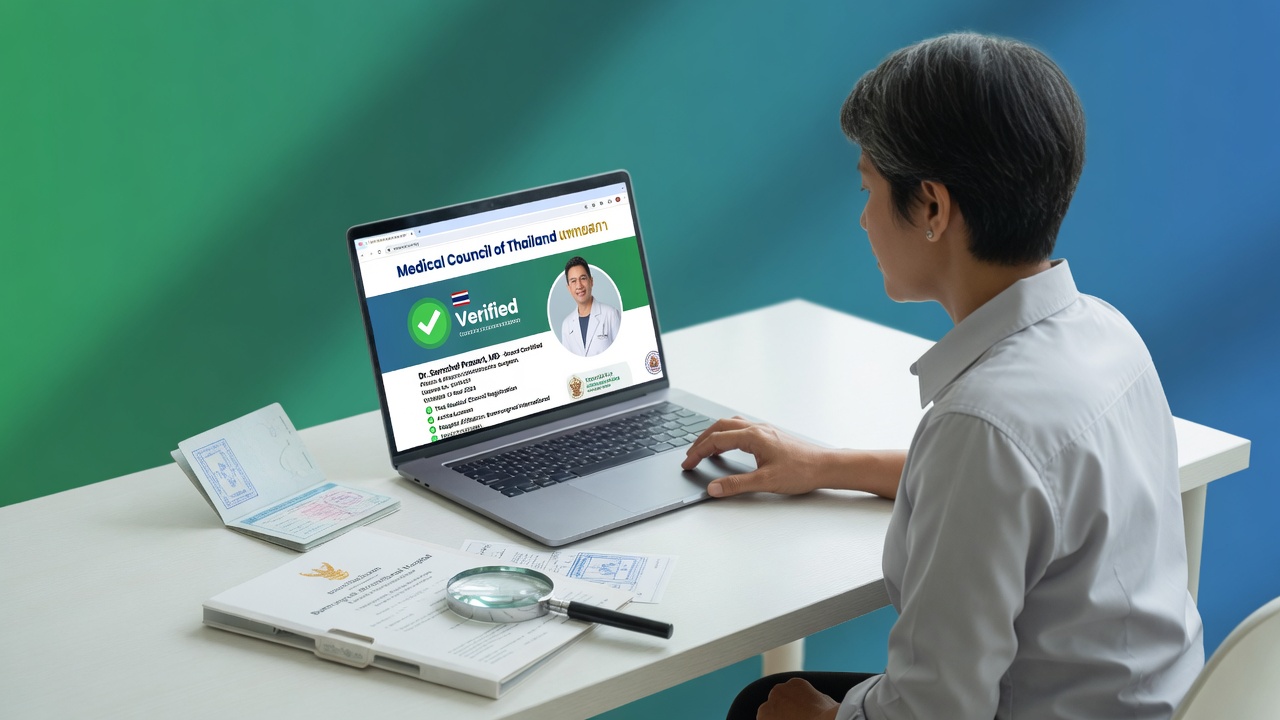
The Medical Council of Thailand (MCT) maintains an online physician verification database. How to officially verify a doctor’s credentials in Thailand involves entering the license number into this database to confirm registration status, specialty, and any disciplinary actions. The interface may be in Thai, but most browsers offer translation tools. This is the most authoritative source – it is the official registry of all licensed physicians in the country.
**
Next, ensure the hospital itself is reputable.
Step 3: Cross‑Check with Hospital Credentialing
Reputable hospitals such as Bumrungrad, Bangkok Hospital, and Samitivej carefully credential their surgeons. Ask the clinic for the hospital’s JCI or ISO certification and verify directly on the accrediting body’s website. For example, you can check Bumrungrad Hospital for its JCI accreditation status. This process also helps with how to verify a company in Thailand – if the hospital is listed, the clinic linked to it is more likely to be legitimate.
Caption: Top Thai hospitals display their JCI accreditation on their websites.
Beyond Thai credentials, many international patients want English‑language verification.
Step 4: Verify English‑Language Credentials and Experience
Many Thai surgeons trained abroad or hold international memberships, such as with the American Board of Plastic Surgery or the Royal College of Surgeons. Request copies of international certificates and check professional affiliations on LinkedIn or the hospital’s website. These supplementary checks confirm that the surgeon’s experience matches international standards.
Knowing the steps is only half the battle – here are the warning signs that should make you walk away.
Red Flags to Watch For
Be alert to these red flags: refusal to provide a license number; pressure to pay a deposit before verification; vague credentials or no clear hospital affiliation; prices that seem too good to be true; and a clinic website that lacks a detailed surgeon profile. If you encounter any of these, stop the process and consider another provider.
Once the surgeon is verified, the next pillar is preparing for your trip.
Medical Tourism Preparation and Travel Requirements
Pre‑Travel Health Checklist
What to check before travelling to Thailand for medical care starts with your health. Consult your primary care doctor at least six weeks before departure. Review recommended vaccines: routine vaccines, plus hepatitis A, typhoid, and possibly rabies (depending on your itinerary). The CDC travel health recommendations provide up‑to‑date guidance. Refill all prescription medications and bring copies of your prescriptions. Pack a folder with your medical records, pre‑existing condition summaries, and emergency contacts – including your hospital’s direct number.
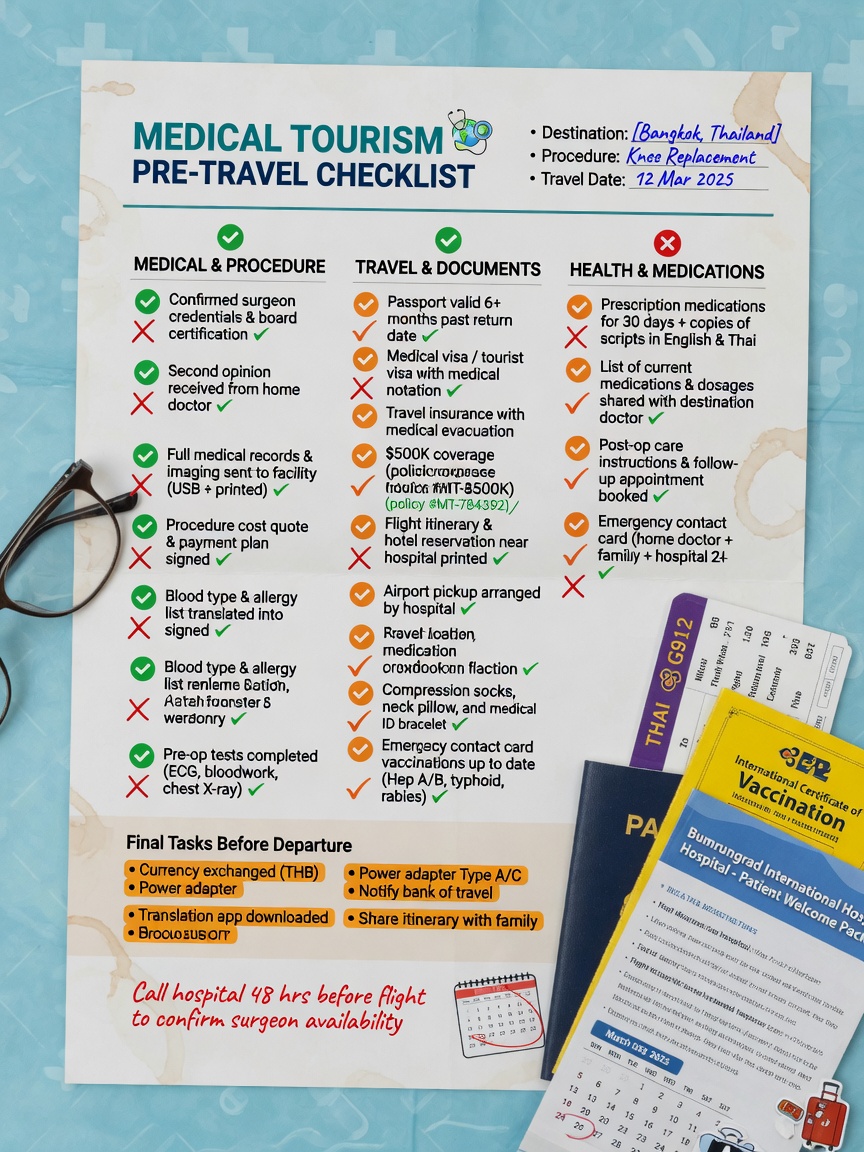
Caption: A pre‑travel checklist helps ensure you don’t miss critical preparations.
Next, understand the entry rules that could stop you at the border.
Passport, Visa, and the 112 Rule Explained
Your passport must be valid for at least six months beyond your date of entry. For medical tourism, a 60‑day tourist visa (available on arrival for many nationalities) is usually sufficient. Longer treatment may require a medical visa – check with the Thai embassy. The 112 rule is a Thai immigration requirement that foreign visitors must carry at least 20,000 baht (∼$550) in cash or traveler’s checks to prove financial self‑sufficiency. This applies to all tourists, including medical travelers. UK Government travel advice confirms that immigration officers may ask to see proof. Practical tip: bring that amount in cash and keep a bank statement as backup.
Once you meet entry requirements, the next critical decision is insurance.
Travel Insurance vs International Health Insurance
Travel insurance typically covers trip cancellations, lost luggage, and emergency medical evacuation – suitable for short stays. International health insurance offers broader coverage for ongoing treatment, pre‑existing conditions (after a waiting period), and outpatient care – better for longer treatment plans. Most US health plans, including Medicare and Medicaid, do not cover care in Thailand. Some private employer plans provide limited emergency coverage. Always call your insurer before traveling and get written confirmation of your benefits. For most medical tourists, a comprehensive travel insurance policy with medical evacuation coverage is the minimum, while international health insurance is recommended for extended stays.
Finally, know how to access care once you land.
How to See a Doctor in Thailand as a Tourist
How to see a doctor in Thailand as a tourist is straightforward. Most private hospitals accept walk‑ins, but appointments are recommended for specialist consultations. Bring your passport and insurance card – these are required for registration. English is widely spoken in private hospitals, and translators are available. Consultation fees range from $30 to $80. Major hospitals accept credit cards, though some require a deposit for procedures. DoctorSA provides a practical guide to navigating the Thai healthcare system as a tourist.
Now that you’re prepared, let’s talk about the costs and insurance options.
Cost of Medical Treatment and Insurance in Thailand
How Much Does a Doctor Visit Cost in Thailand?
A consultation with a specialist in Thailand costs between $30 and $80 – that’s 60–70% less than similar visits in the US or UK. How much does a doctor visit cost in Thailand? Here is a comparison of common procedures:
| Procedure | Thailand Cost (USD) | US/UK Cost (USD) | Estimated Savings |
|---|---|---|---|
| Specialist Consultation | $30–$80 | $150–$300 | 60–70% |
| Hip Replacement | $12,000–$15,000 | $40,000–$60,000 | 70% |
| Rhinoplasty | $3,000–$5,000 | $8,000–$15,000 | 60% |
| Dental Implant | $1,000–$1,500 | $3,000–$5,000 | 65% |
Prices vary by hospital and surgeon reputation. Always ask for a written price quote before treatment. Data sourced from DoctorSA and general industry reports.
Beyond procedure costs, you need to understand a specific entry requirement.
The 20,000 Baht Entry Requirement
What is the 20000 baht rule? It is the financial proof requirement under the 112 rule. As a medical tourist, you must show that you have at least 20,000 baht in cash or equivalent funds. This can be cash, traveler’s checks, or a bank statement showing the balance. While you may not always be asked, it’s safest to carry the cash and keep a copy of a recent bank statement. This requirement applies to all foreign nationals entering Thailand, regardless of the purpose of visit.
Insurance is a major cost consideration – let’s address the most common question.
Does Your US Health Insurance Work in Thailand?
Will my US health insurance cover me in Thailand? The short answer is: rarely. Medicare and Medicaid do not cover international care. Most private PPO plans also exclude out‑of‑country treatment, though some offer limited emergency coverage. Before you travel, call your insurer and ask specifically about international coverage. Get written confirmation. For short trips, purchase a travel insurance policy with at least $100,000 in medical evacuation coverage. For longer stays or planned procedures, consider international health insurance from providers like Cigna Global, GeoBlue, or World Nomads, which may cover pre‑existing conditions after a waiting period.
If you plan an extended stay, factor in living costs.
Budgeting for Longer Stays
Can you live on $3,000 a month in Thailand? Yes, very comfortably in most areas outside central Bangkok. Monthly living costs break down roughly as: rent ($300–$800), food ($200–$400), transport ($50–$100), and miscellaneous ($200). For medical tourists, add a buffer for medications, follow‑up visits, and potential complications. A total budget of $1,500–$3,000 per month provides a comfortable lifestyle while you recover or undergo treatment.
Now that you know the costs, let’s address the biggest concern: safety.
Is It Safe to Have Surgery in Thailand?
JCI and ISO: What These Accreditations Mean
Is it safe to go to Thailand for surgery? Yes, when you choose a JCI‑accredited hospital and a verified surgeon. Joint Commission International (JCI) sets the global standard for healthcare quality. Thailand has more JCI‑accredited hospitals than any other Southeast Asian country – 64 as of 2026. ISO 9001 certification is also common and indicates a strong quality management system. To verify, check the JCI website (Bumrungrad Hospital is a good example) and look for the accreditation logo on the hospital’s site.
Here are some of the most reputable hospitals.
Top Accredited Hospitals in Thailand
- Bumrungrad International Hospital – the largest medical tourism hospital in Thailand, with full JCI accreditation.
- Bangkok Hospital – a large network with multiple JCI‑accredited facilities.
- Samitivej Hospital – excellent for family and cosmetic care, also JCI‑accredited.
- Phyathai Hospital – offers specialized centers and holds ISO certifications.
Always cross‑check the current accreditation status on the JCI website, as statuses can change.
What about hygiene and infection control?
Infection Control and Hygiene Standards
Top Thai hospitals meet or exceed Western standards for infection control. JCI accreditation requires strict infection prevention protocols, including hand hygiene, sterilization, and environmental cleaning. Private hospitals in Thailand are known for high cleanliness standards, often exceeding those in public Western hospitals. If you have specific concerns about COVID‑19 or other infections, ask the hospital about their current protocols.
Patient satisfaction data tells the real story.
Patient Satisfaction and Complication Rates
A 2025 guide from My1Health reports that 94% of patients rated their Thai medical experience as “good” or “excellent.” Complication rates in JCI‑accredited Thai hospitals are comparable to those in the US – around 1–2% for common procedures. When you choose a verified surgeon and an accredited hospital, you are choosing a standard of care that matches what you would expect at home.
Finally, how to confirm the hospital itself is legitimate.
How to Verify a Hospital or Clinic’s Legitimacy
How to verify if a company is legit or not applies to hospitals as well. Start by checking the hospital’s website for accreditation logos – but don’t stop there. Verify the accreditation directly on the JCI or ISO website. Search the hospital’s name on the Thai Ministry of Public Health site (if available). Look for reviews from international patients on platforms like WhatClinic or Trustpilot. Red flags include no accreditation information, no physical address, no phone number, or a website that looks generic or incomplete.
Even with all this information, there are important limitations to consider.
Limitations and Considerations
Potential Pitfalls in Credential Verification
The Medical Council of Thailand database is the official source, but it may not always be updated instantly. Always cross‑check with the hospital itself. Some clinics may display JCI accreditation logos without being currently accredited – verify directly on the JCI website. Language barriers can make verification difficult; request documents in English or use a translator. Finally, regulations and verification steps can change, so check everything within a few weeks of your travel date.
Sometimes the best decision is to explore alternatives or get a second opinion.
When to Seek a Second Opinion or Alternative
If a surgeon refuses to provide their license number, consider it a deal‑breaker. If costs seem suspiciously low compared to industry averages, get a second opinion from another accredited hospital. Consider alternatives such as a different Thai hospital, another country (South Korea, India, or Singapore), or staying local if the cost difference after travel is minimal. A medical tourism facilitator or your primary care doctor can offer independent advice.
Let’s answer the most common questions patients have.
Frequently Asked Questions
How to verify a doctor’s credentials in Thailand?
To verify a doctor in Thailand, request their full Thai name and medical license number, then search the Medical Council of Thailand’s online database. This official database shows registration status, specialty, and any disciplinary actions. Most reputable hospitals will provide this information upon request. For example, surgeons at JCI‑accredited hospitals like Bumrungrad routinely share their credentials. If a clinic refuses to provide a license number, consider it a major red flag and look elsewhere.
What is the 112 rule in Thailand?
The 112 rule requires foreign visitors to carry at least 20,000 baht (∼$550) in cash or traveler’s checks to prove financial self‑sufficiency. This applies to all tourists, including medical travelers. You may need to show proof upon arrival or during your stay. Medical tourists should have the equivalent in cash or accessible funds. Keep bank statements or ATM receipts as backup documentation.
Will my US health insurance cover me in Thailand?
Most US health insurance plans, including Medicare and Medicaid, do not cover medical treatment in Thailand. Some private employer plans offer limited emergency coverage abroad. Travel insurance can cover trip cancellations and emergency evacuation. For planned procedures, consider international health insurance with global coverage. Always contact your insurer before traveling to confirm what’s covered.
Is it safe to have surgery in Thailand?
Yes, surgery in Thailand is safe when you choose a JCI‑accredited hospital and a properly verified surgeon. Thailand has 64 JCI‑accredited hospitals, the most in Southeast Asia. These hospitals meet international standards for infection control, patient safety, and quality. Patient satisfaction rates exceed 90% in accredited facilities. Still, always verify credentials yourself and discuss risks with your doctor.
How much does a doctor visit cost in Thailand?
A consultation with a specialist in Thailand costs between $30 and $80. This is 60–70% less than similar visits in the US or UK. Prices vary by hospital and specialty. For example, a hip replacement can cost $12,000–$15,000 versus $40,000+ in the US. Always ask for a written price quote before treatment.
Conclusion
To verify a surgeon in Thailand, use the Four‑Pillar Framework: verify credentials, prepare documents, budget for costs, and confirm accreditation. With JCI‑accredited hospitals offering 50–70% savings on procedures, Thailand is a safe option when you follow this process. Begin by checking the Medical Council of Thailand database today.
The Four‑Pillar Framework works because it replaces anxiety with action. Each pillar addresses a specific fear – unqualified surgeons, entry requirements, hidden costs, and safety – and gives you a clear, repeatable step to eliminate that fear. This structured approach is the foundation of confident decision‑making.
Start with Pillar 1 – contact the clinic and request the surgeon’s Thai license number. For a complete list of accredited hospitals, visit the JCI website. Then move through each pillar. Your health and safety depend on this foundation.
Medical Disclaimer: This guide is for informational purposes only and does not constitute medical advice. Verify all credentials through official channels.