
How to Read a Thai Surgery Quote: A Guide to Inclusions & Red Flags
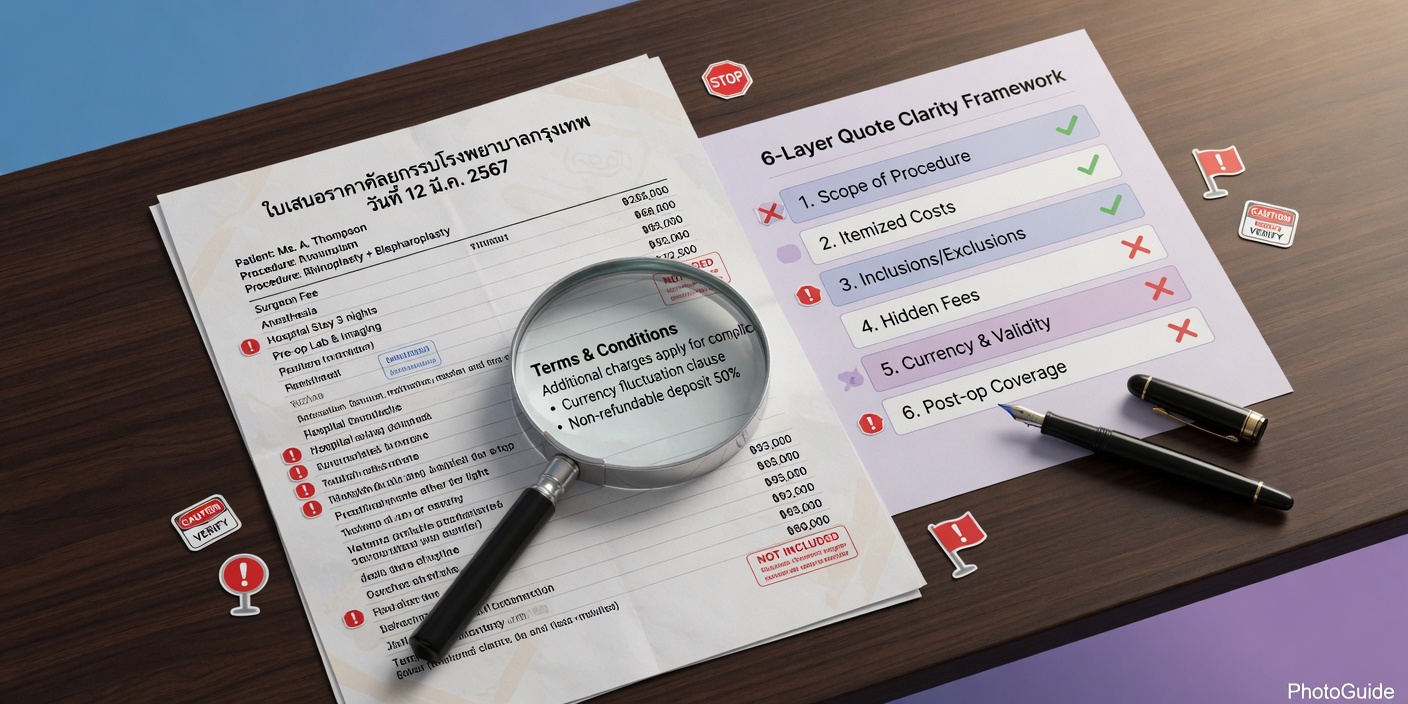
You’ve researched Thai hospitals, compared prices online, and now you have a quote in hand. But does it cover everything – or are you one unforeseen bill away from blowing your budget? The problem is that no two Thai surgery quotes look alike. Some list anesthesia separately, others hide surgeon fees, and many bury exclusions in fine print – costing patients thousands in surprise charges. By the end of this guide, you’ll have a systematic Quote Clarity Framework to decode every part of a Thai surgery quote, so you can confidently choose a transparent, safe, and fairly-priced package. We’ll break down the five layers – inclusions, exclusions, deposit terms, red flags, comparison, and legal safeguards – with a printable checklist and a step-by-step comparison template.
This guide provides informational education only. Consult a licensed physician before making any medical decision.
Key Takeaways
A Thai surgery quote must be broken into five layers: inclusions, exclusions, deposit terms, red flags, and legal safeguards. Using the Quote Clarity Framework, you can spot vague wording, high-pressure tactics, and hidden costs that 60% of patients encounter.
- Inclusions: Always verify anesthesia, hospital stay, and medications are itemized.
- Exclusions: Watch for extra nights, specialist fees, and follow-up consultations.
- Red Flags: Vague language, missing accreditation, and non-refundable deposits are top warning signs.
Decoding Inclusions in Thai Surgery Quotes
Inclusions in a Thai surgery quote are the medical and non-medical services covered by the package price. These typically include surgeon fees, anesthesia, hospital stay, medications, and nursing care. Understanding the standard items is the first step in the Quote Clarity Framework – it prevents double charges and sets a baseline for comparison.
What’s Typically Included in a Thai Surgery Package?
When you receive a quote from a Thai hospital, expect to see these core components in the package price: surgeon’s fee, anesthesiologist fee, operating room charges, hospital room (usually 2–4 nights), basic medications, nursing care, pre-operative tests, and one or two post-operative follow-up visits. Many private hospitals also include airport transfers, an interpreter service, and a welcome kit. For example, Bumrungrad International packages often itemize these clearly, while a smaller clinic might bundle everything into a single “all-inclusive” figure.
surgery quote inclusions – the full list of what you should see – are not always uniform. A wmedtour.com analysis of 50 Thai packages found that 30% omitted medication costs entirely. Always request an itemized breakdown. If a quote says “all-inclusive,” ask for a line-by-line list. The Quote Clarity Framework Layer 1 teaches you to confirm every item rather than assuming.
Once you know what’s typically included, the next question is what’s left out – often the biggest source of surprise charges.
Anesthesia, Hospital Stay, and Medications – What to Expect
Anesthesia is one of the most variable items in a Thai surgery quote. Some hospitals charge a flat fee per procedure, while others bill hourly. what is included in Thai surgery package should clearly state whether anesthesia covers the entire surgery time or if an additional hourly surcharge applies after a certain threshold.
Hospital stay: most quotes include 2–4 nights in a private room. Beyond that, expect $200–500 per extra night. For instance, Spine Connection notes that extended hospital stays are often excluded from base packages. If your procedure has a longer recovery, ask upfront about the daily rate for additional nights.
Medications: “basic medications” usually cover only what you receive during the hospital stay. Brand-name drugs, discharge medications, and specialist drugs for chronic conditions are often extra. Ask for a list of included medications and whether generics are the default.
These three items are the biggest sources of confusion. But even when they are included, exclusions can still lurk – we’ll tackle those next.
Common Variations Between Hospitals
Not all Thai hospitals structure their inclusions the same way. Public university hospitals like Siriraj typically offer lower base prices but fewer frills – no airport transfer, limited interpreter availability, and a shorter included stay. Private accredited hospitals (Bumrungrad, Bangkok Hospital) charge more but include more items: VIP room upgrades, meal choices, and dedicated patient coordinators. Small clinics may lure you with a low headline price but exclude nearly every extra service.
| Hospital Type | Typical Inclusions | Typical Exclusions |
|---|---|---|
| Public university | Surgeon, anesthesia, basic room, nursing care, standard medications | Interpreter, airport transfer, private room, extended meals |
| Private accredited | All of the above + airport transfer, interpreter, VIP room, 24h nursing, welcome kit | Brand-name medications, extra nights beyond standard, specialist consults |
| Small clinic | Basic surgery fee, minimal nursing | Almost everything else – itemize carefully |
Understanding these differences helps you choose Thai hospital package inclusions that match your priorities. If you want maximum transparency, go with a private accredited hospital and request an itemized quote.
Now that you know what to expect to be included, let’s flip the coin and examine what is typically excluded and where hidden costs hide.
Understanding Exclusions and Hidden Costs
Exclusions are services not covered by the quoted package price – and they are the source of most surprise bills in medical tourism. Layer 2 of the Quote Clarity Framework teaches you to identify these gaps before you sign. Common examples include follow-up consultations beyond the first, blood work, and specific medications.
Typical Exclusions You Need to Know
Every Thai surgery quote has a list of exclusions – services you must pay for separately. The most common ones include:
- Lab tests: CBC, blood type, infection screening – often not included, costing $50–150 each.
- Imaging: X-rays, MRIs, CT scans – can add $300–1,000 if needed post-op.
- Specialist consultations: Anesthesiologist pre-assessment, cardiology clearance, etc.
- Extra hospital nights: Beyond the standard 2–4 nights, expect $200–500 per night.
- Brand-name medications: If you require a specific drug not in the hospital formulary.
- Discharge medications: Many packages cover only in-hospital meds.
- Companion expenses: Meals and accommodation for a family member.
surgery quote exclusions can add 20–50% to your final bill. One patient we heard from paid $800 extra for post-op antibiotics because the quote only covered “standard in-hospital medications.” As noted by Plastic Surgery San Antonio, facility fees are also a common exclusion in medical tourism quotes.
These exclusions can add 20-50% to your final bill – but they are often negotiable.
Where Hidden Costs Lurk
Beyond the obvious exclusions, fine print in the quote can hide additional charges. Look for these clauses:
- “Incidentals” clause: This broad term can include anything from bandages to oxygen. If the quote says “incidentals not included,” ask for a cap.
- “Out of hours” charges: Surgeries scheduled on weekends or public holidays may carry a 10–20% surcharge.
- Complications coverage: Almost never included. Separate insurance is essential.
- Post-op visits beyond the first: Some quotes include one follow-up, but a second visit costs $100–200.
hidden costs Thai surgery often emerge when you need something after hours. A patient at a Bangkok hospital was charged $200 for an “urgent post-op consult” simply because it occurred after 8 PM. The best quotes explicitly define what constitutes “emergency” care and what’s routine.
Knowing where costs hide is half the battle; the other half is negotiating upfront, which we cover next.
How to Negotiate Exclusions Upfront
You can protect yourself by discussing exclusions before paying a deposit. Use this script: “Please itemize or confirm whether the following are included or quoted separately: lab work, X-rays, and any anesthesia surcharges. If they are not included, what is the maximum additional cost I might face?”
Many Thai hospitals offer a “complication insurance” add-on for a flat fee of $200–500, covering unexpected post-op needs. Ask for a single all-inclusive price that bundles everything you’re likely to need. Then request an amended quote in writing that lists all exclusions as separate line items.
exclusions in medical tourism are negotiable – especially if you are comparing quotes from multiple hospitals. Hospitals compete for international patients, so they will often adjust terms to win your business.
With inclusions and exclusions clear, the next big financial factor is the deposit – how much do you pay upfront, and can you get it back?
Deposit Policies and Payment Terms
Deposits in Thai surgery quotes typically range from 30% to 50% of the total package price, securing your surgery date and hospital resources. Layer 3 of the Quote Clarity Framework helps you evaluate the fairness of these terms. A refundable deposit (less administrative fees) indicates confidence; fully non-refundable policies are a red flag.
How Thai Hospital Deposits Work
Most Thai hospitals require a deposit after you accept the quote, usually due 2–4 weeks before surgery. The percentage varies by procedure type and hospital:
| Procedure Type | Typical Deposit | Example Hospital |
|---|---|---|
| General surgery | 30% | Bangkok Hospital |
| Cosmetic surgery | 50% | Bumrungrad |
| High-demand surgeon | Up to 100% | Various |
Payment methods include wire transfer (most common, no fee), credit card (often incurs a 3% surcharge), or cash at the hospital. The Thai surgery deposit is held until the final balance is due – either on the day of surgery or at discharge. MCIT highlights that deposit terms can hide red flags, so always read the refund policy carefully.
Understanding the deposit process is straightforward, but the refund policy can be tricky.
Deposit Refund Policies: What to Ask
Before paying a deposit, ask these questions:
- What is your cancellation policy for medical reasons? – Most hospitals offer a full refund minus a 10–15% administrative fee if you cancel due to a documented medical issue.
- What about personal cancellation? – Many policies offer 50% refund if you cancel more than 14 days before surgery; later cancellations may be non-refundable.
- What documentation is required? – For medical cancellations, you’ll need a doctor’s note. For personal, you may lose the deposit entirely.
surgery quote deposit refund policies vary widely. One patient lost $2,000 after cancelling 10 days before surgery due to a family emergency – the policy didn’t cover “personal” reasons broadly. Always get the refund policy in writing.
Now that you know how deposits work, we move to the most actionable layer: spotting red flags in the quote itself.
Negotiating Better Payment Terms
You have more leverage than you think. Most Thai hospitals are flexible with international patients. Try these strategies:
- Ask for a lower deposit: “Can I pay 20% instead of 50%?” Hospitals sometimes agree, especially for higher-cost procedures.
- Request a payment plan: Deposit plus 2–3 installments (e.g., deposit at booking, 30% two weeks before, balance on discharge).
- Mention competitor offers: “I’m evaluating two packages. Can you offer a 25% deposit with a full refund if my medical clearance is not granted?”
Payment plan Thai hospital options exist – you just need to ask. The worst they can say is no, and the best outcome is significantly reduced financial risk.
With financial terms understood, the next layer is identifying critical red flags that should disqualify a quote entirely.
Red Flags to Watch For in Thai Surgery Quotes
Red flags in Thai surgery quotes are warning signs that a package may be unsafe, overpriced, or deceptive. Layer 4 of the Quote Clarity Framework gives you a systematic checklist to evaluate each quote. From vague wording to missing JCI accreditation, these indicators can save you from financial loss and medical risk.
Vague Wording and Missing Credentials
Two of the most dangerous red flags are imprecise language and absence of verifiable credentials.
Vague wording examples:
- “All necessary medications” – who decides what’s necessary?
- “Routine monitoring” – how many checks per day, by whom?
- “Standard care” – what standard, whose definition?
- “Anesthesia as needed” – does that cover the second hour of surgery?
red flags Thai surgery quote often hide behind phrasing that sounds reassuring but is empty. Always ask for specifics: “Please list which medications, how many nursing checks, and what anesthesia plan.”
Missing credentials: Every quote should include the hospital’s JCI or HA accreditation number and the surgeon’s full name and Thai Medical Council registration number. If a quote says “our surgeons are internationally trained” but doesn’t name them, that’s a red flag. Verify via the Thai Medical Council website or JCI’s global directory. As Beauty by Buford notes, vague descriptions of certifications are common in problematic quotes.
From wording to behavior – the next red flag is high-pressure sales tactics.
High-Pressure Tactics and Overpromising
Reputable hospitals give you weeks to decide. Be wary of:
- “Discount expires in 48 hours” – legitimate offers have 30–60 day validity.
- “Only one slot left” – often a sales tactic; verify by asking to speak to the coordinator directly.
- “Guaranteed results” – no ethical surgeon guarantees outcomes. This is both a medical and legal red flag.
- “Painless recovery” – surgery involves some pain; honest providers prepare you for it.
Medical tourism scam alerts frequently involve promises that defy medical reality. The Lett Center lists pressure to decide quickly as a top warning sign. If a quote uses any of these phrases, step back. Legitimate hospitals rely on their reputation, not artificial urgency.
Beyond language and pressure, the physical setting matters – lack of accreditation is a dealbreaker.
Unaccredited Facilities and Pricing Anomalies
Accreditation matters. The gold standard is JCI (Joint Commission International) – about 60 Thai hospitals hold it. The local equivalent is HA (Hospital Accreditation Thailand). Some clinics claim “international standards” without displaying a certificate.
Thai hospital accreditation red flags include:
- No accreditation logo on letterhead or website
- Claiming “affiliated with” a JCI hospital without being accredited themselves
- Surgical quotes from clinics that are not licensed as full hospitals
Pricing anomalies: If a quote is 40% below the market rate, you’re likely paying in hidden costs or compromised safety. If 50% above market, demand itemized justification. For example, a $5,000 quote for a $8,000–$12,000 procedure often means corners cut in equipment or staffing.
Now, let’s assemble all these red flags into a printable checklist you can use with every quote.
Printable Checklist: 10 Red Flags
Use this checklist with every Thai surgery quote. If you see two or more, consider walking away.
- [ ] 1. Inclusions described as “standard” or “basic” without itemization
- [ ] 2. Surgeon name not provided or credentials not verifiable
- [ ] 3. No JCI or HA accreditation logo or number
- [ ] 4. Deposit fully non-refundable (no exceptions)
- [ ] 5. No mention of complication coverage or separate insurance needed
- [ ] 6. Price undercuts comparable quotes by 40% or more
- [ ] 7. “Limited time offer” or “book now” pressure language
- [ ] 8. “Guaranteed results” or “painless recovery” claims
- [ ] 9. Missing or vague medication list (brand names vs. generics)
- [ ] 10. No post-operative follow-up included beyond one visit
Surgery quote warning signs – print this list and keep it with every quote.
With the red flags checklist in hand, you’re ready to compare multiple quotes objectively.
Comparing Quotes from Different Thai Hospitals
Comparing Thai surgery quotes side-by-side is the only way to make an apples-to-apples decision. Layer 5 of the Quote Clarity Framework provides a structured template that scores each quote on inclusions, exclusions, deposit terms, red flags, and accreditation. This systematic approach reveals which package offers the best value and safety.
Creating a Standardized Comparison Template
Build a table with these criteria across the hospitals you’re evaluating. Copy this template into a document or spreadsheet:
| Criterion | Hospital A | Hospital B | Hospital C |
|---|---|---|---|
| Package Price | $ | $ | $ |
| Inclusions Itemized (Y/N) | |||
| Exclusions Listed (Y/N) | |||
| Deposit % | |||
| Refund Policy | |||
| Accreditation (JCI/HA/None) | |||
| Surgeon Credentials Provided | |||
| Red Flag Score (0–10) | |||
| Estimated Total with Hidden Costs | $ | $ | $ |
To calculate the estimated total with hidden costs, add the likely exclusions: lab tests (~$100), extra night ($250 average), and one specialist consult ($150). The Quote Clarity Framework’s side-by-side comparison makes these differences obvious.
AKM Clinic offers a similar comparison approach for medical tourism quotes – adapt their methodology for Thai hospitals.
With quotes in your template, you can evaluate cost versus quality.
Cost vs. Quality: What to Prioritize
A lower headline price rarely saves you money. Consider this real-world example:
- Quote A: $10,000 – excludes medications, follow-up visits, and any extra nights
- Quote B: $12,000 – all-inclusive (meds, 2 follow-ups, 4 nights, airport transfer)
Thai surgery cost comparison reveals that Quote B is cheaper after adding hidden costs to Quote A: $10,000 + $800 meds + $400 follow-ups + $500 extra night = $11,700. Quote B saves $1,700 in reality.
Prioritize JCI accreditation – it adds 10–15% to the price but significantly reduces risk. Use this trade-off: if you’re on a tight budget, consider a non-accredited hospital only for low-risk procedures (e.g., minor dental surgery). For any major surgery, accreditation is non-negotiable.
Now apply your framework with a real-world example.
Using the Quote Clarity Framework Side-by-Side
Let’s walk through two hypothetical quotes for the same procedure using the template.
Hospital X (“Budget Option”)
- Price: $8,500
- Inclusions: Surgeon, anesthesia, 2 nights, “standard medications”
- Exclusions: Not listed, says “contact us for details”
- Deposit: 50%, non-refundable after 7 days
- Accreditation: Claims “international standards” – no JCI number
- Surgeon: Named but no registration number
- Red Flag Score: 5/10
Hospital Y (“Safety-First Option”)
- Price: $11,900
- Inclusions: Itemized: surgeon, anesthesiologist, 4 nights, all medications (brand + generic), airport transfer, interpreter, 2 follow-ups
- Exclusions: Listed: no companion meals, no outpatient imaging
- Deposit: 30%, refundable minus 10% admin fee if cancelled 14+ days before
- Accreditation: JCI – certificate number provided
- Surgeon: Named with Thai Medical Council registration
- Red Flag Score: 0/10
Medical tourism quote comparison shows that Hospital Y is the clear winner despite being $3,400 more upfront. Its total cost after adding likely hidden charges from Hospital X (medications $800, extra night $500, one missing follow-up $200) makes Hospital X actually $9,900, and you still lack legal protection.
With a decision made, the final layer of the framework ensures you protect yourself legally and have insurance backup.
Legal and Insurance Considerations
Legal and insurance protections are the safety net of your medical tourism journey, and Layer 6 of the Quote Clarity Framework ensures you don’t operate without one. Thai medical malpractice law differs significantly from Western systems, and most standard travel insurance excludes surgical complications. Knowing your rights and coverage options is essential.
Your Legal Rights When Having Surgery in Thailand
Thai medical malpractice is governed by the Civil and Commercial Code. To win a claim, you must prove the provider was negligent. There is no jury system – a judge decides. Damage caps are significantly lower than in the US or UK. Settlements for serious errors rarely exceed $30,000–50,000.
Your key legal rights:
- Informed consent: You must sign a consent form in a language you understand. Don’t sign if you have unanswered questions.
- Access to medical records: You have the right to a copy of your full medical file.
- Translator access: Most international hospitals provide an interpreter; if not, demand one.
Legal rights Thai surgery also include the right to file a complaint with the Medical Council of Thailand, but that process is non-binding and slow. For serious cases, hiring a Thai lawyer ($2,000–5,000 retainer) is your best course. SAC Firm warns that liability clauses in contracts may cap damages at absurdly low levels.
Given the legal limitations, insurance becomes your primary financial protection.
Insurance Options for Medical Tourists
Standard travel insurance (e.g., SafetyWing, World Nomads) rarely covers elective surgery complications. You need specialized medical tourism insurance that explicitly covers:
- Surgical complications (infection, bleeding, implant failure)
- Emergency evacuation to a higher-level facility
- Trip cancellation due to medical reasons
- Extra hospital days due to complications
Comparison of popular options:
| Feature | SafetyWing | Trawick International | MediGap |
|---|---|---|---|
| Covers elective surgery complications | ❌ | ✅ (with add-on) | ✅ |
| Evacuation coverage | ✅ ($50k) | ✅ ($100k) | ✅ ($250k) |
| Trip cancellation | ✅ (limited) | ✅ (medical only) | ✅ (any reason) |
| Average cost (2-week trip) | $60 | $100 | $150 |
Medical tourism insurance is a small price for peace of mind. Additionally, ask your hospital if they offer a “complication insurance” add-on – many Thai hospitals do, costing $200–500, covering most post-op needs.
Finally, let’s examine specific contract language red flags that could harm you.
Contract Clauses to Watch For
Read every contract clause, not just the price. These are the most dangerous:
- Limitation of Liability: “Total liability capped at $10,000” – unacceptable for major surgery. Ask for removal or at least a higher cap.
- Binding Arbitration in Thailand: “Any dispute shall be resolved in Thai court under Thai law” – you must travel to Thailand for any legal action. Consider this a major barrier.
- Confidentiality Clause: “You agree not to post negative reviews” – unethical and potentially illegal. Refuse to sign.
- No English Translation: If the contract is only in Thai, you cannot give meaningful consent. Demand an English version.
Surgery quote contract red flags – the MCIT outlines these as top concerns in medical tourism contracts. One patient signed a contract with a clause waiving all claims for “unexpected outcomes” – later suffered nerve damage with no recourse.
If you see any of these, either ask for the clause to be removed or walk away. No surgery is worth signing away your rights.
Legal and insurance knowledge completes the Quote Clarity Framework. Next, we discuss practical limitations – when to seek professional help.
Limitations & When to Seek Professional Help
Common Pitfalls When Relying Solely on This Guide
The Quote Clarity Framework is educational, not legal or medical advice. It cannot replace a thorough review by a qualified medical professional or lawyer. Thailand’s healthcare regulations change – always verify current accreditation and legal requirements with official sources before booking.
When to Hire a Medical Tourism Consultant or Legal Professional
Consider expert help if:
- Your quote involves multiple complex procedures (combination surgery, revision surgery).
- You have pre-existing conditions that require specialist clearance.
- Contract language remains confusing even after applying the framework.
- A dispute has already arisen – consult a Thai law firm immediately.
When to Seek Professional Help (YMYL)
If your red flag count exceeds 5, pay a consultant to vet the clinic thoroughly. For high-risk surgeries (spinal fusion, heart surgery, organ transplant), a legal review of the contract is strongly recommended. Your life is worth the investment.
Frequently Asked Questions
What are red flags to any medical care plan?
Red flags in a medical care plan include vague language (e.g., “standard medications”), missing surgeon credentials, non-refundable deposits, high-pressure deadlines, and guarantees of perfect results. Always check for JCI or HA accreditation. If any of these appear, consider the plan untrustworthy. Consult a medical tourism professional if in doubt.
What are the top 10 red flags in Thai surgery quotes?
The top 10 red flags are: (1) inclusions not itemized, (2) surgeon name missing, (3) no accreditation, (4) fully non-refundable deposit, (5) no complication clause, (6) price far below market, (7) “limited offer” pressure, (8) “guaranteed results,” (9) no mention of medications, (10) no follow-up plan. Use the printable checklist in this guide to identify them.
What are the five categories of red flags?
The five categories are: Vague wording and missing credentials, high-pressure tactics, unaccredited facilities, pricing anomalies, and overpromising results. Each category contains specific warning signs that help you evaluate a Thai surgery quote systematically. The Quote Clarity Framework’s Layer 4 organizes these categories into a simple checklist.
What are red flags for a doctor?
Red flags for a doctor include: no board certification, refusal to provide before/after photos of similar cases, limited online presence or reviews, pressure to decide quickly, and unwillingness to discuss risks. Always verify the surgeon’s credentials through the Thai Medical Council or hospital website.
What are the 5 D’s red flags?
The 5 D’s red flags are a medical screening tool for back pain (not directly surgery quotes), but in medical tourism, adapt: Deadlines, Discounts, Deposits, Disclaimers, and Denial of risks. Watch for these in your quote evaluation.
What is an indication in surgery?
An indication in surgery is a valid medical reason for performing a procedure. It represents the diagnosis or condition that warrants the operation. When reviewing a quote, the indication should be clearly stated in the medical documentation accompanying the package.
Conclusion
Reading a Thai surgery quote doesn’t have to be overwhelming when you apply the Quote Clarity Framework. By systematically evaluating inclusions, exclusions, deposit terms, red flags, comparison, and legal protections, you can identify hidden costs and red flags that 60% of patients face (wmedtour.com, 2024). The best approach combines the printable red flag checklist with a side-by-side comparison template to choose the safest, most transparent package.
The Quote Clarity Framework was designed to give you a systematic, repeatable process for every quote you receive. It transforms anxiety into confidence by turning vague offers into structured evaluations. Start with Layer 1 – Inclusions – and work through each layer before paying any deposit.
Now, print the red flag checklist and comparison template, gather your quotes from two or three hospitals, and work through the framework. Your health and wallet depend on making an informed choice. Proceed with confidence.