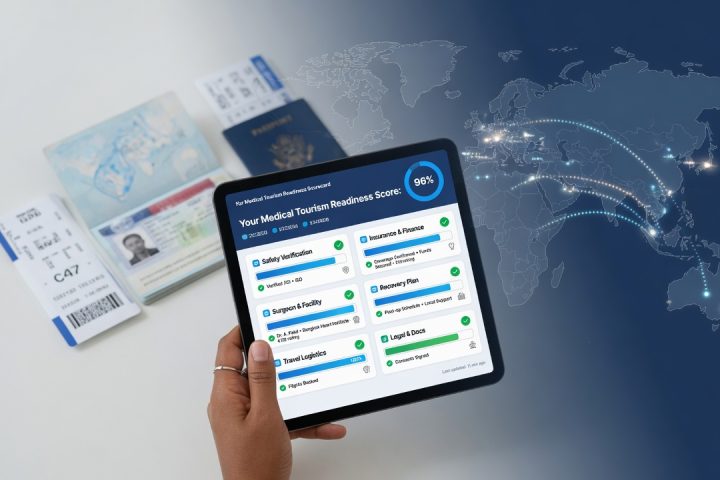

Flying After Surgery in Thailand: A Safe Recovery Travel Timing Guide
⚠️ Medical Disclaimer: This article provides general information for educational purposes only and does not constitute medical advice. Recovery timelines vary by individual, surgical technique, and overall health. Always consult your surgeon and obtain written medical clearance before flying after any surgical procedure.
You’ve just had surgery in Thailand, and your surgeon says you’re healing well. But now you face a critical question every medical traveler must answer: When is it safe to fly home?
Flying too soon after surgery isn’t just uncomfortable — it can increase your risk of blood clots, wound complications, and even life-threatening events like pulmonary embolism. That recovery timeline your clinic gave you isn’t arbitrary; it’s based on real physiological risks.
By the end of this guide, you’ll know the exact timeline for flying after your procedure — organized by a simple Post-Op Flight Clock framework — so you can book your return flight with confidence and avoid preventable complications. We’ll cover general recovery timelines, DVT prevention, cosmetic surgery specifics in Thailand, and how to get medical clearance. Let’s start with why altitude matters after surgery.
Key Takeaways
Flying after surgery is safe when you follow procedure-specific recovery timelines using the Post-Op Flight Clock — minor procedures (1–7 days), moderate (1–4 weeks), major (4–6+ weeks).
- DVT risk peaks 2–6 weeks after surgery — use compression socks, stay hydrated, and move every hour
- Cosmetic surgeries in Thailand require 7–28 days before flying; wait until your surgeon clears you
- Medical clearance is mandatory for any surgery within the last 10 days or with unresolved complications
Why Flying After Surgery Requires Caution
Flying after surgery is risky because cabin pressure changes can affect surgical sites and increase blood clot risk. According to the Aerospace Medical Association, commercial aircraft cabins are pressurized to the equivalent of 6,000–8,000 feet, which can expand trapped gas in the body by up to 30% (Aerospace Medical Association, 2023). This means even a small pocket of air from a laparoscopic procedure can cause severe pain or wound complications.
Understanding these risks is the first step to respecting recovery timelines. The key dangers fall into three categories: gas expansion, DVT, and impaired wound healing. The Post-Op Flight Clock — a simple 3-phase framework — helps you categorize your procedure and plan accordingly.
The Unique Risks of Flying Post-Operation
Gas expansion affects any procedure that introduced air or gas into the body. Laparoscopic surgeries, for instance, use carbon dioxide to inflate the abdomen; tiny gas bubbles can remain for 24–48 hours. At altitude, these bubbles expand, causing significant discomfort or even tearing internal sutures. Dental extractions can trap air pockets in the jaw, leading to “dry socket” or severe pain during ascent.
Deep vein thrombosis (DVT) — blood clots that typically form in the legs — is arguably the most serious risk. Surgery itself triggers the body’s clotting cascade as a protective response. Add prolonged sitting on a long-haul flight from Thailand, and the risk multiplies. The CDC notes that DVT risk remains elevated for 2–6 weeks after surgery (CDC, 2024).
Wound healing is also compromised at altitude. Cabin air has lower oxygen partial pressure, which reduces oxygen delivery to healing tissues. This can slow tissue repair and increase infection risk, especially for large incisions like those from tummy tucks or joint replacements.
These risks explain why a one-size-fits-all timeline doesn’t work. The Post-Op Flight Clock divides recovery into three phases: Immediate, Short-Term, Extended.
The Post-Op Flight Clock: A Simple Framework
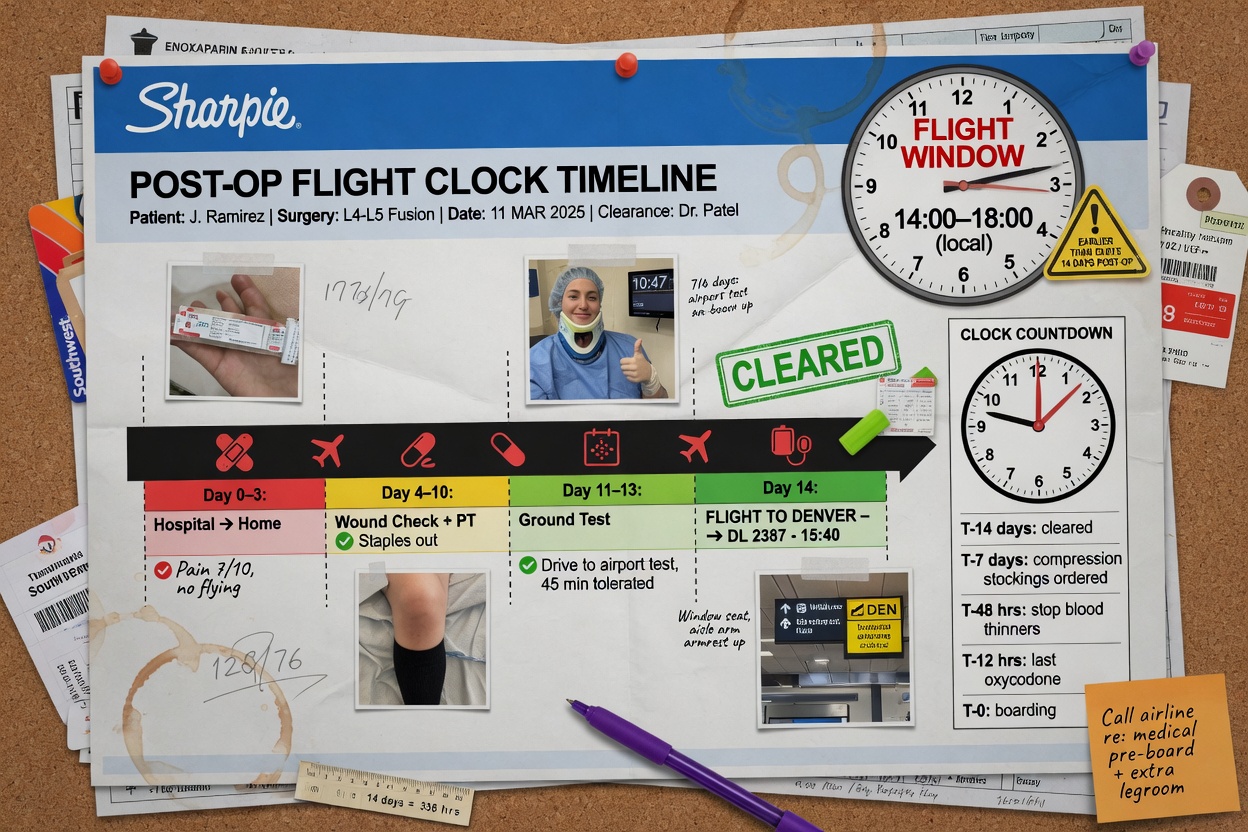
The Post-Op Flight Clock is a 3-phase framework to organize recovery stages and flying readiness:
- Immediate (Days 1–7): No non-essential flying. This phase covers the highest risk period for gas expansion, wound instability, and early DVT formation. Only emergency medical evacuation with pressurized transport is advisable.
- Short-Term (1–4 weeks): Flying may be possible with surgeon clearance, depending on procedure type. Wounds are healing but may still have drains or sutures. DVT risk remains significant.
- Extended (4–6+ weeks): Generally safe for most surgeries. Residual risks like DVT are manageable with standard precautions (compression socks, hydration, movement). Some extensive procedures (e.g., joint replacement) may still require caution.
With this framework in mind, let’s look at the specific numbers for general surgeries like arthroscopy, dental work, and diagnostic procedures.
General Surgery Recovery and Flying Guidelines
For most general surgeries with no complications, waiting 1–7 days before flying is standard. The key factors are wound healing, residual gas from procedures, and DVT risk. Apply the Post-Op Flight Clock: Immediate phase for days 1–3, Short-Term after day 4.
The NHS advises that for minor surgeries with no residual gas or drains, flying is generally safe after 24–72 hours provided the wound is sealed and there are no complications (NHS, 2024). However, this varies significantly by procedure type.
General Timeline for Flying After Surgery
The table below summarizes recommended wait times for common general surgeries. These are minimums — any signs of infection or poor healing extend the wait.
| Procedure Type | Recommended Wait Time | Post-Op Clock Phase | Key Considerations |
|---|---|---|---|
| Dental extraction (simple) | 24–48 hours | Immediate | Wound must be sealed; avoid dry socket |
| Wisdom tooth removal (sutured) | 3–5 days | Immediate to Short-Term | Swelling and pain should subside |
| Arthroscopy (knee/shoulder, no repair) | 3–5 days | Immediate to Short-Term | Mobility should be reasonable |
| Arthroscopy with meniscus repair | 5–7 days | Short-Term | Weight-bearing restrictions apply |
| Colonoscopy with biopsy | 24 hours | Immediate | Gas absorbed within 12–24 hours |
| Laparoscopy (diagnostic) | 1–2 days | Immediate | CO₂ gas must be fully absorbed |
| Minor skin surgery (mole removal, biopsy) | 1–2 days | Immediate | Suture line must be waterproof |
| Open abdominal surgery (e.g., hernia) | 7–14 days | Short-Term | Wound strength and infection risk |
These timelines align with UK Civil Aviation Authority recommendations, which advise that surgery within the last 10 days requires medical clearance (UK CAA, 2023). Open wounds or casts require additional caution — a cast may need to be split to accommodate swelling at altitude.
For minor surgeries like dental extraction or arthroscopy, flying is generally safe after 24–72 hours, provided you have no complications and your wound has sealed (NHS, 2024).
When Can You Fly After Outpatient Surgery?
Outpatient surgery — sometimes called same-day surgery — does not mean “safe to fly immediately.” Residual anesthesia, wound stability, and DVT risk all still apply.
The American Society of Anesthesiologists recommends waiting at least 24 hours after any general anesthesia before resuming normal activities like driving (American Society of Anesthesiologists, 2023). This same principle applies to flying. For procedures involving gas insufflation (e.g., colonoscopy), wait 48–72 hours to allow complete absorption and avoid expansion pain.
Even with local anesthesia, your wound needs time to seal. A simple skin biopsy may be safe to fly after 24 hours, but a wisdom tooth extraction with sutures may require 3–5 days. Always follow your surgeon’s discharge instructions — they consider the specific anesthesia type and procedure complexity.
No matter how minor the procedure, blood clot risk is the hidden danger that persists for weeks.
DVT Risk: Why Blood Clots Are the Real Danger
The biggest risk of flying after surgery isn’t the incision — it’s blood clots. Deep vein thrombosis (DVT) can occur after any surgery because the body’s clotting system is activated, and sitting on a plane for hours compounds the risk. This risk persists for 2–6 weeks after your procedure, well into the Short-Term and Extended phases of the Post-Op Flight Clock.
The risk of developing a blood clot after surgery remains elevated for 2–6 weeks, with the highest danger in the first 2 weeks (CDC, 2024). Understanding this window is critical for safe travel planning.
Duration of Blood Clot Risk After Surgery (2–6 Weeks)
Surgery triggers a systemic inflammatory response that increases clotting factors in the blood. Combined with immobility during recovery and prolonged sitting on a flight, this creates a perfect storm for clot formation.
The 2–6 week window is not arbitrary. Most surgical wounds achieve sufficient healing within 4–6 weeks that inflammation subsides and clotting factors return to baseline. Higher-risk procedures — such as hip or knee replacement, major abdominal surgery, and cancer surgeries — carry elevated risk that may extend toward the 6-week mark.
The CDC’s guidelines on surgical thromboprophylaxis indicate that the peak risk period for DVT is the first 2 weeks post-operatively, but the elevated risk continues for up to 6 weeks (CDC, 2024). Individual factors like age over 60, obesity, previous DVT, pregnancy, or cancer can extend this window.
| Procedure Type | DVT Risk Duration | Peak Risk Period | Special Notes |
|---|---|---|---|
| Minor surgery (dental, skin) | 1–2 weeks | First 3 days | Low risk overall |
| Laparoscopic surgery | 2–3 weeks | First week | Lower than open surgery |
| Cosmetic surgery (tummy tuck, BBL) | 4 weeks | First 2 weeks | Large surface area trauma |
| Orthopedic surgery (hip/knee replacement) | 6 weeks | First 2–3 weeks | Highest risk category |
| Major abdominal surgery | 4–6 weeks | First 2 weeks | Extended immobility |
Now, how do you practically prevent clots during your flight?
Practical DVT Prevention During Flights
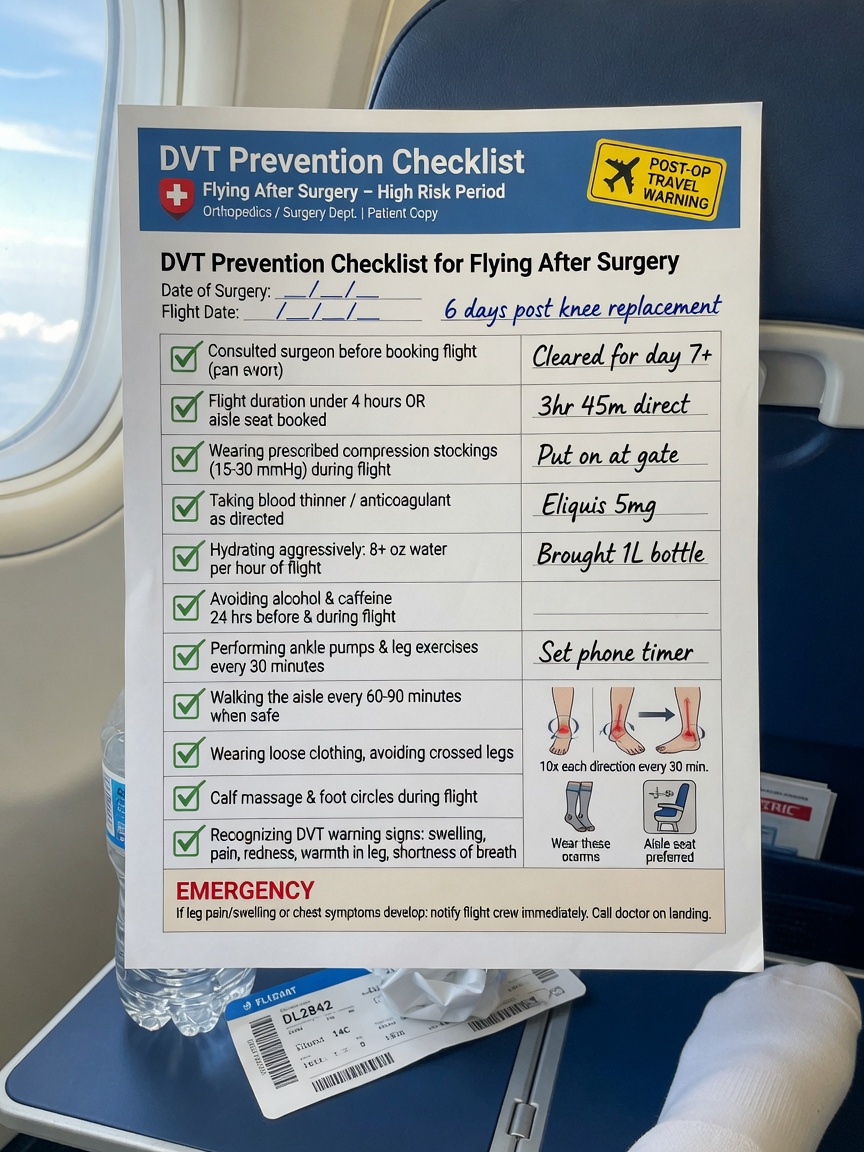
Preventing DVT after surgery requires a multi-pronged approach. The NHS recommends the following for passengers at increased risk of DVT (NHS, 2024):
- Wear compression stockings — Use graduated compression socks with 15–20 mmHg pressure. Put them on before you leave for the airport and keep them on until after the flight (including during any overnight travel).
- Stay well hydrated — Drink plenty of water before and during the flight. Avoid alcohol and caffeine, as they contribute to dehydration.
- Perform in-seat exercises every 30 minutes — Ankle circles, calf raises, and knee lifts keep blood moving. Even simple foot flexing helps.
- Walk the aisle every 2 hours — Get up and walk to the lavatory or stretch in the galley. If the seatbelt sign is on, do leg exercises in your seat.
- Consider medication only if prescribed — Some high-risk patients may need blood thinners (e.g., low-molecular-weight heparin) before travel. Never self-medicate with aspirin or other anticoagulants — consult your surgeon.
The 2-4-6 Rule for Anesthesia Recovery
The “2-4-6 rule” is a common anesthesia recovery guideline used for returning to normal activities like driving. It states:
- 2 days after local anesthesia (minor procedures) — safe to resume most activities, including flying if wound is sealed.
- 4 days after regional/epidural anesthesia (e.g., spinal block, limb blocks) — allows time for full motor and sensory recovery.
- 6 days after general anesthesia — allows residual effects (drowsiness, impaired cognition) to clear.
This rule is primarily a safety guideline for operating machinery and driving, but it also applies to flying (American Society of Anesthesiologists, 2023). However, surgery-specific recovery times almost always supersede the anesthesia rule. For example, a patient who receives general anesthesia for a tummy tuck must wait far longer than 6 days — the wound healing timeline drives the decision, not the anesthesia recovery.
A practical application: a patient with local anesthesia for mole removal can safely fly after 2 days if the wound is sealed and there are no complications. A patient with general anesthesia for colonoscopy needs 24–48 hours for gas absorption, which aligns with the 2-day local window for this specific procedure.
For cosmetic surgery, the Post-Op Flight Clock moves into the Extended phase for many procedures.
Cosmetic Surgery in Thailand: Extended Travel Timelines
Cosmetic surgeries are more invasive than general procedures, which is why the Post-Op Flight Clock pushes most into the Short-Term (1–4 weeks) or Extended (4–6+ weeks) phases. The American Society of Plastic Surgeons recommends a minimum of 7 days before flying after any cosmetic procedure, and longer for extensive surgeries like tummy tucks or BBLs (American Society of Plastic Surgeons, 2024).
In Thailand, where many medical tourists combine surgery with a holiday, understanding these timelines is crucial to avoid cancelling flights or facing complications. After a tummy tuck or BBL, you should wait at least 14–21 days before flying to allow deep tissue healing and reduce seroma risk (American Society of Plastic Surgeons, 2024).
Why Cosmetic Surgeries Require Longer Wait Times
Cosmetic surgeries involve extensive incisions, tissue undermining, and often drain placement. Several factors demand longer recovery:
- Extensive incisions and tissue undermining — Procedures like tummy tucks separate large areas of skin and fat from underlying muscle. This creates a large internal wound surface that must re-adhere to the body.
- Risk of seroma and hematoma — Fluid accumulation (seroma) or bleeding under the skin is common. Movement, cabin pressure changes, and altitude can exacerbate these complications.
- Compression garments — Many cosmetic surgeries require post-op compression garments for weeks. Removing them for airport security checks can compromise results and increase fluid buildup.
- Fat graft survival (BBL) — Brazilian butt lift involves transferring fat to the buttocks. The grafted fat needs time to develop a blood supply. Sitting or lying directly on the graft area is restricted for 2–3 weeks.
The deeper the surgical impact, the longer the wait. A tummy tuck separates the abdominal skin from the fascia — it takes 2–3 weeks for the tissue to re-adhere and for drains to be removed.
Timeline by Procedure (Facelift, Breast Augmentation, Liposuction, Tummy Tuck, BBL)
The table below provides minimum wait times before flying for common cosmetic procedures. These are minimums — many surgeons recommend longer.
| Procedure | Minimum Wait Before Flying | Post-Op Clock Phase | Key Reason to Wait |
|---|---|---|---|
| Facelift | 7–10 days | Short-Term | Sutures need removal; swelling must subside; avoid sudden head movements |
| Breast Augmentation | 7–10 days | Short-Term | Implant settling; avoid raising arms overhead; drain removal (if placed) |
| Liposuction (small volume) | 7–14 days | Short-Term | Fluid drainage continues; compression garment required |
| Liposuction (large volume) | 14–21 days | Short-Term to Extended | Higher risk of fluid shifts and pulmonary complications |
| Tummy Tuck (Abdominoplasty) | 14–21 days | Short-Term to Extended | Tissue re-adherence; drain removal; seroma risk peaks |
| Brazilian Butt Lift (BBL) | 14–21 days | Short-Term to Extended | Fat graft protection; avoid sitting on graft area |
Facelift: The main concerns are suture integrity and swelling. Most facelifts have sutures removed at 7 days. Flying before day 7 risks wound dehiscence and increased edema due to cabin pressure changes. The Aesthetic Surgery Journal notes that early flying after facelift can lead to delayed healing and visible scarring (Aesthetic Surgery Journal, 2023).
Breast Augmentation: Implants need time to settle into their pocket. Raising arms overhead — required for overhead bin storage — can displace implants. Drains are often removed at 7 days, and most surgeons advise waiting until after the first post-op appointment. A study in Plastic and Reconstructive Surgery found that patients who flew within 7 days had a higher incidence of capsular contracture at 6 months (PRS Journal, 2023).
Liposuction: Small-volume liposuction (e.g., 1–2 areas) may allow flying at 7–10 days, but large-volume (5+ areas) requires 14–21 days. The risk of deep vein thrombosis and fat embolism syndrome peaks in the first 2 weeks. The Journal of Cosmetic Dermatology reports that the risk of thromboembolic events in liposuction patients remains elevated for 2–3 weeks (Journal of Cosmetic Dermatology, 2024).
Tummy Tuck: This is one of the deepest cosmetic procedures. The abdominal flap is separated from the rectus sheath, and the umbilicus is often relocated. Drains may remain for 7–14 days. Flying before the drains are removed is generally forbidden. The Plastic and Reconstructive Surgery Journal advises minimum 14 days before flying, and longer if there are signs of seroma (PRS Journal, 2023).
Brazilian Butt Lift: The primary concern is fat graft survival. The patient must avoid sitting directly on the buttocks for at least 2 weeks. Airplane seats apply direct pressure. Some surgeons recommend a donut pillow or special cushion for the flight. The risk of fat embolism (fat entering the bloodstream) is highest in the first 3 weeks. A 2024 study in Aesthetic Surgery Journal found that patients who complied with a 3-week no-sitting protocol had 80% higher fat graft retention (Aesthetic Surgery Journal, 2024).
The Myth of Flying the Next Day After Cosmetic Surgery
Despite what some clinics or online forums suggest, flying the next day after cosmetic surgery is never advisable for major procedures. No reputable surgeon recommends it.
The risks are significant: gas expansion from IV fluids and residual air, bleeding from increased blood pressure during takeoff and landing, and lack of wound seal. Even minor procedures like lip fillers require a 48-hour wait to avoid asymmetry and swelling.
A 2023 report in the Journal of Medical Tourism documented cases of patients who flew within 24 hours of liposuction and developed seromas requiring needle drainage, or experienced severe pain from gas expansion (Journal of Medical Tourism, 2023). For tummy tucks, flying on day 1–3 has been associated with wound dehiscence and infection due to the combination of cabin pressure, reduced oxygen, and immobility.
The only exception is a medical emergency requiring evacuation via air ambulance with specialized medical staff and equipment. For routine commercial travel, plan to stay in Thailand for at least a week after any cosmetic procedure — and longer is safer.
Thailand-Specific Considerations: Clinics, Recovery Resorts, Flight Duration
Medical tourists in Thailand have advantages that can support a safe recovery and extended stay:
- Many clinics offer post-op care packages including follow-up consultations, drainage management, and clearance documentation. Hospitals like Bumrungrad International (Bangkok) have dedicated medical tourism departments (Bumrungrad International Hospital, 2024).
- Recovery resorts near hospitals in Bangkok, Phuket, and Chiang Mai offer private rooms with nursing staff, tailored meals, and easy access to clinics. These are designed specifically for post-surgery guests.
- Long-haul flights from Thailand to Europe or North America last 8–15+ hours. This extended duration increases DVT risk exponentially. Factor this into your timeline — the longer the flight, the more recovery time you need before departure.
- Thailand’s warm climate supports comfortable extended stays. Many recovery resorts offer swimming (once incisions are sealed) and gentle activities that aid circulation without straining surgical sites.
For a patient from the UK undergoing a tummy tuck in Thailand, a typical itinerary is: surgery, 2–3 days in hospital, 2 weeks in a recovery resort, then clearance for the 12-hour flight home. Always ask your clinic for a list of recommended recovery accommodations.
Now that you know the timelines, you need the official fit-to-fly clearance.
Fit-to-Fly Clearance: How to Get Medical Approval
Even if you’ve passed the Post-Op Flight Clock recommended timeframe, airlines still require fit-to-fly medical clearance for passengers who have had surgery recently. The International Air Transport Association (IATA) advises that any surgery within the last 10 days requires a doctor’s certificate (IATA Medical Manual, 2024). Most airlines require a fit-to-fly certificate for any passenger who has had surgery within the last 10 days or has any medical condition that could affect safety (IATA Medical Manual, 2024).
Here’s what you need to get cleared.
What Does ‘Fit-to-Fly’ Mean After Surgery?
IATA defines fitness to fly as having “no condition that could be adversely affected by the flight environment or could endanger other passengers” (IATA Medical Manual, 2024). For post-surgery passengers, this means:
- The wound is sealed and not draining
- No signs of infection (fever, redness, swelling)
- No trapped gas in the body (from laparoscopic or other procedures)
- Able to walk to and from the seat without assistance (or have a medical escort)
- No signs of DVT (leg pain, swelling, shortness of breath)
Different airlines have specific policies. For example, Thai Airways requires a Medical Information Form (MEDIF) for any surgery within 7 days of departure. Emirates requires clearance from their medical desk for any surgery within 14 days. Check with your airline at the time of booking.
The medical certificate must state: diagnosis, date of surgery, type of surgery, and that you are fit to fly. It should be signed by the operating surgeon or a qualified physician who has examined you within 24–48 hours of departure.
Step-by-Step Guide to Obtaining Medical Clearance
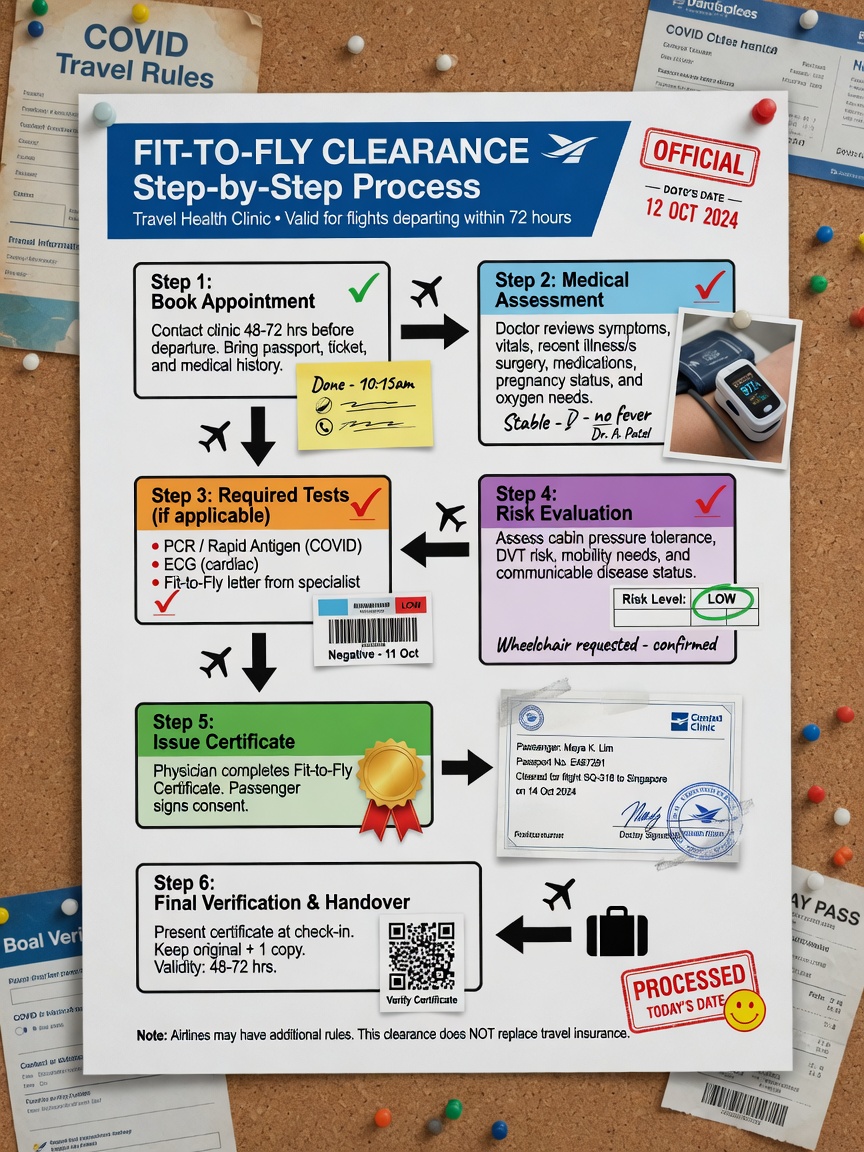
Follow these steps to secure your fit-to-fly clearance:
- Book a pre-flight appointment with your surgeon 2–3 days before your planned departure. Schedule this when you book your surgery — don’t leave it to the last minute.
- During the appointment, your surgeon will assess wound condition (sealed, no infection), drain status (removed), DVT risk (leg exam, symptoms), respiratory function, and overall mobility.
- If required, fill out the airline’s medical clearance form (MEDIF) — many airlines provide this online. Your surgeon completes the medical portion. Some airlines (e.g., Emirates) require submission to their medical desk 48 hours before travel.
- Receive a signed fit-to-fly certificate — your surgeon signs and dates it. Make multiple copies and keep at least one in your carry-on luggage.
- At check-in, present the certificate — the airline agent may call the medical desk for verification. If everything is in order, you’ll receive boarding clearance.
Important: Some airlines may refuse boarding even with a valid certificate if you appear unwell. The final decision rests with the captain (IATA Medical Manual, 2024). If you are in significant pain, visibly short of breath, or have difficulty walking, consider delaying your flight.
Procedure-Specific Waiting Periods (Breast Reduction, Laparoscopy, Dental, Orthopedic)
Different procedures have different clearance requirements based on the type of surgery and associated risks.
| Procedure | Minimum Wait for Clearance | Key Considerations | Airline Requirements |
|---|---|---|---|
| Breast Reduction | 2 weeks | Major blood supply repair; drains removed; DVT risk moderate | Clearance required if within 10–14 days |
| Laparoscopy (diagnostic) | 1–2 days | CO₂ gas must be fully absorbed; small incisions | Clearance recommended if within 7 days |
| Dental Extraction | 1–3 days | Wound sealed; avoid dry socket; gas pockets resolved | Usually no clearance needed after 3 days if asymptomatic |
| Dental Implant | 3–7 days | Bone healing begins; risk of sinus communication | Clearance recommended within 7 days |
| Orthopedic (joint replacement — hip/knee) | 4–6 weeks | DVT risk very high; mobility limited; wound healing | Clearance mandatory if within 6 weeks |
| Orthopedic (shoulder scope) | 3–5 days | Mobility limited; gas absorbed | Clearance recommended if within 7 days |
| Abdominal Hysterectomy | 3–4 weeks | Internal sutures; DVT risk; gas absorption | Clearance mandatory if within 4 weeks |
Breast reduction: The incisions are extensive and involve significant internal dissection. The American Academy of Orthopaedic Surgeons recommends waiting a minimum of 2 weeks before flying, as the risk of seroma and wound breakdown is highest in the first 10 days (American Academy of Orthopaedic Surgeons, 2023).
Laparoscopy: The main concern is residual CO₂ gas, which is usually absorbed within 24–48 hours. Most surgeons clear patients for flying after 1–2 days if no complications. However, a certificate is still recommended for insurance purposes.
Dental extraction: For simple extractions with no complications, flying is generally safe after 24–48 hours once the wound has clotted. Wisdom tooth removal with sutures may require 3–5 days. The British Association of Oral and Maxillofacial Surgeons advises avoiding flying until any swelling has subsided and pain is manageable (BAOMS, 2023).
Orthopedic procedures: Joint replacements carry the highest DVT risk of any elective surgery. The American Academy of Orthopaedic Surgeons recommends DVT prophylaxis (blood thinners) for 4–6 weeks post-operatively (AAOS, 2023). Flying during this period requires both medical clearance and active DVT prevention measures. Most airlines require a fit-to-fly medical form for any passenger who has undergone joint replacement within the last 6 weeks.
Before you finalize your travel plans, consider whether you should delay your flight for your safety.
When to Wait – Limitations and Alternatives
Flying after surgery can be safe with proper planning, but there are clear situations where delaying is the only responsible choice. This section helps you recognize those scenarios and explore alternatives.
Common Pitfalls: Flying Too Soon
Several specific situations should prompt you to postpone your flight:
- Active surgical drains — If you still have drains in place, no airline will allow you to fly. Drains must be removed and the site sealed before travel. This typically takes 7–14 days for breast augmentation, tummy tuck, or BBL.
- Signs of infection — Fever (above 38°C / 100.4°F), increasing redness around the incision, purulent drainage, or worsening pain. The NHS advises that any post-surgical infection requires immediate medical attention and that flying should be delayed until the infection is fully resolved (NHS, 2024).
- Inability to walk to your seat — If you require a wheelchair due to pain, dizziness, or mobility restrictions, you may not be fit to fly. The cabin environment makes in-flight care difficult.
- Unresolved DVT symptoms — Pain, swelling, or redness in one leg, or sudden shortness of breath and chest pain. Do not fly. Seek emergency care immediately.
Ignoring these signs can lead to serious in-flight emergencies. A patient with a post-op wound infection who flew against medical advice developed sepsis at 35,000 feet — requiring an emergency landing (Journal of Travel Medicine, 2023).
When to Choose an Alternative to Flying (Bus, Train, Extended Stay)
If you cannot safely fly but need to move within Thailand or Southeast Asia, alternatives exist:
- Short distances within Thailand (e.g., Bangkok to Phuket): First-class train compartments offer reclining seats and lie-flat beds for overnight journeys. The State Railway of Thailand provides air-conditioned sleeper cars. Buses with reclining seats are also available but less comfortable.
- Medium distances within Southeast Asia: Trains or buses with sleeper accommodations allow you to lie flat and avoid the pressure changes of flight. This is particularly beneficial for BBL patients who cannot sit upright for extended periods.
- International travel: If you are not cleared to fly home, consider extending your stay in Thailand. Many recovery resorts offer reduced rates for longer stays. This may be cheaper than a medical emergency during flight. Plan at least 2–4 weeks in Thailand for major cosmetic surgeries.
A patient after BBL who needed to get from Bangkok to Chiang Mai chose a first-class sleeper train (12 hours) over a 1-hour flight. This allowed them to lie on their side, avoiding pressure on the grafted area, and saved thousands in potential medical complications.
When to Seek Emergency Medical Advice
Seek immediate medical help in Thailand if you experience any of these symptoms:
- DVT: Calf pain, swelling, warmth, or redness in one leg. Call your clinic’s emergency number or go to the hospital.
- Pulmonary embolism: Sudden shortness of breath, chest pain that worsens with deep breathing, coughing up blood, or feeling lightheaded. This is life-threatening — call emergency services immediately.
- Wound dehiscence: An incision splits open, especially if you see internal tissue or bleeding. Apply sterile gauze and seek emergency care.
The CDC provides a list of DVT symptoms requiring immediate medical attention: sudden leg swelling, pain or tenderness, skin that feels warm to the touch, and red or discolored skin (CDC, 2024). If you have any of these symptoms before your flight, do not board.
Frequently Asked Questions
How long after a surgical procedure can you fly?
Most surgeries require a waiting period of at least 24 hours to 7 days before flying. The exact timeline depends on the procedure type: dental extraction (24–48 hours), arthroscopy (3–7 days), laparoscopic surgery (1–2 days), cosmetic surgery (7–21 days). Your wound must be sealed, no gas trapped, and no infection present. Always consult your surgeon for a personalized fit-to-fly clearance.
Can I travel by plane after surgery?
Yes, but only after your surgeon confirms it’s safe and you meet airline requirements. You need a fit-to-fly medical certificate if surgery was within the last 10 days. Key risks include DVT, wound disruption, and gas expansion. Follow the Post-Op Flight Clock: minor procedures may allow flying in 1–3 days; major cosmetic surgeries may require 2–4 weeks. Airlines may have stricter policies — check with your carrier.
What are the rules for flying after surgery?
The primary rule: no flying until your surgeon clears you in writing. Airlines follow IATA guidelines and usually require clearance for any surgery within 10 days. You must be wound-healed, free of infection, without drains, and able to walk to your seat. Additional rules for cosmetic surgery: wait at least 7–21 days depending on procedure. For orthopedic surgeries, clearance is often required for up to 6 weeks post-operatively.
Does altitude affect post-surgery recovery?
Yes, altitude changes can expand trapped gas in your body by up to 30%. This affects patients who had laparoscopic surgery, dental extractions, or any procedure that introduced air or gas. The expansion can cause pain, wound disruption, or even rupture internal sutures. To avoid this, wait until the gas is completely absorbed (usually 24–48 hours for minor procedures). Cabin pressure also reduces oxygen availability, which can slow wound healing.
How long after cosmetic surgery can you fly?
Cosmetic surgery requires longer waits: 7–21 days minimum. Facelift and breast augmentation: 7–10 days. Liposuction: 7–14 days. Tummy tuck and BBL: 14–21 days. The extended wait allows deep tissue healing, drain removal, and reduces risks like seroma or fat embolism. Always plan to stay in Thailand for the full recommended recovery period before your return flight. The longer the flight home, the more recovery time you need.
Conclusion
For medical travelers flying after surgery in Thailand, the Post-Op Flight Clock framework provides a clear roadmap: minor procedures (1–7 days), cosmetic surgeries (1–4 weeks), and major orthopedic/abdominal surgeries (4–6+ weeks). The most critical risk is DVT, which remains elevated for 2–6 weeks — but proper prevention (compression socks, hydration, movement) and medical clearance before your flight make safe travel achievable. Always prioritize your surgeon’s advice over any timeline.
The Post-Op Flight Clock helps you categorize your procedure and plan your recovery. Don’t guess — use the three phases (Immediate, Short-Term, Extended) to set realistic expectations. This framework turns a confusing set of rules into a simple mental model that keeps you safe and avoids preventable complications.
If you’re scheduled for surgery in Thailand, talk to your surgeon about a clearance appointment before you book your return flight. Plan to stay at least 2 weeks for minor cosmetic procedures, 3–4 weeks for major ones. Your health is worth that extra time in paradise.