

Disc Replacement vs Spinal Fusion: Essential Questions for Consultation
You’ve been told you need spine surgery, but the two main options — disc replacement and spinal fusion — seem equally valid. How do you decide which one is right for you? Choosing wrong could mean longer recovery, more pain, or even a second surgery down the road. Without a clear comparison, you might leave your surgeon consultation feeling overwhelmed instead of confident. By the end of this guide, you’ll have a clear decision framework — the Motion‑Stability Compass — plus a printable list of essential questions to ask your surgeon. We’ll compare disc replacement and fusion side‑by‑side, explore recovery and costs, and help you determine your best candidacy.
Key Takeaways
Disc replacement and spinal fusion are both effective for different patients — your choice depends on disc health, spine stability, and activity demands.
- Motion‑Stability Compass helps you weigh trade‑offs: motion preservation (disc replacement) vs stability (fusion)
- Recovery is faster with disc replacement (6 weeks vs 3‑6 months), but fusion offers durable pain relief for unstable spines
- Thailand offers world‑class hospitals at 40‑60% less cost than the US
- Ask these 10+ questions in your consultation to ensure you’re the right candidate
Overview: Disc Replacement vs Fusion
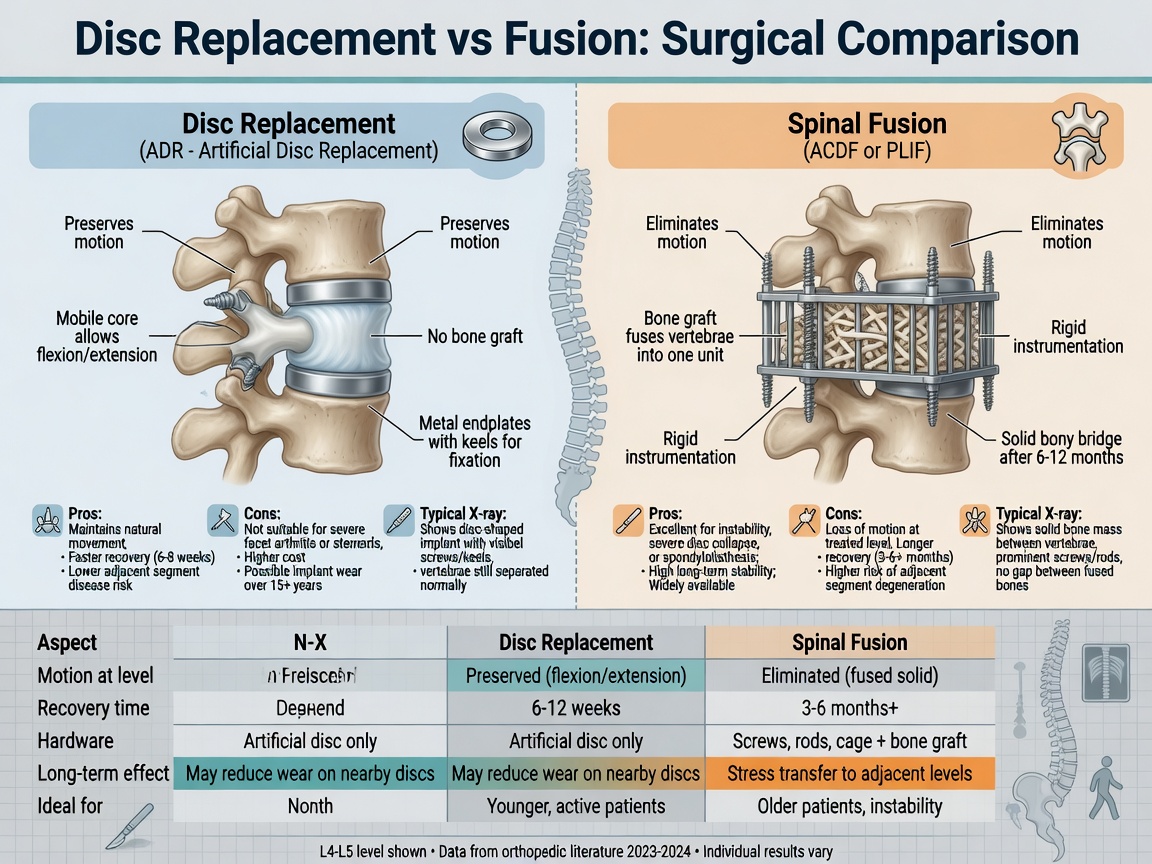
Disc replacement and spinal fusion are the two primary surgical options for degenerative disc disease, but they work in opposite ways. Artificial disc replacement preserves motion by inserting a prosthetic disc, while spinal fusion eliminates motion by fusing two vertebrae together. Choosing the right one depends on the health of your disc, your spine’s stability, and your activity goals.
What is Disc Replacement?
Artificial disc replacement (ADR) is a motion‑preserving surgery where a damaged spinal disc is removed and replaced with a prosthetic implant — typically metal‑on‑polyethylene or metal‑on‑metal. Candidates must have healthy facet joints, no major instability, and good bone quality. A typical patient is a 40‑year‑old active professional with a single‑level L4‑L5 herniated disc who wants to maintain flexibility. This is considered a major surgery but generally involves a shorter hospital stay than fusion.
What is Spinal Fusion?
Spinal fusion permanently connects two or more vertebrae using bone graft and hardware such as rods and screws. Common techniques include anterior lumbar interbody fusion (ALIF), posterior fusion (PLIF), and transforaminal fusion (TLIF). Fusion is often chosen for conditions like L4‑L5 spondylolisthesis (instability) or severe arthritis where motion preservation would be unsafe. The trade‑off is clear: you gain stability but lose motion at the operated segment.
Is Disc Replacement Better Than Fusion?
There is no universal answer. For younger, active patients with single‑level disc disease, disc replacement offers faster recovery and preserved motion. For multi‑level disease, instability, or severe arthritis, fusion provides more reliable pain relief. A 2023 review in Spine found comparable long‑term outcomes for appropriately selected patients — the key is matching the procedure to your specific spine condition.
Quick Comparison Table
| Feature | Disc Replacement | Spinal Fusion |
|---|---|---|
| Goal | Preserve motion | Provide stability |
| Approach | Implant prosthetic disc | Fuse vertebrae together |
| Recovery time | ~6 weeks | 3‑6 months |
| Best for | Young, active, single‑level | Multi‑level, unstable, arthritis |
| Reoperation rate | ~10‑15% over 10 years | ~20% due to adjacent segment disease |
| Mobility | Near‑normal motion | Loss of motion at operated level |
Recovery, Pain, and Outcomes
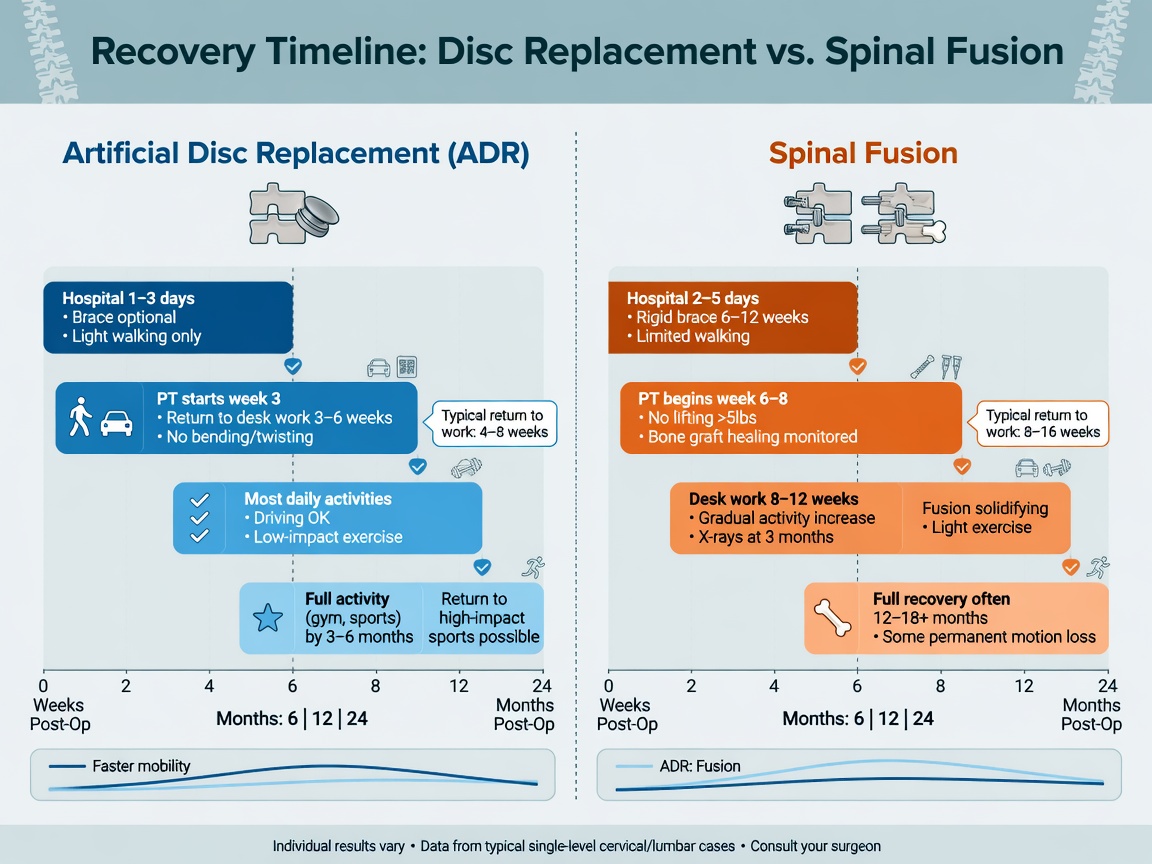
Recovery from disc replacement is generally faster and less painful than from spinal fusion, but the gap narrows when fusion is performed with modern techniques. An L4‑L5 fusion can be significantly painful during the first week, while disc replacement patients often report moderate discomfort managed with oral medication.
Recovery Timeline: Disc Replacement vs Fusion
Disc replacement patients typically stay in the hospital 1‑2 days, return to a desk job at 4 weeks, and resume full activity at 6‑12 weeks. Fusion patients stay 2‑4 days, wear a brace for 6‑12 weeks, and face a full recovery timeline of 6‑12 months. Driving is usually permitted around the 6‑week mark for both procedures, pending surgeon approval.
Pain Management After Surgery
Fusion patients often describe moderate to severe pain in the first 72 hours, managed with IV painkillers, then oral medication for 2‑4 weeks. Disc replacement pain is typically moderate and managed with NSAIDs and early mobilization. As one surgeon noted, “Fusion pain is a deep ache; disc replacement pain is more muscular.” Understanding this difference helps you prepare mentally and logistically for recovery.
Long‑Term Outcomes: Mobility and Success Rates
Disc replacement shows an 80‑90% success rate at 10 years, though 10‑15% of patients may need revision surgery. Fusion has a 70‑80% success rate, with adjacent segment disease — degeneration of discs next to the fused level — becoming a growing risk over time. The Motion‑Stability Compass applies here: fusion trades mobility for stability, which is acceptable for many, but active patients may prefer disc replacement to preserve range of motion.
Questions for Your Spine Surgeon
Walking into your surgeon’s office prepared with the right questions can make the difference between confusion and confidence. Here’s a checklist of questions tailored to disc replacement and spinal fusion.
Questions to Ask About Disc Replacement
- “Am I a candidate for disc replacement?” — Your surgeon should evaluate facet joint health, instability, and bone quality before recommending ADR.
- “What type of artificial disc will you use?” — Metal‑on‑polyethylene and metal‑on‑metal designs have different wear profiles and outcomes.
- “What is your personal reoperation rate with disc replacement?” — Ask for the surgeon’s own data, not just published averages.
- “How long will the disc last?” — Most last 10‑15 years; newer designs may extend that window.
- “Will I still be able to do sports or physical work after?” — Motion preservation typically allows a return to high‑impact activities.
Questions to Ask Before Spinal Fusion
- “Is fusion necessary, or could disc replacement work for me?” — Ensure your surgeon has considered all alternatives before committing to fusion.
- “How many levels will be fused?” — Multi‑level fusion extends recovery and increases the risk of adjacent segment disease.
- “Will you use bone graft from my hip or donor bone?” — Autograft (your own bone) fuses faster but adds a second surgical site; allograft avoids that but may take longer to heal.
- “What fusion technique will you use?” — ALIF, PLIF, and TLIF have different recovery profiles and complication rates.
- “What is my risk of adjacent segment disease down the road?” — Fusion increases mechanical stress on neighboring discs, and understanding that risk helps you plan long‑term.
General Consultation Checklist
- “What would happen if I try non‑surgical treatments first?”
- “How much time off work will I need?”
- “What red flags should I watch for after surgery?”
- “Do you have experience with patients who travel for surgery?” — This is especially relevant if you are considering treatment abroad.
Medical Tourism in Thailand: Hospitals and Costs
Thailand has emerged as a leading destination for spine surgery, offering JCI‑accredited hospitals at 40‑60% less cost than the US. For patients considering disc replacement or fusion, understanding hospital quality and total costs is essential.
Cost Comparison: Disc Replacement in Thailand vs USA
| Procedure | Thailand Cost | US Cost | Savings |
|---|---|---|---|
| Disc replacement | $12,000‑$18,000 | $40,000‑$80,000 | 60‑70% |
| Spinal fusion | $15,000‑$25,000 | $50,000‑$100,000 | 50‑75% |
These prices typically include the surgeon, hospital stay, anesthesia, and follow‑up appointments. Lower overhead and no malpractice insurance crisis contribute to the significant savings.
Which Hospital is Best? Bumrungrad vs Bangkok Hospital
Bumrungrad International Hospital is JCI‑accredited with 55+ specialties and a dedicated international patient center, making it a top choice for medical tourists. Bangkok Hospital is also JCI‑accredited, with a renowned orthopedic center and slightly lower costs. For a detailed comparison of Bumrungrad vs Bangkok Hospital, including spine‑specific success rates, see our full guide. We also provide a cost and quality analysis of Bangkok Hospital for spine procedures to help you compare both options side‑by‑side. Both hospitals meet international standards, so your choice may come down to surgeon preference and package pricing.
Is Thailand Safe for Spine Surgery?
JCI accreditation ensures that Thai hospitals meet international safety and quality standards. Infection rates for spine surgery in accredited Thai hospitals are below 1%, comparable to Western institutions. Many Thai spine surgeons trained in the US or Europe and maintain active international collaborations.
Practical Tips for Medical Tourists
Plan to stay in Thailand for 2‑4 weeks after surgery for follow‑up care before flying home. Many hospitals offer package deals that include airport transfer, hotel accommodation, and nursing support. Bring all your medical records and consider a telehealth second opinion with a Thai surgeon before you travel.
Candidacy and Decision Factors
Whether you’re a candidate for disc replacement or fusion depends on three key factors: the health of your disc, the stability of your spine, and your activity level. Here’s how to evaluate each factor.
Who is a Good Candidate for Disc Replacement?
Ideal candidates have single‑level disc degeneration (usually L4‑L5 or L5‑S1), healthy facet joints with no arthritis, and no spinal instability like spondylolisthesis. Age is a factor — most successful candidates are under 60, non‑obese, and non‑smokers. If you lead an active lifestyle and want to return to sports or physical work, disc replacement is often the better fit.
Who is a Good Candidate for Spinal Fusion?
Fusion is typically recommended for patients with multi‑level disc disease (two or more levels), spinal instability such as spondylolisthesis or scoliosis, or severe facet arthritis. It is also the preferred option after a failed disc replacement. Patients who do not require full range of motion at the operated level — often older or less active individuals — tend to do well with fusion.
When Fusion is the Better Choice
Fusion becomes the clear winner when disc replacement is contraindicated. Conditions like osteoporosis, active infection, allergy to implant metals, and severe spinal deformity rule out ADR. Fusion is also preferred for revision surgery, correction of spinal deformity, and cases involving multiple affected levels where motion preservation would be ineffective.
The Motion‑Stability Compass: Making Your Decision
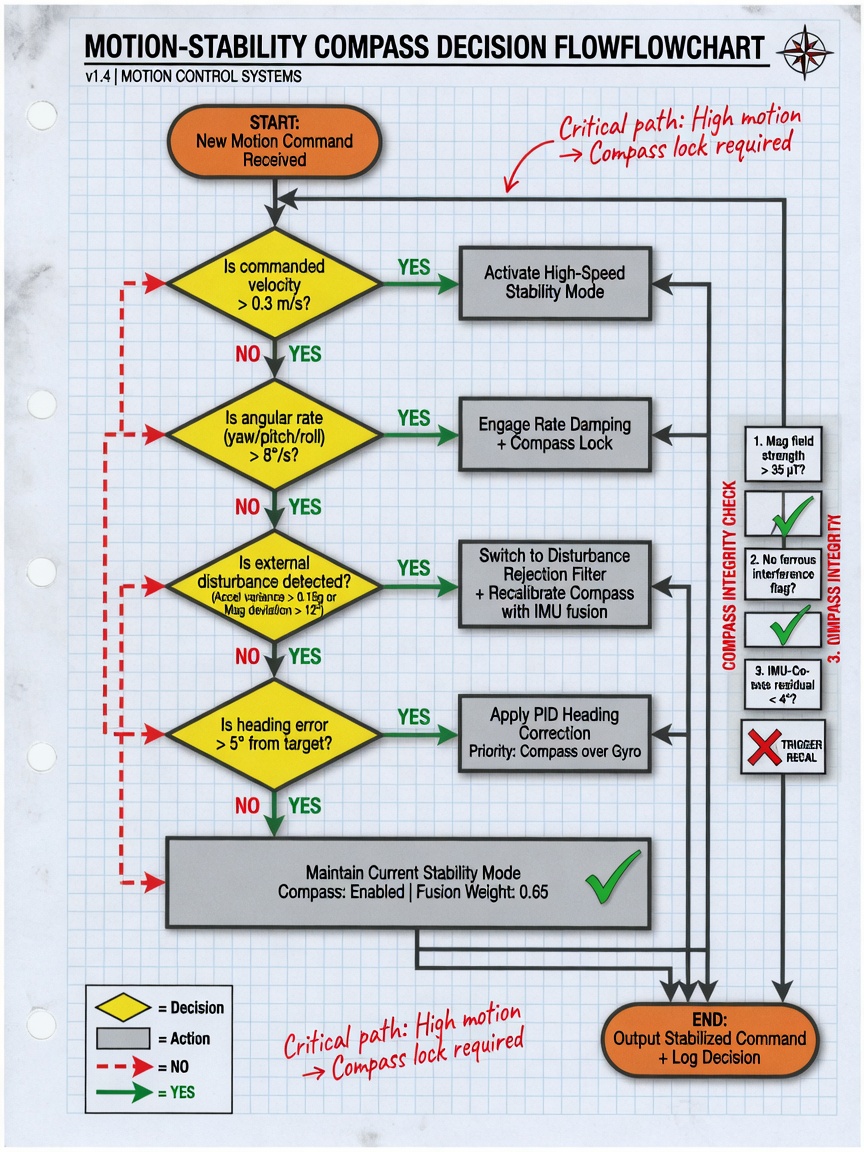
The Motion‑Stability Compass evaluates three axes: disc health (good → poor), spine stability (stable → unstable), and activity demands (high → low). If your disc health is good and activity demands are high, disc replacement is likely best. If your spine is unstable and activity demands are low, fusion is the safer choice. Most patients fall somewhere in between — and that’s where your surgeon’s expertise becomes critical.
Limitations & Considerations
Common Pitfalls
Choosing disc replacement when facet arthritis is present often leads to continued pain — the implant preserves motion, but arthritic joints still hurt. Opting for fusion without understanding the permanent loss of motion can affect lifestyle and sports participation. Not getting a second opinion is another common mistake, especially for spine surgery where outcomes vary significantly by surgeon experience. Underestimating recovery time leads to frustration and premature return to activity, which can compromise results.
When to Seek a Second Opinion
If you have multi‑level disease, conflicting recommendations from different surgeons, or a high‑risk condition such as osteoporosis or previous spine surgery, a second opinion is strongly advised. Most insurance plans cover second consultations, and many Thai hospitals offer telehealth pre‑assessments for international patients.
Frequently Asked Questions
How painful is L4‑L5 fusion surgery?
Most patients describe L4‑L5 fusion pain as moderate to severe for the first 48 hours. It is managed with IV pain medication and typically improves to a dull ache by day 3. After 1‑2 weeks, pain shifts to muscle soreness and can be controlled with oral medication. By 4‑6 weeks, most patients are comfortable with over‑the‑counter meds. Individual results vary, and your surgeon will provide a personalized pain management plan.
Is disc replacement a major surgery?
Yes, disc replacement is a major surgery that requires general anesthesia and an incision in the abdomen or back. However, it is less invasive than spinal fusion in many ways — no bone graft harvesting, no rods or screws, and a shorter hospital stay. Most patients go home in 1‑2 days and return to light work in 4‑6 weeks. While still a significant procedure, recovery is typically faster and less painful than fusion.
Which is better for athletes, disc replacement or fusion?
Disc replacement is generally preferred for athletes because it preserves motion at the operated level. Fusion creates a rigid segment that increases stress on adjacent discs and may limit high‑impact activities. Studies show that athletes who receive disc replacement return to sports like running, golf, and tennis at a higher rate than those who undergo fusion. Heavy contact sports may still be discouraged after any spine surgery.
What is the cost of disc replacement in Thailand?
In Thailand, a disc replacement costs between $12,000 and $18,000, compared to $40,000‑$80,000 in the US. This price typically includes the surgeon, hospital stay, anesthesia, and follow‑up appointments. Leading hospitals like Bumrungrad and Bangkok Hospital offer transparent pricing packages. While cheaper, the quality of care is on par with Western standards — both hospitals are JCI‑accredited.
How long does it take to recover from spinal fusion?
Full recovery from spinal fusion takes 6‑12 months, though most patients return to desk work at 6‑12 weeks. The first 3 weeks require rest and limited walking. After 6 weeks, a bone stimulator may be used to help the fusion heal. By 3‑6 months, patients can begin physical therapy. Complete fusion takes 9‑12 months to show on X‑rays. Recovery is longer than disc replacement but necessary for those with unstable spines.
Conclusion
For patients with chronic back pain, deciding between disc replacement and spinal fusion is a personal trade‑off between motion and stability. The Motion‑Stability Compass simplifies this choice: evaluate your disc health, spine stability, and activity demands. Disc replacement offers faster recovery with preserved motion, while fusion provides reliable pain relief for unstable spines — and Thailand delivers world‑class care at roughly half the cost. Always bring our consultation checklist to your appointment.
The Motion‑Stability Compass isn’t just a guide — it’s a conversation starter with your surgeon. By framing your decision around these three factors, you’ll leave your appointment with clarity, not confusion.
Start by reviewing your options with this guide, then schedule a consultation with a spine specialist. If Thailand is on your radar, reach out to Bumrungrad or Bangkok Hospital for a cost estimate. Your journey to a pain‑free life begins with one informed question.
This article is for informational purposes only and does not constitute medical advice. Always consult with a qualified spine surgeon to determine the best treatment for your specific condition.