

Thigh Lift in Thailand: A Complete Guide to Types and Recovery
⚠️ MEDICAL DISCLAIMER: This article is for informational purposes only and does not constitute medical advice. Thigh lift surgery carries risks, and individual results vary. Always consult with a board-certified plastic surgeon to determine the best approach for your specific anatomy, health status, and aesthetic goals.
Choosing between an inner and outer thigh lift in Thailand involves more than comparing before‑and‑after photos — the real decision comes down to recovery expectations, mobility limitations, and what each procedure demands from your body in the weeks after surgery. Many medical tourists book surgery based on aesthetic goals alone, only to discover that recovery timelines, pain levels, and activity restrictions differ significantly between procedure types — leaving them unprepared for the reality of healing in a foreign country.
By the end of this guide, you’ll understand the differences between inner and outer thigh lifts, what recovery actually looks like week by week, and how to plan your medical tourism journey to Thailand with realistic expectations and a well‑prepared recovery plan. We’ll start with the basics of each procedure type, then walk through recovery timelines, pain management strategies, and cost considerations specific to having a thigh lift in Thailand.
Key Takeaways
Choosing a thigh lift in Thailand means deciding between recovery demands as much as aesthetic outcomes — inner lifts heal faster but outer lifts target more extensive areas.
- Inner thigh lifts involve shorter incisions and faster recovery (2-3 weeks to normal activity)
- Outer thigh lifts require more extensive recovery (4-6 weeks) with greater mobility restrictions
- Thailand offers 40–60% cost savings compared to the US and UK for comparable surgical quality
- The Three-Phase Recovery Protocol — mobility (weeks 1-2), healing (weeks 3-4), and results (weeks 5-8) — helps set realistic expectations
What Is a Thigh Lift? Understanding the Procedure
A thigh lift, medically known as thigh dermolipectomy, is a surgical procedure that removes excess skin and tightens the underlying tissues in the thigh area. It differs fundamentally from liposuction, which removes fat but does not address loose skin. Understanding this distinction is critical because many patients mistakenly believe a single procedure can solve both problems.
A thigh lift is most commonly performed after significant weight loss (50 lb or more) or age‑related skin laxity. The surgery takes about 2–3 hours under general anesthesia and typically requires a one‑ to two‑night hospital stay. While liposuction is ideal for patients with good skin elasticity and excess fat, a thigh lift is the appropriate choice when skin has lost its ability to retract. Many patients combine both procedures in a single operation, but the goals remain distinct. According to the American Society of Plastic Surgeons, a thigh lift addresses skin and tissue laxity that cannot be corrected by fat reduction alone.
The type of thigh lift you choose — inner or outer — determines your recovery experience, which we’ll compare next.
How a Thigh Lift Differs From Liposuction
Liposuction removes fat cells but does not tighten skin. If skin laxity is already present, liposuction can actually worsen the appearance of sagging. Conversely, a thigh lift removes excess skin and tightens tissues but does not significantly reduce fat volume. A patient with good skin elasticity and excess fat is a liposuction candidate; a patient with loose, sagging skin after weight loss needs a thigh lift. Many patients who have both issues undergo a combination approach in a single surgery. As the Mayo Clinic explains, liposuction and skin‑removal procedures are complementary but serve different purposes.
Who Makes an Ideal Candidate
Surgeons typically consider ideal candidates those with stable weight (no major fluctuations planned), excess skin in the thigh area, and realistic expectations about permanent scarring. Non‑smokers heal significantly better — most surgeons require patients to be smoke‑free for at least 4–6 weeks before and after surgery. Overall health status also matters: conditions like diabetes, poor circulation, or obesity increase surgical risk. Your surgeon will evaluate candidacy during consultation based on your medical history, skin quality, and aesthetic goals.
Inner Thigh Lift vs. Outer Thigh Lift: Key Differences
Choosing between an inner and outer thigh lift requires understanding how each procedure affects your recovery. Inner thigh lifts generally allow return to normal activity within 2–3 weeks, while outer thigh lifts require 4–6 weeks due to more extensive tissue involvement (American Society of Plastic Surgeons). The table below summarizes the key differences.
Inner Thigh Lift — Incision Patterns and Results
An inner thigh lift addresses skin laxity along the inner thigh from the groin to the knee. The incision runs along the groin crease and extends down the inner thigh, with length depending on the amount of skin to remove. This procedure is best for patients whose loose skin is concentrated on the inner thigh — common after 30–50 lb weight loss or aging. Recovery is generally easier because the incision does not interfere with sitting surfaces or hip movement. The scar is typically hidden in the groin crease when standing but becomes more visible when legs are apart.
Outer Thigh Lift — A More Extensive Procedure
An outer thigh lift, also called a lateral thigh lift, targets skin laxity along the outer thigh and may extend to the hip or buttock area. The incision runs along the hip/waistline and continues down the outer thigh. This procedure is more involved and is often part of a lower body lift for patients who have lost 100 lb or more. Recovery is longer and more restrictive — sitting, bending, and lying on sides are difficult for the first 2–3 weeks because the incision crosses weight‑bearing areas. Scarring is more visible and may extend above the underwear line.
Quick Comparison: Inner vs. Outer Thigh Lift
| Aspect | Inner Thigh Lift | Outer Thigh Lift |
|---|---|---|
| Incision location | Groin crease to inner knee | Hip to outer thigh |
| Primary target area | Inner thigh skin laxity | Outer thigh + hip/buttock |
| Typical recovery (normal activity) | 2–3 weeks | 4–6 weeks |
| Pain level (patient‑reported) | Moderate | Moderate to high |
| Mobility impact | Low — walking is easier | Higher — sitting/bending affected |
| Scar visibility | Hidden in groin crease | May extend above underwear line |
These are general guidelines. Your specific recovery depends on surgical technique, extent of correction, and individual healing factors. Consult with your surgeon for personalized expectations.
Why Choose Thailand for Your Thigh Lift?
Thailand offers 40–60% lower costs for thigh lift surgery compared to the US and UK, with comparable quality when choosing JCI‑accredited facilities. The real value isn’t just lower prices — it’s that lower overhead allows for more comprehensive surgical packages, including longer hospital stays, better nursing ratios, and included transfers that support safer recovery.
Cost Comparison: Thailand vs. Western Countries
A thigh lift in Thailand typically costs $3,000–$6,000 USD (surgeon + hospital + anesthesia). In the US, the same procedure ranges from $8,000 to $15,000+ ; in the UK, from £6,000 to £10,000. The Thai package usually includes pre‑op consultation, surgery, 1–2 nights hospital stay, medications, and follow‑up — but does not cover flights, accommodation, or extended recovery stay. A patient paying $5,000 for surgery plus $1,500 for flights and two weeks’ accommodation still saves 40–50% compared to the US average for surgery alone.
What to Look for in a Thai Surgical Facility
When researching facilities, look for these quality indicators:
- JCI accreditation — Joint Commission International is the gold standard for international hospital quality. Visit Joint Commission International to verify accreditation.
- Surgeon credentials — board certification from the Thai Board of Plastic Surgery, plus training at Western institutions (US, UK, Australia).
- Hospital facilities — on‑site ICU, 24/7 nursing staff, strong infection control ratings.
- Patient support — English‑speaking coordinators, clear aftercare protocols, emergency contact.
Prices are estimates and vary by surgeon, facility, and individual case requirements. Always confirm exact pricing during consultation.
Thigh Lift Recovery: What to Expect Week by Week
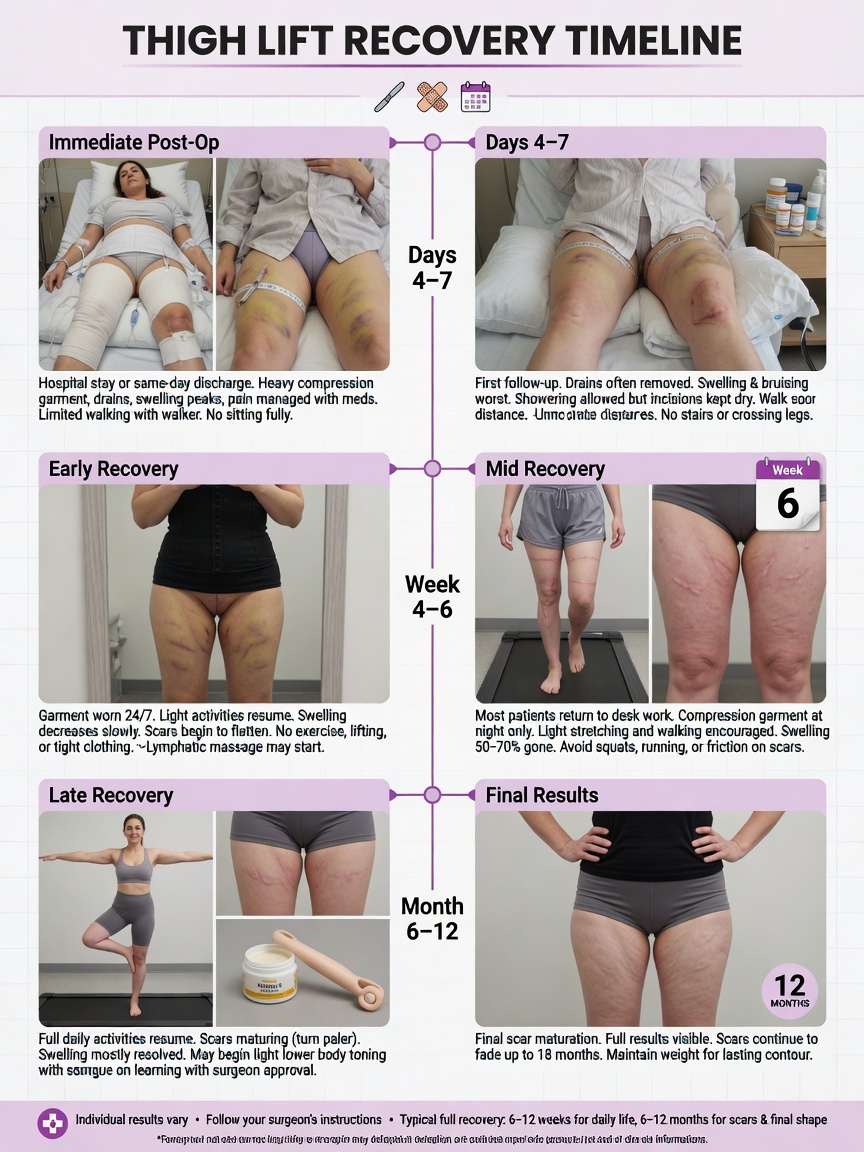
The first two weeks of thigh lift recovery are the most restrictive — patients typically cannot walk upright for more than 10–15 minutes at a time. The Three-Phase Recovery Protocol provides a realistic framework for planning your recovery journey: mobility (weeks 1‑2), healing (weeks 3‑4), and results (weeks 5‑8). Below is a week‑by‑week guide.
Week 1–2: Mobility Phase — The Most Restrictive Period
Days 1–2: You remain in the hospital with drains, compression garments, IV fluids, and minimal walking (to the bathroom only). Days 3–7: Discharge occurs — you need assistance with basic tasks, walk slightly hunched for comfort, and manage pain with prescribed medication. Week 2: Swelling peaks then begins to subside; first follow‑up; stitches or drains may be removed. Walking improves but is still limited to 15–20 minutes. Outer thigh lift patients find sitting extremely uncomfortable — a donut cushion or reclining position helps. Plan to stay in Thailand for at least 10–14 days before flying home, with a companion available for assistance during the first week.
Week 3–4: Healing Phase — Returning to Light Activity
Swelling is significantly reduced, but compression garments are still required (typically for 4–6 weeks total). Walking becomes more comfortable — you can manage 30‑minute walks by week 4. Return to desk work is possible by week 3–4 with an ergonomic sitting setup. Driving remains restricted due to discomfort from turning, braking, and seatbelt pressure. Most patients can comfortably fly home after week 3, assuming no complications and surgeon clearance — meaning a minimum 3‑week stay in Thailand.
Weeks 5–8: Results Phase — Seeing Final Outcomes
Most swelling resolves by week 6–8, and scars begin to fade (full maturation takes 12–18 months). You can return to light cardio by week 6, and full activity including leg‑focused exercise by week 8 (with surgeon approval). The compression garment is typically discontinued by week 6. The final contour — smoother thighs with reduced skin laxity — becomes visible around week 8, though subtle improvements continue for 3–6 months.
These are general guidelines. Individual recovery varies based on the extent of surgery, overall health, and adherence to post‑operative instructions. Always follow your surgeon’s specific recovery plan.
Pain Management and Mobility During Recovery
Most patients rate thigh lift pain as moderate (4–6 out of 10) for the first 3–5 days. Understanding what types of pain to expect and how to manage them can significantly improve your recovery experience.
What Pain to Expect After Each Thigh Lift Type
Inner thigh lift: Pain is localized to the inner thigh/groin area. A burning sensation along incision lines is common. Walking causes mild to moderate discomfort. Outer thigh lift: Pain extends to the hip and lateral buttock. Sitting and lying on sides are significantly uncomfortable. A pulling sensation when standing up from a seated position is normal. Most patients rate overall pain 4–6/10 for the first 3–5 days, dropping to 2–3/10 by day 7–10. Patients who have had both procedures often report that outer thigh lift recovery pain is 30–40% more intense due to hip flexor and sitting surface involvement.
Mobility Restrictions by Activity Type
- Walking: Possible immediately but hunched for 5–7 days; normal gait returns by 2–3 weeks.
- Sitting: Difficult for the first 2 weeks (especially after outer lift); reclining positions are preferred; a donut cushion helps.
- Bending and lifting: Forbidden for the first 4 weeks (risk of wound separation); use reacher/grabber tools.
- Sleeping: On your back only for the first 2–3 weeks; side sleeping depends on incision location.
- Driving: Not recommended for 2–4 weeks (depends on medication use and ability to brake/turn safely).
Tips for Managing Discomfort in the First Weeks
- Medication: Follow the prescribed schedule strictly for the first 3–5 days; don’t wait for pain to become severe.
- Compression garment: Wear it as directed; adjust as swelling changes; do not remove without surgeon approval for the first 48 hours.
- Ice therapy: Apply ice packs (wrapped in cloth) to inner thighs for 20‑minute intervals to reduce swelling and numb discomfort.
- Positioning: Elevate your legs when resting; a recliner chair is ideal for the first week.
- Hydration and nutrition: Stay hydrated and consume anti‑inflammatory foods (protein, vitamin C) to support healing.
Many patients find these strategies helpful, but your surgeon’s instructions always take precedence. Never make changes to your recovery plan without consulting your surgeon.
Thigh Lift Costs in Thailand vs. Other Countries
A thigh lift in Thailand costs $3,000–$6,000 for the procedure alone — 40–60% less than US prices of $8,000–$15,000. But the total cost of your medical tourism journey includes more than the surgery itself.
Average Cost Range for Thigh Lift in Thailand
The price depends on several factors: surgeon reputation, hospital accreditation level, extent of correction (inner vs. outer), and length of hospital stay. Bangkok tends to be slightly more expensive than Phuket or Chiang Mai. A typical inner thigh lift at a JCI‑accredited Bangkok hospital with a senior surgeon runs ~$4,500–$5,500 all‑inclusive (pre‑op, surgery, 1–2 night stay, and follow‑up). Outer or extended lifts are at the higher end of the range.
What’s Included in the Cost (and What Isn’t)
| Included | Not Included |
|---|---|
| Pre‑op consultation (video or in‑person) | Flights |
| Surgery and anesthesia | Accommodation before/after surgery |
| Hospital stay (1–2 nights) | Meals |
| Initial medications | Additional medication refills |
| Compression garment | Scar treatment products (e.g., silicone sheets) |
| Follow‑up appointments | Treatment of complications |
| Surgeon’s fee | Travel insurance |
A typical medical tourism budget = surgery cost ($3,000–$6,000) + travel and stay ($2,000–$4,000). Example: a $5,000 thigh lift plus $3,000 for 3 weeks in Thailand (flights, apartment, meals, transport) = $8,000 total — still 35–50% less than the US average for surgery alone.
Financing and Payment Options
Most Thai hospitals require full payment before surgery for international patients (via bank transfer or credit card). Some offer payment plans or accept medical tourism financing companies. Medical travel insurance (not standard travel insurance) is strongly recommended to cover potential complications. Never send full payment without a written agreement and confirmed surgery date.
Risks and Considerations
Thigh lift surgery carries risks, and acknowledging them honestly helps you make an informed decision — especially when having surgery abroad. Consulting with a board-certified plastic surgeon is essential before making any surgical decision.
Acknowledging risks honestly builds trust and helps you make an informed decision. Here are the most important factors to consider — especially when having surgery abroad.
Common Surgical Risks and How to Minimize Them
- Wound healing complications (infection, dehiscence): Reduced by choosing accredited facilities with proper sterilization protocols. Watch for redness, warmth, or discharge.
- Seroma (fluid accumulation): Common after thigh lifts; drains help prevent it. If it occurs, your surgeon may need to drain it.
- Scarring: Scars are permanent. Quality varies by genetics, surgical technique, and aftercare (silicone sheets, massage starting at week 6).
- Asymmetry: Some asymmetry is normal; significant asymmetry may require revision.
- Blood clots (DVT): Risk reduced by early ambulation, compression garments, and blood thinners as prescribed. The ASPS Patient Safety guidelines emphasize these preventive measures.
Unique Considerations for Medical Tourists
- Follow‑up care gap: Once you fly home, your Thai surgeon cannot provide in‑person follow‑up. Establish a relationship with a local surgeon before traveling.
- Complication management: If complications arise after returning home, local treatment costs are your responsibility. Medical travel insurance can offset this.
- Flight after surgery: Long‑haul flights increase DVT risk. Plan at least 10–14 days in Thailand before flying; 3 weeks is safer for outer lifts.
- Language: Ensure your surgeon speaks your language fluently for medical discussions. Avoid relying solely on a translator for complex topics.
When to Seek Medical Attention
- Fever >101°F, increasing redness or discharge — possible infection.
- Unilateral leg swelling, calf pain, or warmth — possible DVT.
- Wound separation >1 cm or bleeding that doesn’t stop with pressure — seek immediate care.
Your surgical coordinator should provide a 24/7 emergency contact number. Save it in your phone and share it with your travel companion.
This article does not constitute medical advice. Consult with a board-certified plastic surgeon before making any surgical decisions. Results vary, and all surgery carries risks.
Frequently Asked Questions
How long does a thigh lift take?
A thigh lift typically takes 2 to 3 hours when performed as a standalone procedure. The duration depends on whether you’re having an inner or outer lift (inner lifts are usually shorter) and whether any additional procedures like liposuction are performed simultaneously. Most patients spend 1–2 nights in the hospital for monitoring. This is a general guideline — your surgeon will provide a more specific estimate based on your case.
How much does a thigh lift cost in Thailand?
A thigh lift in Thailand typically costs between $3,000 and $6,000 USD for the complete surgical package. Inner thigh lifts generally fall at the lower end of this range, while outer or extended lifts cost more. This price usually includes surgeon fees, hospital stay, anesthesia, medications, and follow‑up appointments. Additional costs like flights, accommodation, and recovery supplies are not included. Price varies by surgeon reputation, hospital accreditation level, and the extent of correction needed.
How painful is thigh lift recovery?
Most patients rate thigh lift pain as moderate (4–6 out of 10) for the first 3–5 days. The discomfort is often described as a burning or pulling sensation along incision lines, combined with pressure from the compression garment. Pain typically drops to 2–3 out of 10 by day 7–10 and is well‑managed with prescribed medication. Outer thigh lifts tend to be more uncomfortable than inner lifts due to involvement of the hip and sitting areas. Individual pain tolerance varies significantly.
How long before I can walk normally after a thigh lift?
Most patients can walk normally within 2 to 3 weeks after a thigh lift. During the first week, walking is possible but requires a hunched posture and is limited to short distances (bathroom, brief walks around the room). By week 2, most patients can walk for 15–20 minutes comfortably. Normal gait typically returns by week 3, and light walking for exercise is possible by week 4. Recovery is faster after inner thigh lifts compared to outer lifts.
When can I fly home after a thigh lift in Thailand?
Most surgeons recommend waiting at least 10–14 days after surgery before flying home. The most conservative recommendation is 3 weeks, especially for outer thigh lifts or extensive procedures. Long‑haul flights increase the risk of blood clots (DVT), and early post‑op discomfort makes sitting for extended periods difficult. Always obtain written clearance from your surgeon before booking your return flight. Plan your trip budget and itinerary around at least 2–3 weeks of recovery time in Thailand.
Conclusion
For medical tourists considering a thigh lift, Thailand offers a compelling combination of cost savings — typically 40–60% less than US prices — and high‑quality surgical care at JCI‑accredited facilities. The most important decision is choosing between an inner or outer thigh lift, as recovery demands differ significantly: inner lifts allow return to normal activity in 2–3 weeks, while outer lifts require 4–6 weeks. The Three‑Phase Recovery Protocol — mobility (weeks 1‑2), healing (weeks 3‑4), and results (weeks 5‑8) — provides a realistic framework for planning your recovery journey.
The Three‑Phase Recovery Protocol makes one thing clear: recovery should drive your decision, not just aesthetics. Knowing that the first two weeks require nearly constant support, that you will need 2–4 weeks in Thailand, and that managing pain and mobility is the first real challenge — this framework turns an abstract decision into a concrete plan.
Start by researching JCI‑accredited hospitals in Thailand and board‑certified surgeons who match your needs. Schedule virtual consultations with at least two surgeons to compare approaches, pricing, and recovery plans. Budget for the full journey — surgery plus 3 weeks in Thailand — and establish a post‑operative relationship with a local surgeon before you travel.